Traumatic Pneumothorax
WHAT YOU SHOULD KNOW:
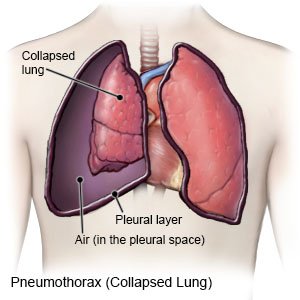
- A traumatic (trah-mah-tik) pneumothorax (new-mo-thor-aks) is the collapse of all or part of a lung. It happens when you have an injury that allows air into the area between the lung and the chest wall. The lung deflates because the air between the lung and the chest wall prevents the lung from filling up with air when you take a breath. You may have one or more of the following symptoms if you have a traumatic pneumothorax.
- Very bad chest pain especially when you inhale (breathe in).
- Uneven chest if bones are broken and poking inward.
- Trouble breathing.
- Fast breathing.
- Coughing.
- Blood in your sputum (spit).
- Fingernails, toenails, and lips may turn blue if you are not getting enough oxygen to your body.

- Very bad chest pain especially when you inhale (breathe in).
- A traumatic pneumothorax is caused by an accident of some kind. Because of this, other serious injuries to the chest, head, neck, or abdomen (belly) may have happened as well. You may have been taken to the ER after the accident causing your pneumothorax. After being treated in the ER you may be taken to the intensive care unit or another nursing unit. It may take days to weeks for the pneumothorax to heal with treatment.
CARE AGREEMENT:
You have the right to help plan your care. To help with this plan, you must learn about your health condition and how it may be treated. You can then discuss treatment options with your caregivers. Work with them to decide what care may be used to treat you. You always have the right to refuse treatment.
RISKS:
If only a small part of your lung is collapsed, it may heal by itself. But if it is large and not treated, your lungs may fail or become infected. You could die. Call your caregiver if you are worried or have questions about your medicine or care.
WHILE YOU ARE HERE:
- Activity: At first you may need to rest in bed with your upper body raised on pillows until the lung is re-expanded. This helps you breathe easier. You may get out of bed when your breathing has improved.
- Back Board. Caregivers may lay you flat on a special board with your head strapped down. This keeps your back and neck still until tests are done to make sure that your spinal cord has not been injured.
- Call Button: You can use the call button when you need your caregiver. Pain, trouble breathing, or wanting to get out of bed are good reasons to call.
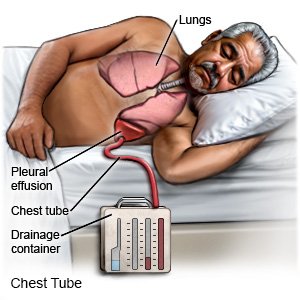
- Chest Tube(s). These are tubes that are put into your chest. Chest tubes remove air, blood, or fluid from around your lung(s). This lets your lungs fill back up with air when you breathe. The chest tubes are attached to a container with bubbling water. After the chest tube is removed, your lung should be normal. Call a caregiver right away if the tube comes apart from the container. Let caregivers know if the tubing gets bent, twisted, or the tape comes loose.
- Deep Breathing: This exercise should be done once an hour to keep you from getting a lung infection.
- Deep breathing opens the tubes going to your lungs. Take a deep breath and hold the breath as long as you can. Then let out your breath. Take 10 deep breaths in a row every hour while awake.
- You may be asked to use an incentive (in-sen-tiv) spirometer (sper-om-ih-ter). This helps you take deeper breaths. Put the plastic piece into your mouth and take a very deep breath. Hold your breath as long as you can. Then let out your breath. Use your incentive spirometer 10 times in a row every hour while awake.
- Deep breathing opens the tubes going to your lungs. Take a deep breath and hold the breath as long as you can. Then let out your breath. Take 10 deep breaths in a row every hour while awake.
- Heart Monitor: This is also called an EKG or an electrocardiogram (e-lek-tro-kar-d-o-gram). It is a painless test to see how your heart is working. Sticky pads (3 or 5) are placed on different parts of your body. Each pad has a wire that is hooked to a TV-type screen or to a small portable box (telemetry unit). This screen or box shows a tracing of each heartbeat. Caregivers watch this tracing to make sure your heart is doing well.
- Ice: Ice causes blood vessels to constrict (get small) which helps lessen inflammation (swelling, pain, and redness). Ice is best started after the injury and for the next 24 to 48 hours afterwards. Put crushed ice in a plastic bag and cover it with a towel. Place this on your chest for 15 to 20 minutes every hour as long as you need it. Do not sleep on the ice pack because you can get frostbite.
- Heat: You can use heat to lessen pain or swelling after the first 24 to 48 hours. Heat brings blood to the injured area and helps it heal faster. Use a heating pad (turned on low). Do this for 15 to 20 minutes out of every hour as long as you need it. Do not sleep on the heating pad. This can cause a bad burn.
- Informed Consent:
- You have the right to understand your health problem. In words you can understand, you should be told what tests, treatments, or procedures may be done to treat your problem. Your doctor should also tell you about the risks and benefits of each treatment.
- You may be asked to sign a consent form. If you are unable to give your consent, someone who has permission can sign this form for you. A consent form is a legal piece of paper that gives your doctor permission to do certain tests, treatments, or procedures. This form should tell you exactly what will be done to you. Your doctor should tell you what the risks and benefits of each treatment are before you sign the form. Before giving your consent, make sure all your questions have been answered so that you understand what may happen.
- You have the right to understand your health problem. In words you can understand, you should be told what tests, treatments, or procedures may be done to treat your problem. Your doctor should also tell you about the risks and benefits of each treatment.
- IV: An IV is a tube placed in your vein for giving medicine or liquids. This tube is capped or connected to tubing and liquid.
- Oxygen: You may be given extra oxygen through a plastic mask over your mouth and nose. Or, it may be given through nasal prongs (short, thin tubes in your nose). Tell your caregiver if the oxygen is drying out your nose or if the nasal prongs bother you. Don't take off your oxygen without asking your caregiver. If you do, your body may not have enough oxygen.
- Pain Medicine: Caregivers may give you medicine to take away or lessen your pain. This medicine may be given in your IV, as a shot, or by mouth. Tell caregivers if the pain does not go away or comes back.
- Pulse oximeter: A pulse oximeter is a machine that tells how much oxygen is in your blood. A cord with a clip or sticky strip is placed on your ear, finger, or toe. The other end of the cord is hooked to a machine. Caregivers use this machine to see if you need more oxygen.
- Surgery. You may need surgery to repair injuries inside your chest or in other parts of your body.
- Tests:Blood Gases. You may need one or more of the following tests to help caregivers plan your treatment.
- This test is also called an "ABG." Blood is taken from an artery in your wrist or groin. The groin is the area where your abdomen (belly) meets your upper leg. Your blood is tested for the amount of oxygen, acids, and carbon dioxide (di-oks-ide) in your blood. ABGs may be done if you have trouble breathing or other problems caused by your illness.
- Blood Tests. You may need blood taken for tests. The blood can be taken from a vein in your hand, arm, or the bend in your elbow. It is tested to see how your body is handling your illness. You may need to have blood drawn more than once.
- Blood Transfusion. You may need a blood transfusion if you bleeding in your chest or other areas of your body. Many people are worried about getting AIDS or hepatitis from a blood transfusion. The risk of this happening is rare. Usually the risk of not getting the blood is greater than getting AIDS or hepatitis. If your body doesn't have enough blood, you could have a heart attack or die.
- Bone X-rays. You may have x-rays to find fractures (broken bones). More x-rays may be taken later to watch how the bones are healing.
- Chest tap. A needle may be put between ribs to see if there is bleeding in your chest or lungs. The needle can also be used to take air out from around your lungs.
- Chest X-ray. This is a picture of your lungs and heart. Caregivers use it to see if you have broken ribs. Caregivers may use the x-ray to look for a collapsed lung. Chest x-rays may also show fluid around the heart and lungs.
- C-Spine X-rays. Several pictures are taken of the 7 vertebrae or small bones in your neck. Caregivers look carefully at the x-rays for breaks in the vertebrae.
- CT Scan. This test is also called a "CAT" scan. A special x-ray machine uses a computer to take pictures of different areas of the body, especially your chest and lungs. Before taking the pictures, you may be given dye through an IV in your vein. The dye helps area show up better in the pictures. People who are allergic to shellfish (lobster, crab, or shrimp) may be allergic to this dye. Tell your caregiver if you are allergic to any of these.
- Echo. This test is also called an echocardiography (eh-ko-kar-d-ah-gruh-fee). Sound waves are used to show pictures of the size and shape of your heart. It also looks at how your heart moves when it is beating. These pictures are seen on a TV-like screen. This is a painless test done while lying down with your left side resting on pillows. This test can tell how well your heart is pumping. An echo can also find problems, such as fluid around the heart or problems with your lungs.
- 12 Lead EKG. This test helps caregivers look for damage or problems in different areas of the heart. Sticky pads (10) are placed on your chest, arms, and legs. Each pad has a wire that is hooked to a machine. This machine prints a paper tracing of your heart working instead of showing it on a TV-type screen. This test is painless and takes about 5 to 10 minutes.
- Peritoneal (pair-uh-tah-nee-ull) Lavage (luh-vaj). A needle may be put into your abdomen to see if you are bleeding inside your abdomen.
- Ultrasound. This is a painless test using sound waves to look at different organs inside your chest, abdomen, or pelvis. Caregivers may be looking at your heart, lungs, kidneys, bladder, or uterus. The pictures show up on a TV-like screen.
- This test is also called an "ABG." Blood is taken from an artery in your wrist or groin. The groin is the area where your abdomen (belly) meets your upper leg. Your blood is tested for the amount of oxygen, acids, and carbon dioxide (di-oks-ide) in your blood. ABGs may be done if you have trouble breathing or other problems caused by your illness.
- Ventilator (ven-tih-la-ter). This is a special machine that can breathe for you. You may have an endotracheal (end-o-tra-kee-ull) tube (ET tube) in your mouth or nose. The ET tube is hooked to a ventilator. Oxygen can then be given to you by the ventilator.
- Wrist Restraints: These are strips of cloth or leather that tie your wrists to the sides of your bed. Restraints are used to keep you from pulling out the ET tube. The restraints are taken off when the ET tube is removed.
- Vital Signs: This includes taking your temperature, blood pressure, pulse (counting your heartbeat), and respirations (counting your breaths). To take your blood pressure, a cuff is put on your arm and tightened. The cuff is attached to a machine which will give your blood pressure reading. Caregivers may listen to your heart and lungs by using a stethoscope (steth-uh-skop). Your vital signs may be taken so caregivers can see how you are doing.
Copyright © 2008 Thomson Healthcare Inc. All rights reserved. Information is for End User's use only and may not be sold, redistributed or otherwise used for commercial purposes.
The above information is an educational aid only. It is not intended as medical advice for individual conditions or treatments. Talk to your doctor, nurse or pharmacist before following any medical regimen to see if it is safe and effective for you.
| Link to Page | Print Page | Email Page |