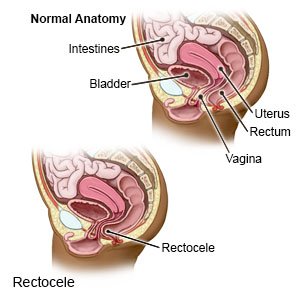
Rectocele
WHAT YOU SHOULD KNOW:
Rectocele (Aftercare Instructions) Care Guide
- Rectocele
- Rectocele Aftercare Instructions
- Rectocele Discharge Care
- Rectocele Inpatient Care
- En Espanol
- A rectocele (REK-to-sel), also called vaginal hernia, occurs when a part of the rectum bulges down into the vagina. It is often caused by weak muscles and ligaments that hold and support the vagina and rectum. This may be caused by aging, surgery, straining, pregnancy, or trauma during labor or delivery of a baby. There may be no signs or symptoms, or you may feel a bulge in your vagina that may come out through the vaginal opening. You may also have rectal pain, trouble having a bowel movement (BM), , or a feeling of fullness in your rectum.
- Your caregiver will be able to find your rectocele by doing a physical exam. You may need other tests, such as a barium enema, colonoscopy, MRI, or ultrasound. Treatment may include a high fiber diet, biofeedback therapy, or estrogen medicine. A pessary (ring-like device) placed inside your vagina may help support your rectum. You may need surgery to repair the weak or thin muscles around your vagina and rectum. With treatment your symptoms, such as back pain and constipation, may go away.

INSTRUCTIONS:
Take your medicine as directed:
Call your primary healthcare provider if you think your medicine is not working as expected. Tell him if you are allergic to any medicine. Keep a current list of the medicines, vitamins, and herbs you take. Include the amounts, and when, how, and why you take them. Take the list or the pill bottles to follow-up visits. Carry your medicine list with you in case of an emergency. Throw away old medicine lists.
Ask for information about where and when to go for follow-up visits:
For continuing care, treatments, or home services, ask for more information.
Bowel Movements:
You may need to do the following:
- Constipation: If you are constipated, you may have a hard time having a bowel movement (BM) Do not try to push the BM out if it is too hard. Walking is the best way to get your bowels moving. Eat foods high in fiber to make it easier to have a BM. Good examples are high fiber cereals, beans, vegetables, and whole grain breads. Prune juice may help make the BM softer. Caregivers may give you fiber medicine or a stool softener to help make your BMs softer and more regular. You can also buy these medicines at a grocery or drug store.
- Keep track of your bowel movements: Record the number of bowel movements (BMs) you have each week and describe the color and form (liquid, soft, or hard). If you see blood in your BM, write this down also. Bring this information with you when you see your caregiver.
Preventing a rectocele from coming back:
- Do Kegel exercises regularly: This exercise squeezes your pelvic floor muscles and helps them become stronger. Ask your caregiver for more information about Kegel exercises.
- Drink 8 to 10 (eight-ounce) cups of liquid each day: Women 19 years old and older should drink about 2.2 Liters of liquid each day (close to 9 eight-ounce cups). Good drink choices for most people include water, juice, and milk. If you drink liquids that contain caffeine, such as coffee, these can also be counted in your daily liquid amount. Some food items such as soup and fruit also add liquid to your diet. Try to drink enough liquid each day, and not just when you feel thirsty.
- Eat more fiber: High fiber foods, such as fresh fruits, vegetables, and whole grains, soften stools. This helps stools pass more quickly through your colon. Slowly add fiber into your diet to avoid bloating, stomach pain, and gas.
- Maintain a healthy weight: Talk to your caregiver the best weight for you. Ask for help planning an exercise program. Exercise helps your bowels work better and decreases pressure inside your colon. Exercise at least 30 minutes every day.
- Treat your cough: If you have a chronic (long-term) cough, tell your caregiver. Get help to stop smoking. Many people who smoke get a chronic cough over time. Ask your caregiver for more information about how to quit smoking if you are having trouble quitting.
Manage stress:
Stress may slow healing and cause illness later. Since it is hard to avoid stress, learn to control it. Learn new ways to relax, such as deep breathing, meditation, relaxing muscles, music, or biofeedback. Talk to someone about things that upset you.
CONTACT A CAREGIVER IF:
- You have a fever.
- You have chills, a cough, or feel weak and achy.
- You are losing weight without trying.
- You have stomach or back pain that does not go away.
- You are unable to have a BM.
- You have questions or concerns about your condition, treatment, or care.
SEEK CARE IMMEDIATELY IF:
- You have abnormal or irregular bleeding from your vagina.
- You have a mass hanging or protruding out of the vagina that you cannot push back.
- You have a very bad pain in your rectum or vagina that does not go away.
- You have a bad smelling discharge coming from your vagina.
- You have trouble breathing all of a sudden.
- Your stools are black or bright red.
Copyright © 2011. Thomson Reuters. All rights reserved. Information is for End User's use only and may not be sold, redistributed or otherwise used for commercial purposes.
The above information is an educational aid only. It is not intended as medical advice for individual conditions or treatments. Talk to your doctor, nurse or pharmacist before following any medical regimen to see if it is safe and effective for you.
Learn more about Rectocele (Aftercare Instructions)
Micromedex Care Notes: