Thomson Reuters Micromedex

Foot Fracture In Adults

What is a foot fracture?

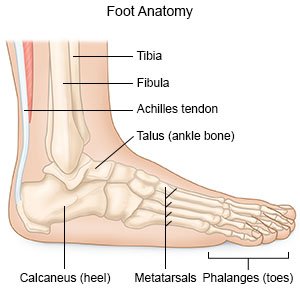
  • A foot fracture is a crack or break in one or more of the bones in your foot. The metatarsal bones are the long bones in your foot that connect to your toes. The metatarsals are needed to support your weight and movement. You also have three cuneiform bones, a cuboid bone, and a navicular bone that connect to your metatarsals. These bones make up your midfoot. The midfoot and metatarsals together make the arch at the top of your foot, between your ankle and toes. Strong ligaments (tissues) connect the bones together.
    Lower Leg and Foot


  • When you have a foot fracture, you may not be able to move your foot and walk like you normally do. It may be hard for you to put any weight on your broken foot. Having your foot fracture treated may decrease your symptoms such as pain. Treatment may allow you to return to the activities you enjoy.

What causes a foot fracture?

Your foot fracture may be caused by any of the following:

  • Trauma: Car and sports accidents are common causes of foot fractures. A direct blow from a blunt (not sharp) object to your foot may cause a fracture. This may happen if something very heavy falls on your foot. With this kind of injury you may also damage the muscles and ligaments in your foot. You also may have open skin areas from your injury.

  • Falling and twisting: Falling down the stairs, or from high up, such as when on a ladder, may cause a foot fracture. Stepping into a hole or off a curb may lead to a fracture if you twist your foot. Twisting your leg or ankle while your foot stays in position also may cause a foot fracture.

  • Stress: Stress fractures occur when the muscles attached to bone become tired from using them too much. Muscle stress leading to a foot fracture is more common in dancers and military recruits. Stress fractures may also occur in runners and soccer, tennis, or football players. You also may get a stress fracture if you are normally not active and begin a new physical activity.

What are the different types of foot fractures?

  • Non-displaced: A fracture is non-displaced when the bone cracks or breaks but stays in place.

  • Displaced: A fracture is displaced when the two ends of the broken bone are separated.

  • Comminuted: A fracture is comminuted when the bone is broken in many different places.

  • Open fracture: An open fracture occurs when the broken bone breaks through your skin.

What are the signs and symptoms of a foot fracture?

You may have any of the following:

  • Pain in your foot that increases when trying to stand or walk.

  • Crepitus (hearing a cracking sound when moving your foot).

  • Decreased foot movement and trouble walking.

  • Deformity (your foot is shaped different then normal).

  • Foot tenderness (pain when touched) over the injured area.

  • Numbness (loss of feeling) in an area of your foot or toes.

  • Swelling, bruising, blistering, or open breaks in the skin of your injured foot.

How is a foot fracture diagnosed?

Your caregiver will check the skin over your injured foot for any open breaks in the skin. He may touch areas of your foot to see if you have decreased feeling. He also may check for any problems with your foot movements. You may need any of the following tests:

  • X-ray: An x-ray is a picture done to check your foot for broken bones. You may need to put weight on your injured foot to take the x-ray pictures.

  • Bone scan: This test is done to look at your foot bones. You are given a small, safe amount of radioactive dye in an IV. An IV is a tube placed in your vein for giving medicine or liquids. Pictures are then taken of your foot bones to look for fractures.

  • Computed tomography scan: This is also called a CT scan. A CT scan is an x-ray that uses computers to take pictures of your foot. Your caregiver may use this test to look for broken bones and other foot injuries. You may be given a dye before the pictures are taken to help caregivers see the pictures better. People who are allergic to shellfish (lobster, crab, or shrimp) may be allergic to this dye. Tell your caregiver if you are allergic to shellfish or have other allergies.

  • Magnetic resonance imaging: This test is also called an MRI. During an MRI, magnetic waves are used to take pictures of the bones, and other tissues in your foot. You will need to lie still during an MRI. Never enter the MRI room with any metal objects. This can cause serious injury.

How is a foot fracture treated?

Treatment depends on what kind of fracture you have, and how bad it is. You may need any of the following:

  • Rest: Some fractures may heal on their own without treatment. You may need to rest your foot and avoid activities that cause you pain. Rest is most commonly used to treat a stress or non-displaced fracture.

  • Boot, cast, or splint: A boot, cast, or splint may be put on your foot and lower leg to decrease your foot movement. Boots, casts, and splints work to hold the broken bones in place. These devices may help decrease pain, and prevent further damage to your broken bones. Certain boots and casts will allow you to put weight on your foot, and can be used for walking.

  • Medicine: Medicines may be given to help decrease or take away your pain. You also may need antibiotic medicine to prevent or treat an infection by germs called bacteria.

  • Surgery: You may need surgery if you have a severe (very bad) foot fracture. You may also need surgery if your fracture does not heal with other treatments. If you have an open fracture, you may need debridement before your surgery. Debridement is when your caregiver removes damaged and infected tissue, and cleans your wound. Debridement is done to help prevent infection and improve healing. You may need any of the following:

    • External fixation: During external fixation, screws may be put through your skin and into your broken bones. The screws will be secured to a device outside of your foot. External fixation will allow your bones to be held together so they can heal. External fixation is often done if you have severe tissue damage, or you have many injuries.

    • Open reduction and internal fixation: During internal fixation surgery, your caregiver will make an incision (cut) in your foot to straighten your broken bones. He may use wires, screws and metal plates, or nails to hold your broken bones together. This surgery will help your broken bones grow back together.

    • Percutaneous pin fixation: During percutaneous pin fixation, your caregiver will use metal wire pins to straighten the broken bones in your foot. The pins will hold the broken pieces of bone together. Your caregiver will place the pins through your skin and into your bone using a small drill.

  • Traction: You may need traction when your broken bones are displaced. Traction pulls on the bones to put them back into place. A pin may be put in your bone or cast, and hooked to a traction device. Weights are hung from the traction device to help pull the bones into the right position.

  • Physical therapy: You may need to see a physical therapist to teach you special exercises. These exercises help improve movement and decrease pain. Physical therapy can also help improve strength and decrease your risk for loss of function.

  • Tetanus shot: You may need a tetanus shot if you have breaks in your skin from your injury. A tetanus shot is a shot of medicine to prevent you from getting tetanus. The shot is normally given into your arm. You should have a tetanus shot if you have not had one in the past 5 to 10 years. Your arm can get red, swollen, and sore after getting this shot.

What can I do to help my foot fracture heal?

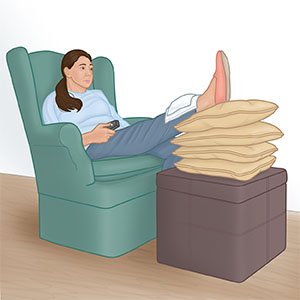
  • Elevate your foot: Keeping your foot at, or above the level of your heart may help decrease pain and swelling. Pillows can be used to keep your foot elevated.

  • Ice: Ice causes blood vessels to constrict (get small) which helps decrease swelling and pain. Put crushed ice in a plastic bag and cover it with a towel. Put the ice pack on your foot for 15 to 20 minutes every hour. Use the ice for as long as your caregiver says you should. Do not sleep with the ice pack on because you can get frostbite.

  • Keep normal blood sugar levels: People with diabetes may have poor wound healing. Keeping your blood sugar levels normal may improve your healing. Ask your caregiver what your blood sugar level should be.

What are the risks of having a foot fracture?

  • If you need a cast or splint, your foot and ankle may become very stiff. During surgery, the nerves, tissues, and blood vessels in your foot may be damaged. You may have numbness or weakness in your foot and toes. After surgery, you may get an infection. You may also get an infection where pins have been placed through your skin. Your foot may not heal, or work as well as it did before your injury. Screws, nails, or pins used during your surgery may come loose, and you may need another surgery.

  • You may get a blood clot in your leg. This can cause pain and swelling, and it can stop blood from flowing where it needs to go in your body. The blood clot can break loose and travel to your lungs. A blood clot in your lungs can cause chest pain and trouble breathing. This problem can be life-threatening.

  • Without treatment, your broken foot may not heal. If your fracture heals on its own, your foot may be deformed. You may not be able to move your foot as well as you did before your injury. You may have pain and weakness in your foot. You also may lose feeling in your foot. You may be at risk for blood clots. You may have tissue damage, and you may get an infection. Severe (very bad) infections may lead to a bone infection, and you may need your foot amputated (cut off). Ask your caregiver if you have any questions or concerns about your foot fracture or treatment.

Where can I find more information?

Contact the following for more information:

  • American Academy of Family Physicians
    11400 Tomahawk Creek Parkway
    Leawood , KS 66211-2680
    Phone: 1- 913 - 906-6000
    Phone: 1- 800 - 274-2237
    Web Address: http://www.aafp.org
  • American Academy of Orthopaedic Surgeons
    6300 North River Road
    Rosemont , IL 60018-4262
    Phone: 1- 847 - 823-7186
    Web Address: http://www.aaos.org/

When should I call my caregiver?

Call your caregiver if:

  • You have a fever.

  • You have more pain or swelling than you did before your cast was put on.

  • You have any questions about your injury, treatment, or care.

  • You have chest pain or trouble breathing that is getting worse over time.

When should I seek immediate help?

Seek care immediately or call 911 if:

  • The pain in your injured foot gets worse.

  • The skin or toes of your injured foot become swollen, cold, or turn white or blue.

  • Your injured foot or toes become numb.

  • You have open skin areas on your foot that will not stop bleeding.

  • You suddenly feel lightheaded and have trouble breathing.

  • You have new and sudden chest pain. You may have more pain when you take deep breaths or cough. You may cough up blood.

  • Your leg feels warm, tender, and painful. It may look swollen and red.

Care Agreement

You have the right to help plan your care. Learn about your health condition and how it may be treated. Discuss treatment options with your caregivers to decide what care you want to receive. You always have the right to refuse treatment.

Copyright © 2012. Thomson Reuters. All rights reserved. Information is for End User's use only and may not be sold, redistributed or otherwise used for commercial purposes.

The above information is an educational aid only. It is not intended as medical advice for individual conditions or treatments. Talk to your doctor, nurse or pharmacist before following any medical regimen to see if it is safe and effective for you.

Learn more about Foot Fracture In Adults

Advertisement
Close

Recommended

(web2)