
Crohn Disease
Medically reviewed by Drugs.com. Last updated on May 6, 2024.
Crohn disease is an inflammatory disease of the digestive system. Crohn disease causes the lining of your intestines to become inflamed. The lining of your mouth, esophagus, or stomach may also be affected.
 |
WHILE YOU ARE HERE:
Informed consent
is a legal document that explains the tests, treatments, or procedures that you may need. Informed consent means you understand what will be done and can make decisions about what you want. You give your permission when you sign the consent form. You can have someone sign this form for you if you are not able to sign it. You have the right to understand your medical care in words you know. Before you sign the consent form, understand the risks and benefits of what will be done. Make sure all your questions are answered.
You may be weighed each day.
Healthcare providers compare your weight from day to day to record how much body fluid you have. You can become dehydrated if you lose too much fluid. You can have shortness of breath or swelling in your legs if you retain (hold) too much fluid.
Medicines:
- Aminosalicylates stop your immune system from releasing substances that can cause inflammation.
- Antibiotics treat or prevent an infection caused by bacteria.
- Antidiarrheal medicine is given to decrease diarrhea.
- Steroids may be given to decrease inflammation.
- Antitumor necrosis factor (anti-TNF) medicine blocks inflammation.
- Immunosuppressants may be given to slow your immune system.
- Nutritional supplements , such as vitamins or minerals, may be given.
Tests:
- Blood tests may be needed to check for infection or health problems caused by Crohn disease, such as low iron levels. Inflammation levels may also be checked.
- A bowel movement sample may show if bacteria are causing your illness.
- A colonoscopy is a test that is done to look at your colon. A tube with a light on the end will be put into your anus, and then moved forward into your colon.
- A barium enema is an x-ray of the colon. A tube is put into your anus, and a liquid called barium is put through the tube. Barium is used so that healthcare providers can see your colon better.
- A barium swallow is an x-ray of your throat and esophagus. This test may also be called a barium esophagram. You will drink a thick liquid called barium. Barium helps your esophagus and stomach show up better on x-rays. Follow the instructions of your healthcare provider before and after the test.
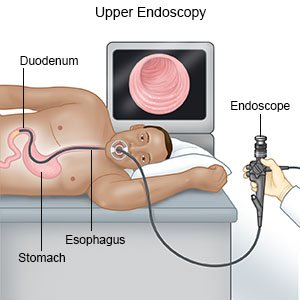
- An endoscopy is a test that uses a scope to see the inside of your digestive tract, including the esophagus and stomach. Samples may be taken from your digestive tract and sent to a lab for tests. Bleeding may also be treated during an endoscopy.
- MRI or CT pictures may be taken of your digestive system and other organs. You may be given contrast liquid to help the pictures show up better. Tell the healthcare provider if you have ever had an allergic reaction to contrast liquid. The MRI machine contains a powerful magnet. Do not enter the MRI room with anything metal. Metal can cause serious injury from the magnet. Tell the healthcare provider if you have any metal in or on your body.
- An ultrasound is a test that uses sound waves to look at pictures of your digestive system.
Treatment options
The following list of medications are related to or used in the treatment of this condition.
Surgery:
You may need surgery to decrease your symptoms or to correct problems, such as blockage or bleeding. Healthcare providers may remove the diseased part of your intestines and reconnect the healthy parts. You may also need a colostomy.
RISKS:
Without treatment, you may develop a blockage in your digestive tract. If your intestines become infected, abscesses could develop. You may have sores that break through your intestines and move into other parts of your intestines or tissues. This can cause abnormal tunnels called fistulas. If a fistula reaches your skin, such as around your anus, you may have rectal bleeding. Swelling of your joints, eyes, or mouth may occur. You may also develop other health problems, such as skin problems, kidney stones, gallstones, and liver disease.
CARE AGREEMENT:
You have the right to help plan your care. Learn about your health condition and how it may be treated. Discuss treatment options with your healthcare providers to decide what care you want to receive. You always have the right to refuse treatment.© Copyright Merative 2024 Information is for End User's use only and may not be sold, redistributed or otherwise used for commercial purposes.
The above information is an educational aid only. It is not intended as medical advice for individual conditions or treatments. Talk to your doctor, nurse or pharmacist before following any medical regimen to see if it is safe and effective for you.
Learn more about Crohn Disease
Treatment options
Care guides
Medicine.com guides (external)
Further information
Always consult your healthcare provider to ensure the information displayed on this page applies to your personal circumstances.
