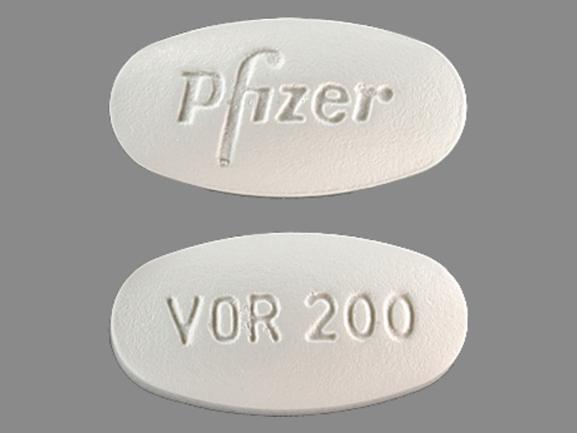
Vfend
Generic name: voriconazole (oral/injection) [ vor-i-KON-a-zole ]
Drug class: Azole antifungals
What is Vfend?
Vfend is an antifungal medicine.
Vfend is a prescription medicine used to treat infections caused by yeast or other types of fungus. These infections are called "aspergillosis," "esophageal candidiasis," "Scedosporium," "Fusarium," and "candidemia".
It is not known if Vfend is safe and effective in children younger than 2 years old.
Warnings
Do not use Vfend if you are pregnant. It could harm the unborn baby.
There are many other medicines that can cause serious or life-threatening drug interactions with voriconazole. Tell your doctor about all the prescription and over-the-counter medications you use.
Before taking Vfend, tell your doctor if you have heart rhythm problems, an electrolyte imbalance, liver or kidney disease, or a history of allergy to other antifungal medications such as fluconazole (Diflucan), ketoconazole (Nizoral), or itraconazole (Sporanox).
Take Vfend for the full prescribed length of time. Your symptoms may improve before the infection is completely cleared. Skipping doses may also increase your risk of further infection that is resistant to antifungal medicine. This medicine will not treat a viral infection such as the common cold or flu.
Voriconazole can cause problems with your vision. If you use Vfend for more than 28 days, you may need to have your eyes checked.
Before taking this medicine
You should not use Vfend if you are allergic to voriconazole.
Many drugs can interact and cause dangerous effects. Some drugs should not be used together with Vfend. Your doctor may change your treatment plan if you also use:
-
cisapride;
-
ivabradine;
-
lurasidone;
-
naloxegol;
-
rifabutin, rifampin;
-
tolvaptan;
-
venetoclax;
-
certain barbiturates (mephobarbital, phenobarbital); or
-
"ergot" migraine headache medicines (dihydroergotamine, ergotamine, ergonovine, methylergonovine).
To make sure Vfend is safe for you, tell your doctor if you have ever had:
-
heart disease, or a heart rhythm disorder;
-
high or low levels of calcium, potassium, or magnesium in your blood;
-
liver or kidney disease; or
-
trouble digesting sugar or dairy products (Vfend tablets contain lactose, Vfend liquid contains sucrose).
Voriconazole may harm an unborn baby. Use effective birth control to prevent pregnancy, and tell your doctor if you become pregnant.
Voriconazole can interact with certain birth control pills, which may increase side effects. Ask your doctor about the best form of birth control to use during treatment with Vfend.
It may not be safe to breastfeed while using this medicine. Ask your doctor about any risk.
Vfend is not approved for use by anyone younger than 2 years old.
How should I use Vfend?
Take Vfend exactly as prescribed by your doctor. Follow all directions on your prescription label and read all medication guides or instruction sheets.
Take oral Vfend (tablets or liquid) at least 1 hour before or 1 hour after eating a meal.
Shake the liquid before you measure a dose. Use the dosing syringe provided, or use a medicine dose-measuring device (not a kitchen spoon).
Do not mix Vfend liquid with any other medicine or liquid.
Vfend injection is given as a slow infusion into a vein, over 1 to 2 hours. Voriconazole is usually given by injection only if you are unable to take the medicine by mouth. A healthcare provider will give your first dose and may teach you how to properly use the medication by yourself.
Vfend injection is a powder medicine that must be mixed with a liquid (diluent) before using it. When using injections by yourself, be sure you understand how to properly mix and store the medicine.
Prepare your injection only when you are ready to give it. Do not use if the medicine has changed colors or has particles in it. Call your pharmacist for new medicine.
If you cannot use the mixed injection right away, store it in the refrigerator and use it within 24 hours. Do not freeze.
Do not reuse a needle or syringe. Place them in a puncture-proof "sharps" container and dispose of it following state or local laws. Keep out of the reach of children and pets.
Vfend is sometimes given for up to several days after lab tests show that the infection has cleared. Very severe infections may need to be treated for several weeks.
Use this medicine for the full prescribed length of time, even if your symptoms quickly improve. Skipping doses can increase your risk of infection that is resistant to medication. Voriconazole will not treat a viral infection such as the flu or a common cold.
You may need frequent blood tests. Your vision and kidney or liver function may also need to be checked.
Store Vfend tablets or liquid at room temperature away from moisture and heat. Do not store in a refrigerator or freezer. Keep the medicine bottle tightly closed when not in use. Throw away any unused liquid after 14 days.
What happens if I miss a dose?
Take the medicine as soon as you can, but skip the missed dose if it is almost time for your next dose. Do not take two doses at one time.
Call your doctor for instructions if you miss a dose of injectable Vfend.
What happens if I overdose?
Seek emergency medical attention or call the Poison Help line at 1-800-222-1222.
What should I avoid while using Vfend?
Voriconazole may cause vision changes such as blurred vision and sensitivity to light. Wear sunglasses during the day to protect your eyes from bright light. Be careful if you drive or do anything that requires you to be alert and able to see clearly.
Avoid exposure to sunlight or tanning beds. Voriconazole can make you more sensitive to sunlight or cause a serious skin reaction, including lesions that may lead to skin cancer. Wear protective clothing and use sunscreen (SPF 30 or higher) when you are outdoors.
Vfend side effects
Get emergency medical help if you have signs of an allergic reaction to Vfend (hives, difficult breathing, swelling in your face or throat) or a severe skin reaction (fever, sore throat, burning eyes, skin pain, red or purple skin rash with blistering and peeling).
Seek medical treatment if you have a serious drug reaction that can affect many parts of your body. Symptoms may include: skin rash, fever, swollen glands, muscle aches, severe weakness, unusual bruising, or yellowing of your skin or eyes.
Some side effects may occur during the injection. Tell your medical caregiver if you feel dizzy, nauseated, light-headed, itchy, sweaty, or have a headache, chest tightness, back pain, trouble breathing, or swelling in your face.
Call your doctor at once if you have:
-
fast or pounding heartbeats, fluttering in your chest, shortness of breath, and sudden dizziness (like you might pass out);
-
a sunburn;
-
vision problems, changes in your color vision;
-
easy bruising, unusual bleeding, purple or red spots under your skin;
-
slow heart rate, weak pulse, fainting, slow breathing;
-
increased adrenal gland hormones - hunger, weight gain, swelling, skin discoloration, slow wound healing, sweating, acne, increased body hair, mood changes, muscle weakness, missed menstrual periods, sexual changes;
-
decreased adrenal gland hormones - stomach pain, loss of appetite, feeling light-headed, muscle or joint pain, skin discoloration, craving salty foods;
-
kidney problems - little or no urination, swelling in your feet or ankles;
-
liver problems - nausea, vomiting, flu-like symptoms, itching, tiredness, or jaundice (yellowing of the skin or eyes); or
-
signs of an electrolyte imbalance - dizziness, numbness or tingling, constipation, increased thirst or urination, irregular heartbeats, cough or choking feeling, feeling jittery, leg cramps, muscle spasms, muscle weakness or limp feeling.
Common Vfend side effects may include:
-
fever, chills, stuffy nose, sneezing, sinus pain, cough, sore throat, trouble breathing;
-
bruising or bleeding, nosebleeds, coughing up blood;
-
high or low blood pressure, fast heart rate;
-
electrolyte imbalance;
-
stomach pain, bloating, nausea, vomiting, diarrhea, constipation;
-
kidney problems;
-
swelling in your hands or feet;
-
headache, dizziness, vision changes, hallucinations;
-
rash; or
-
abnormal liver function tests.
This is not a complete list of side effects and others may occur. Call your doctor for medical advice about side effects. You may report side effects to FDA at 1-800-FDA-1088.
What other drugs will affect Vfend?
Many drugs can interact with voriconazole, and some drugs should not be used at the same time. Tell your doctor about all your current medicines and any medicine you start or stop using. This includes prescription and over-the-counter medicines, vitamins, and herbal products. Not all possible interactions are listed here.
More about Vfend (voriconazole)
- Check interactions
- Compare alternatives
- Pricing & coupons
- Reviews (3)
- Drug images
- Side effects
- Dosage information
- During pregnancy
- Generic availability
- Drug class: azole antifungals
- Breastfeeding
- En español
Professional resources
Related treatment guides
Further information
Remember, keep this and all other medicines out of the reach of children, never share your medicines with others, and use Vfend only for the indication prescribed.
Always consult your healthcare provider to ensure the information displayed on this page applies to your personal circumstances.
Copyright 1996-2024 Cerner Multum, Inc. Version: 14.01.