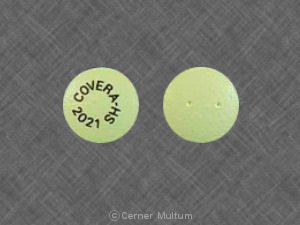
Covera-HS Side Effects
Generic name: verapamil
Medically reviewed by Drugs.com. Last updated on Sep 25, 2023.
Note: This document contains side effect information about verapamil. Some dosage forms listed on this page may not apply to the brand name Covera-HS.
Applies to verapamil: oral capsule extended release, oral tablet, oral tablet extended release. Other dosage forms:
Serious side effects of Covera-HS
Along with its needed effects, verapamil (the active ingredient contained in Covera-HS) may cause some unwanted effects. Although not all of these side effects may occur, if they do occur they may need medical attention.
Check with your doctor immediately if any of the following side effects occur while taking verapamil:
Less common
- Blue lips and fingernails
- blurred vision
- burning, crawling, itching, numbness, prickling, "pins and needles", or tingling feelings
- chest pain
- confusion
- coughing that sometimes produces a pink frothy sputum
- difficult, fast, noisy breathing, sometimes with wheezing
- dizziness, faintness, or lightheadedness when getting up from a lying or sitting position suddenly
- increased sweating
- lightheadedness, dizziness, or fainting
- pale skin
- shortness of breath
- slow or irregular heartbeat
- sore throat
- sweating
- swelling in legs and ankles
- unusual tiredness or weakness
Rare
- Chills
- cold sweats
- feeling of warmth
- redness of the face, neck, arms and occasionally, upper chest
Other side effects of Covera-HS
Some side effects of verapamil may occur that usually do not need medical attention. These side effects may go away during treatment as your body adjusts to the medicine. Also, your health care professional may be able to tell you about ways to prevent or reduce some of these side effects.
Check with your health care professional if any of the following side effects continue or are bothersome or if you have any questions about them:
More common
- Difficulty having a bowel movement (stool)
- headache
Less common
- Acid or sour stomach
- belching
- difficulty in moving
- heartburn
- indigestion
- joint pain
- muscle aching or cramping
- muscle pains or stiffness
- nausea
- rash
- stomach discomfort, upset, or pain
- trouble sleeping
- unusual drowsiness, dullness, tiredness, weakness, or feeling of sluggishness
- swollen joints
For Healthcare Professionals
Applies to verapamil: compounding powder, intravenous solution, oral capsule extended release, oral tablet, oral tablet extended release.
General
The most commonly reported side effects include constipation, dizziness, and headache.[Ref]
Nervous system
Seizures occurred rarely with IV administration.
Paralysis/tetraparesis was reported in a patient taking this drug and colchicine concurrently.[Ref]
Very common (10% or more): Headache (up to 12.1%)
Common (1% to 10%): Dizziness, lethargy
Rare (0.01% to 0.1%): Seizures
Frequency not reported: Rotary nystagmus, sleepiness, vertigo, lightheadedness, tingling, numbness, neuropathy
Postmarketing reports: Syncope, cerebrovascular accident, equilibrium disorders, parkinsonism/extrapyramidal symptoms/syndrome, paresthesia, shakiness/tremor, paralysis/tetraparesis, somnolence[Ref]
Cardiovascular
Common (1% to 10%): Symptomatic hypotension/hypotension/abrupt blood pressure fall, sinus bradycardia/bradycardia (heart rate less than 50 beats/minute), severe tachycardia, ankle edema/edema, development/aggravation of congestive heart failure (CHF), atrioventricular (AV) block, peripheral edema
Uncommon (0.1% to 1%): Second-/third-degree AV block, palpitations, orthostasis
Postmarketing reports: Angina pectoris/chest pain, AV dissociation, ECG abnormal, claudication, hypertension, myocardial infarction, sinus arrest with asystole, decreased myocardial contractility, cardiogenic shock, bradyarrhythmia in atrial fibrillation, vasculitis, erythromelalgia[Ref]
Cardiovascular side effects may occur with greater intensity at higher doses or in patients with a history of myocardial damage.
Approximately 15% of patients who had atrial flutter/fibrillation and received this drug and digoxin developed resting ventricular rates below 50 beats/min; in the same trial, asymptomatic hypotension occurred in approximately 5% of patients.
Asystole occurred after second/third degree AV block and was usually short in duration, with spontaneous cardiac action returning within seconds in the form of a sinus rhythm.[Ref]
Gastrointestinal
Common (1% to 10%): Constipation, dyspepsia, nausea, diarrhea, flatulence
Uncommon (0.1% to 1%): Abdominal discomfort/pain
Frequency not reported: Non-obstructive paralytic ileus/ileus, bloating
Postmarketing reports: Dry mouth, gastrointestinal stress, gingival hyperplasia, vomiting[Ref]
Non-obstructive paralytic ileus was reversible when treatment was stopped.
Gingival hyperplasia occurred when this drug was given over a prolonged period of time, and was reversible once the drug was discontinued.[Ref]
Respiratory
Common (1% to 10%): Pulmonary edema, pharyngitis, sinusitis, rhinitis, dyspnea
Rare (0.01% to 0.1%): Broncho/laryngeal spasm[Ref]
Bronchospasm and laryngeal spasm occurred during hypersensitivity reactions.[Ref]
Other
Common (1% to 10%): Fatigue, tiredness/malaise, accidental injury, pain
Frequency not reported: Infection, flu syndrome
Postmarketing reports: Tinnitus, asthenia[Ref]
Dermatologic
Common (1% to 10%): Scalp irritation, rash
Uncommon (0.1% to 1%): Itching, urticaria, flushing, exanthema
Frequency not reported: Diaphoresis, photodermatitis
Postmarketing reports: Ecchymosis, bruising, alopecia/hair loss, hyperkeratosis, macules, Stevens-Johnson syndrome, hyperhidrosis/sweating, erythema multiforme, Quincke's edema/angioneurotic edema[Ref]
Itch and urticaria occurred in hypersensitivity reactions.[Ref]
Psychiatric
Common (1% to 10%): Sleep disturbance
Uncommon (0.1% to 1%): Bad dreams, depression/emotional depression
Postmarketing reports: Confusion, psychotic symptoms, insomnia, nervousness[Ref]
Musculoskeletal
Common (1% to 10%): Myalgia
Frequency not reported: Muscle fatigue
Postmarketing reports: Muscle cramps, arthralgia[Ref]
Hepatic
Uncommon (0.1% to 1%): Elevated liver enzymes (transaminases, alkaline phosphatase)[Ref]
Reversible elevations liver enzymes occurred during treatment, and are likely the result of a hypersensitivity reaction (e.g., allergic hepatitis).[Ref]
Hypersensitivity
Rare (0.01% to 0.1%): Hypersensitivity/allergic reactions
Postmarketing reports: Allergy aggravated[Ref]
Metabolic
Frequency not reported: Lowered glucose tolerance
Postmarketing reports: Hyperkalemia[Ref]
Genitourinary
Postmarketing reports: Galactorrhea, increased blood prolactin/hyperprolactinemia, increased urination, spotty menstruation, erectile dysfunction/impotence[Ref]
Renal
Postmarketing reports: Renal failure[Ref]
Endocrine
Postmarketing reports: Gynecomastia[Ref]
Gynecomastia occurred in older male patients on prolonged treatment, and was reversible upon discontinuation of this drug.[Ref]
Hematologic
Postmarketing reports: Purpura[Ref]
Ocular
Postmarketing reports: Blurred vision[Ref]
More about Covera-HS (verapamil)
- Check interactions
- Compare alternatives
- Reviews (1)
- Drug images
- Dosage information
- During pregnancy
- Drug class: calcium channel blocking agents
- Breastfeeding
Patient resources
Other brands
Calan SR, Calan, Verelan, Isoptin SR, Verelan PM
Professional resources
Other brands
Calan SR, Calan, Verelan, Verelan PM
Related treatment guides
References
1. Product Information. Calan (verapamil). Searle. 2001;PROD.
2. Product Information. Isoptin (verapamil). Knoll Pharmaceutical Company. 2001;PROD.
3. Product Information. Covera-HS (verapamil). Searle. 2001;PROD.
4. Cerner Multum, Inc. UK Summary of Product Characteristics.
5. Cerner Multum, Inc. Australian Product Information.
6. Product Information. Verelan PM (verapamil). Schwarz Pharma. 2010.
Further information
Always consult your healthcare provider to ensure the information displayed on this page applies to your personal circumstances.
Some side effects may not be reported. You may report them to the FDA.