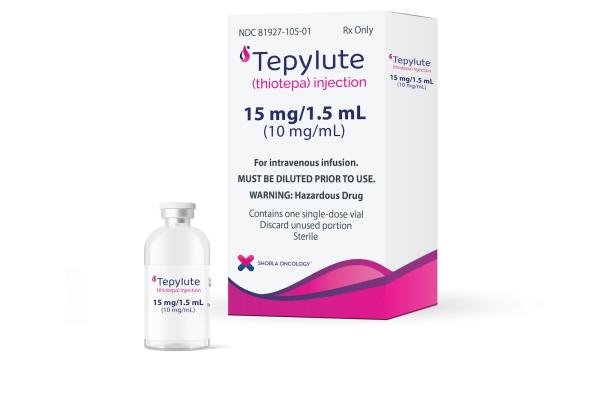
Thiotepa (Monograph)
Drug class: Antineoplastic Agents
- Alkylating Agents
VA class: AN100
Chemical name: Tris(1-aziridinyl)phosphine sulfide
CAS number: 52-24-4
Introduction
Antineoplastic agent; nitrogen mustard derivative; ethylenimine alkylating agent.
Uses for Thiotepa
Bladder Cancer
Used intravesically for the treatment of residual tumor and/or as adjuvant therapy for prophylaxis of superficial bladder cancer.
Less effective than live intravesical Bacillus Calmette-Guerin (BCG) in reducing the frequency of tumor recurrence in patients with superficial bladder cancer.
Breast Cancer
Used in the treatment of adenocarcinoma of the breast; however, other agents are preferred.
Ovarian Cancer
Used in the treatment of adenocarcinoma of the ovary; however, other agents are preferred.
Malignant Effusions
Used by intracavitary injection to control pleural, pericardial, or peritoneal effusions secondary to metastatic tumors.
Lymphomas
Has been used for treatment of lymphomas (e.g., lymphosarcoma, Hodgkin's disease); however, other treatments are preferred.
Meningeal Neoplasms
Has been investigated as an intrathecal† [off-label] agent in the treatment of malignant meningeal neoplasms (e.g., leukemia), but additional studies are required to determine safety and efficacy.
Pterygium
Has been used as an ophthalmic instillation† [off-label] to prevent the recurrence of pterygium† [off-label] following surgical excision; however, postoperative β-irradiation generally is preferred as preventive therapy because it results in a low incidence of recurrence and is relatively easy to administer.
Many clinicians recommend use be limited to management of pterygium† [off-label] that recurs following postoperative β-irradiation.
Thiotepa Dosage and Administration
General
-
Consult specialized references for procedures for proper handling and disposal of antineoplastics and for specific techniques of administration.
-
Individualize dosage carefully according to clinical and hematologic response and tolerance to obtain optimum therapeutic results with minimum adverse effects.
-
Administer only after complete hematologic recovery from any previous chemotherapy (e.g., alkylating agents) or radiation therapy occurs. (See Specific Drugs and Therapies under Interactions.)
-
Slow response does not necessarily indicate lack of effect and increasing the dosage may increase drug-associated toxicity. Consider possible delayed myelosuppressive effects of the drug. (See Hematologic Effects under Cautions.)
Administration
Administer by IV or intracavitary (e.g., intrapleural, intraperitoneal, intrapericardial) injection, or by intravesical instillation.
Has also been administered IM† [off-label], intrathecally†, by intratumor injection†, and as an ophthalmic instillation†.
Vials are for single use only.
Handle cautiously (e.g., use gloves); avoid exposure during handling and preparation of thiotepa solution. If skin or mucosal contact occurs, immediately and thoroughly wash skin with soap and water or flush mucosa with water.
To eliminate haze, filter reconstituted solutions with a pore size of 0.22 µm (e.g., polysulfone membrane [Gelman Sterile Acrodisc, single use], triton-free mixed ester of cellulose/PVC [Millipore Millex-GS Filter Unit]).
Do not use reconstituted solutions that are opaque or contain a precipitate after filtration.
IV Administration
For solution and drug compatibility information, see Stability: Compatibility.
Reconstitution
Reconstitute vial containing 15 mg of thiotepa powder with 1.5 mL of sterile water for injection to provide a solution containing about 10 mg/mL. Reconstitution with other diluents produces hypertonic solutions that may cause mild to moderate discomfort on injection.
Reconstituted solutions are hypotonic; must be diluted further before IV administration.
Dilution
Further dilute reconstituted solutions with 0.9% sodium chloride injection solution immediately prior to use.
If larger volumes of solution are desired for intracavitary, IV infusion, or perfusion therapy, dilute the reconstituted solution with sodium chloride, dextrose, dextrose and sodium chloride, Ringer’s, or lactated Ringer’s injection.
Rate of Administration
Administer by rapid IV injection.
Intracavitary Administration
Administer through the same tubing used to drain effusion fluid from the involved cavity.
Consult specialized references for specific techniques of administration.
Intravesical Administration
Prior to intravesical administration, patients should be dehydrated for 8–12 hours.
Instill 60 mL of diluted thiotepa solution by catheter into the bladder; retain solution in the bladder for 2 hours for maximum effect. Reposition patient every 15 minutes for maximum area contact. If patient is unable to retain 60 mL for 2 hours, instill 30 mL.
Reconstitution and Dilution
Reconstitute vial containing 15 mg of thiotepa powder with 1.5 mL of sterile water for injection to provide a solution containing about 10 mg/mL.
Prepare intravesical solution by diluting 60 mg of thiotepa solution in 30–60 mL of 0.9% sodium chloride injection.
Intratumor Administration†
Administer directly into tumor via a 22-gauge needle.
Prior to administration, inject a small amount of local anesthetic and leave the needle in place; then use a separate syringe to inject thiotepa through the same needle.
Dosage
Initially, administer the higher dose in a given dosage range.
Adjust maintenance dosage based on pretreatment and subsequent blood counts; do not administer at intervals of <1 week.
Adults
Bladder Cancer
Superficial Bladder Tumors
IntravesicalUsually, 60 mg instilled into the bladder and retained for 2 hours once a week for 4 weeks.
Additional courses may be required, but administer with caution because of risk of cumulative myelosuppressive effects. (See Hematologic Effects under Cautions.) Some clinicians recommend reduced doses of the drug for additional courses.
Reduced dosage may be required in patients with extensive local resection and/or fulguration of bladder tumors.
Consult published protocols for the dosage and schedule of administration and duration of therapy.
Breast Cancer
IV
0.3–0.4 mg/kg as a single dose at intervals of 1–4 weeks.
Alternatively, 0.2 mg/kg or 6 mg/m2 daily for 4 or 5 days at intervals of 2–4 weeks.
IM†
15–30 mg in various schedules.
Intratumor†
Initially, 0.6–0.8 mg/kg as a single dose.
Maintenance doses: 0.07–0.8 mg/kg as a single dose at intervals of 1–4 weeks.
Ovarian Cancer
IV
0.3–0.4 mg/kg as a single dose at intervals of 1–4 weeks.
Alternatively, 0.2 mg/kg or 6 mg/m2 daily for 4 or 5 days at intervals of 2–4 weeks.
IM†
15–30 mg in various schedules.
Intratumor†
Initially, 0.6–0.8 mg/kg as a single dose.
Maintenance doses: 0.07–0.8 mg/kg as a single dose at intervals of 1–4 weeks.
Malignant Effusions
Intracavitary
0.6–0.8 mg/kg; usually through the same tubing used to remove the fluid from the cavity involved.
Intrapericardial: 15–30 mg has been used. Consult specialized references for specific techniques of administration.
Pterygium†
Ophthalmic†
0.05% solution in Ringer’s injection has been instilled into the eye(s)† every 3 hours during waking hours for 6–8 weeks postoperatively.
Dosage Modification for Toxicity
Hematologic Effects
Reduce dosage or discontinue therapy if WBC or platelet counts decrease rapidly. Consider discontinuing therapy if leukocyte count falls to ≤3000/mm3 or if platelet count falls to <150,000 per mm3.
Prescribing Limits
Adults
Usual Dosage
IV
Do not administer maintenance dosage at intervals of <1 week.
Special Populations
Hepatic Impairment
IV
Administer in low doses and carefully monitor hepatic and hematopoietic function. (See Hepatic Impairment under Cautions.)
Renal Impairment
IV
Administer in low doses and carefully monitor renal and hematopoietic function. (See Renal Impairment under Cautions.)
Geriatric Patients
In general, dose selection should be cautious, usually initiating therapy at the low end of the dosage range reflecting the greater frequency of decreased hepatic, renal, and/or cardiac function and of concomitant disease and drug therapy observed in the elderly.
For treatment of superficial bladder cancer, reduced intravesical dosage may be required.
Cautions for Thiotepa
Contraindications
-
Known hypersensitivity to thiotepa or any ingredient in the formulation.
-
Bone marrow depression. (See Hematologic Effects under Cautions.)
-
Hepatic damage. (See Hepatic Impairment under Cautions.)
-
Renal damage. (See Renal Impairment under Cautions.)
Warnings/Precautions
Warnings
Toxicity
Highly toxic drug with a low therapeutic index; therapeutic response is not likely to occur without some evidence of toxicity.
Administer only under constant supervision by clinicians experienced in therapy with cytotoxic agents.
Hematologic Effects
Risk of dose-related and cumulative myelosuppression, manifested as leukopenia, anemia, thrombocytopenia; potentially fatal pancytopenia has been reported.
Risk of potentially fatal infections and hemorrhagic complications.
Leukocyte nadir may occur at 10–14 days when given once weekly IV; however, initial effects on bone marrow may not be evident for up to 30 days.
Perform repeated hematologic studies (WBC or platelet counts) during therapy and for at least 3 weeks following discontinuance of the drug. Discontinue or reduce dosage if WBC or platelet counts decrease rapidly. Discontinue therapy if leukocyte count falls to ≤3000/mm3 or if platelet count falls to <150,000 per mm3.
Manufacturer states that thiotepa is probably contraindicated in patients with preexisting bone marrow damage; if therapy is necessary in these patients, administer in low doses and carefully monitor hematopoietic function.
Treatment of severe hematologic toxicity may consist of supportive therapy, anti-infective agents for complicating infections, and blood product transfusions.
Intravesical Administration
Fatalities resulting from bone marrow depression secondary to systemic absorption of the drug have occurred following intravesical instillation. (See Hematologic Effects under Cautions.)
Fetal/Neonatal Morbidity and Mortality
May cause fetal harm; teratogenicity and embryolethality demonstrated in animals. Avoid pregnancy during therapy; use effective contraceptive methods. If used during pregnancy or if patient becomes pregnant, apprise of potential fetal hazard.
Mutagenicity and Carcinogenicity
Mutagenic effects (chromosomal aberrations) reported.
Carcinogenicity reported in animals; possible leukemia or secondary malignancies in humans.
Sensitivity Reactions
Hypersensitivity Reactions
Hypersensitivity reactions, including allergic reactions, rash, urticaria, laryngeal edema, asthma, anaphylactic shock, and wheezing have been reported.
Specific Populations
Pregnancy
Category D. (See Fetal/Neonatal Morbidity and Mortality under Cautions.)
Lactation
Not known whether thiotepa is distributed into milk. Discontinue nursing or the drug.
Pediatric Use
Safety and efficacy not established.
Geriatric Use
Clinical studies did not include sufficient numbers of patients ≥65 years of age to determine whether geriatric patients respond differently than younger patients.
Hepatic Impairment
Pharmacokinetics not evaluated. Manufacturer states that thiotepa is probably contraindicated in patients with preexisting hepatic damage; if therapy is necessary in these patients, administer in low doses and carefully monitor hepatic function. (See Contraindications.)
Renal Impairment
Pharmacokinetics not evaluated. Manufacturer states that thiotepa is probably contraindicated in patients with preexisting renal damage; if therapy is necessary in these patients, administer low doses and carefully monitor renal function. (See Contraindications.)
Common Adverse Effects
Bone marrow suppression.
Drug Interactions
Appears to be extensively metabolized by the CYP microsomal enzyme system.
Specific Drugs and Therapies
|
Drug or Therapy |
Interaction |
Comments |
|---|---|---|
|
Antineoplastic agents (e.g., alkylating agents) |
Increased risk of toxicity |
Concomitant therapy not recommended until patient recovers from previously induced myelosuppression If chemotherapeutic agents are used, allow for recovery from the first agent, as indicated by WBC count, before therapy with the second agent is instituted |
|
Myelosuppressive agents |
Possible additive hematologic toxicity |
Avoid concomitant therapy |
|
Radiation therapy |
Increased risk of toxicity |
Concomitant therapy not recommended until patient recovers from previously induced myelosuppression |
|
Succinylcholine |
Thiotepa may inhibit pseudocholinesterase activity Prolonged apnea reported after administration of succinylcholine prior to surgery following combined use of thiotepa and other antineoplastic agents |
Administer with caution |
Thiotepa Pharmacokinetics
Absorption
Bioavailability
Variably absorbed from GI tract. Variable absorption also occurs through serous membranes (e.g., pleura, bladder) and from IM injection sites.
Absorption through the bladder mucosa ranges from 10% to almost 100% and is enhanced by extensive tumor infiltration or acute mucosal inflammation, following endoscopic surgical procedures or radiation therapy, and in the presence of vesicoureteral reflux.
Following IV administration, peak plasma concentrations occur immediately and are proportional to the dose administered.
Following intravesical administration, plasma concentrations detected within 15 minutes, peak plasma concentrations occur within 1 hour, and plasma concentrations decline rapidly thereafter; plasma concentrations of the main metabolite TEPA are detected within 15 minutes and remain relatively constant for at least 6 hours.
Following intraperitoneal administration, approximately 80–100% of the dose absorbed into systemic circulation; peak intraperitoneal concentrations occur immediately after administration.
Distribution
Extent
Not fully elucidated.
Not known whether thiotepa is distributed into milk.
Elimination
Metabolism
Extensively metabolized in the liver by the CYP microsomal enzyme system, principally via oxidative desulfuration to triethylenephosphoramide (TEPA).
Elimination Route
Excreted in urine as thiotepa, TEPA (pharmacologically active), and unidentified metabolites.
Following IV administration of high doses, excreted in sweat to an appreciable extent.
Half-life
Thiotepa: Biphasic; terminal half-life is 1.2–2.9 hours.
TEPA: About 10–21 hours.
Special Populations
Removed by dialysis.
In patients with hepatic impairment, possible decreased clearance.
Stability
Storage
Parenteral
Powder for Injection
2–8°C. Protect from light.
Reconstituted solutions with sterile water for injection: 2–8°C; use within 8 hours.
Compatibility
Parenteral
Solution CompatibilityHID
1Variable by conventional definition, but recommended for dilution with use in shorter periods of time
|
Variable |
|
Dextrose 5% in water |
|
Sodium chloride 0.9%1 |
Drug Compatibility
|
Incompatible |
|
Cisplatin |
|
Compatible |
|
Acyclovir sodium |
|
Allopurinol sodium |
|
Amifostine |
|
Amikacin sulfate |
|
Aminophylline |
|
Amphotericin B |
|
Ampicillin sodium |
|
Ampicillin sodium–sulbactam sodium |
|
Aztreonam |
|
Bleomycin sulfate |
|
Bumetanide |
|
Buprenorphine HCl |
|
Butorphanol tartrate |
|
Calcium gluconate |
|
Carboplatin |
|
Carmustine |
|
Cefazolin sodium |
|
Cefepime HCl |
|
Cefotaxime sodium |
|
Cefotetan disodium |
|
Cefoxitin sodium |
|
Ceftazidime |
|
Ceftizoxime sodium |
|
Ceftriaxone sodium |
|
Cefuroxime sodium |
|
Chlorpromazine HCl |
|
Cimetidine HCl |
|
Ciprofloxacin |
|
Clindamycin phosphate |
|
Co-trimoxazole |
|
Cyclophosphamide |
|
Cytarabine |
|
Dacarbazine |
|
Dactinomycin |
|
Daunorubicin HCl |
|
Dexamethasone sodium phosphate |
|
Diphenhydramine HCl |
|
Dobutamine HCl |
|
Dopamine HCl |
|
Doxorubicin HCl |
|
Doxycycline hyclate |
|
Droperidol |
|
Enalaprilat |
|
Etoposide |
|
Etoposide phosphate |
|
Famotidine |
|
Floxuridine |
|
Fluconazole |
|
Fludarabine phosphate |
|
Fluorouracil |
|
Furosemide |
|
Gallium nitrate |
|
Ganciclovir sodium |
|
Gemcitabine HCl |
|
Gentamicin sulfate |
|
Granisetron HCl |
|
Haloperidol lactate |
|
Heparin sodium |
|
Hydrocortisone sodium succinate |
|
Hydromorphone HCl |
|
Hydroxyzine HCl |
|
Idarubicin HCl |
|
Ifosfamide |
|
Imipenem–cilastatin sodium |
|
Leucovorin calcium |
|
Lorazepam |
|
Magnesium sulfate |
|
Mannitol |
|
Melphalan HCl |
|
Meperidine HCl |
|
Mesna |
|
Methotrexate sodium |
|
Methylprednisolone sodium succinate |
|
Metoclopramide HCl |
|
Metronidazole |
|
Mitomycin |
|
Mitoxantrone HCl |
|
Morphine sulfate |
|
Nalbuphine HCl |
|
Ofloxacin |
|
Ondansetron HCl |
|
Paclitaxel |
|
Piperacillin sodium–tazobactam sodium |
|
Potassium chloride |
|
Prochlorperazine edisylate |
|
Promethazine HCl |
|
Ranitidine HCl |
|
Sodium bicarbonate |
|
Streptozocin |
|
Teniposide |
|
Ticarcillin disodium–clavulanate potassium |
|
Tobramycin sulfate |
|
Vancomycin HCl |
|
Vinblastine sulfate |
|
Vincristine sulfate |
|
Zidovudine |
|
Incompatible |
|
Cisplatin |
|
Filgrastim |
|
Vinorelbine tartrate |
Drug Compatibility
|
Compatible |
|---|
|
Epinephrine hydrochloride (1:1000) |
|
Procaine hydrochloride |
Actions
-
Alkylating agent, interferes with DNA replication and transcription of RNA, and ultimately results in the disruption of nucleic acid function.
-
Cytotoxic and radiomimetic activity results through the release of ethylenimine radicals, which disrupt the bonds of DNA; alkylates guanine at the N-7 position, which severs the linkage between the purine base and the sugar and liberates alkylated guanines.
-
Has some immunosuppressive activity.
-
Following intracavitary administration, may control malignant effusions by a direct antineoplastic effect.
Advice to Patients
-
Importance of informing the clinician of any sign of bleeding (epistaxis, easy bruising, change in color of urine, black stool) or infection (fever, chills).
-
Importance of informing patients of the increased risk of a secondary malignancy associated with use of the drug.
-
Importance of women informing their clinician if they are or plan to become pregnant or plan to breast-feed; necessity for clinicians to advise women to avoid pregnancy during therapy, advise pregnant women of risk to the fetus, and advise patient or partner of childbearing potential to utilize effective contraception during therapy.
-
Importance of informing clinicians of existing or contemplated therapy, including prescription and OTC drugs, as well as any concomitant illnesses.
-
Importance of informing patients of other important precautionary information. (See Cautions.)
Preparations
Excipients in commercially available drug preparations may have clinically important effects in some individuals; consult specific product labeling for details.
Please refer to the ASHP Drug Shortages Resource Center for information on shortages of one or more of these preparations.
* available from one or more manufacturer, distributor, and/or repackager by generic (nonproprietary) name
|
Routes |
Dosage Forms |
Strengths |
Brand Names |
Manufacturer |
|---|---|---|---|---|
|
Parenteral |
For injection |
15 mg* |
Thiotepa for Injection |
Bedford |
AHFS DI Essentials™. © Copyright 2024, Selected Revisions February 15, 2013. American Society of Health-System Pharmacists, Inc., 4500 East-West Highway, Suite 900, Bethesda, Maryland 20814.
† Off-label: Use is not currently included in the labeling approved by the US Food and Drug Administration.
Reload page with references included
More about thiotepa
- Check interactions
- Compare alternatives
- Pricing & coupons
- Side effects
- Dosage information
- During pregnancy
- Drug class: alkylating agents
- Breastfeeding
- En español