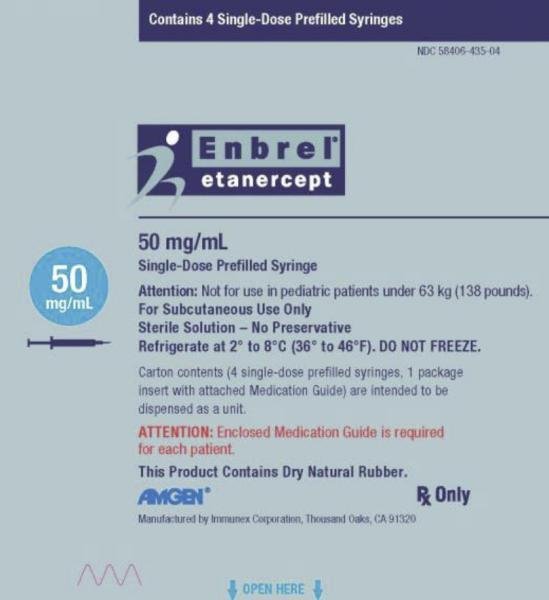
Etanercept Dosage
Medically reviewed by Drugs.com. Last updated on Mar 5, 2024.
Applies to the following strengths: 25 mg; 25 mg/0.5 mL; 50 mg/mL
Usual Adult Dose for:
Usual Pediatric Dose for:
Additional dosage information:
Usual Adult Dose for Ankylosing Spondylitis
50 mg subcutaneously once a week
Comments:
- Methotrexate, glucocorticoids, salicylates, nonsteroidal anti-inflammatory drugs (NSAIDs), or analgesics may be continued during therapy with this drug.
- Doses higher than 50 mg per week are not recommended.
Uses:
- Rheumatoid arthritis (RA): To reduce symptoms, inducing major clinical response, inhibiting the progression of structural damage, and improving physical function in patients with moderately to severely active RA; this drug can be used alone or in combination with methotrexate (MTX)
- Ankylosing spondylitis (AS): To reduce symptoms in patients with active AS
- Psoriatic arthritis (PsA): To reduce symptoms, inhibiting the progression of structural damage of active arthritis, and improving physical function in patients with PsA; this drug can be used alone or in combination with methotrexate (MTX)
Usual Adult Dose for Rheumatoid Arthritis
50 mg subcutaneously once a week
Comments:
- Methotrexate, glucocorticoids, salicylates, nonsteroidal anti-inflammatory drugs (NSAIDs), or analgesics may be continued during therapy with this drug.
- Doses higher than 50 mg per week are not recommended.
Uses:
- Rheumatoid arthritis (RA): To reduce symptoms, inducing major clinical response, inhibiting the progression of structural damage, and improving physical function in patients with moderately to severely active RA; this drug can be used alone or in combination with methotrexate (MTX)
- Ankylosing spondylitis (AS): To reduce symptoms in patients with active AS
- Psoriatic arthritis (PsA): To reduce symptoms, inhibiting the progression of structural damage of active arthritis, and improving physical function in patients with PsA; this drug can be used alone or in combination with methotrexate (MTX)
Usual Adult Dose for Psoriatic Arthritis
50 mg subcutaneously once a week
Comments:
- Methotrexate, glucocorticoids, salicylates, nonsteroidal anti-inflammatory drugs (NSAIDs), or analgesics may be continued during therapy with this drug.
- Doses higher than 50 mg per week are not recommended.
Uses:
- Rheumatoid arthritis (RA): To reduce symptoms, inducing major clinical response, inhibiting the progression of structural damage, and improving physical function in patients with moderately to severely active RA; this drug can be used alone or in combination with methotrexate (MTX)
- Ankylosing spondylitis (AS): To reduce symptoms in patients with active AS
- Psoriatic arthritis (PsA): To reduce symptoms, inhibiting the progression of structural damage of active arthritis, and improving physical function in patients with PsA; this drug can be used alone or in combination with methotrexate (MTX)
Usual Adult Dose for Plaque Psoriasis
50 mg subcutaneously 2 times a week for 3 months (alternatively, starting doses of 25 to 50 mg once a week have been shown to be effective); then 50 mg subcutaneously once a week
Use: For chronic moderate to severe plaque psoriasis (PsO) who are candidates for systemic therapy or phototherapy
Usual Pediatric Dose for Juvenile Idiopathic Arthritis
2 years and older:
- Less than 63 kg: 0.8 mg/kg subcutaneously once a week
- Greater than or equal to 63 kg: 50 mg subcutaneously once a week
- Maximum dose: 50 mg subcutaneously once a week
Comments:
- Glucocorticoids, nonsteroidal anti-inflammatory drugs (NSAIDs), or analgesics may be continued during treatment with this drug.
Use: For reducing symptoms of moderately to severely active polyarticular juvenile idiopathic arthritis (JIA) in patients 2 years and older
Usual Pediatric Dose for Plaque Psoriasis
4 years and older:
- Less than 63 kg: 0.8 mg/kg subcutaneously once a week
- Greater than or equal to 63 kg: 50 mg subcutaneously once a week
- Maximum: 50 mg subcutaneously once a week
Comments:
- Glucocorticoids, nonsteroidal anti-inflammatory drugs (NSAIDs), or analgesics may be continued during treatment with this drug.
Use: For the treatment of patients 4 years and older with chronic moderate to severe plaque psoriasis (PsO) who are candidates for systemic therapy or phototherapy.
Renal Dose Adjustments
Data not available
Liver Dose Adjustments
Data not available
Precautions
US BOXED WARNINGS:
SERIOUS INFECTIONS:
- This drug is associated with an Increased risk of serious infections leading to hospitalization or death, including tuberculosis (TB), bacterial sepsis, invasive fungal infections (such as histoplasmosis), and infections due to other opportunistic pathogens.
- This drug should be discontinued if a patient develops a serious infection or sepsis during therapy.
- A test for latent TB should be performed before starting treatment with this drug. If the test is positive, treatment for TB should be started prior to beginning therapy with this drug.
- All patients should be monitored for active TB during treatment, even if the initial latent TB test is negative.
- Lymphoma and other malignancies, some fatal, have been reported in children and adolescent patients treated with TNF blockers, including this drug.
CONTRAINDICATIONS:
- Patients with, or at risk of, sepsis
- Safety and efficacy for use in polyarticular juvenile idiopathic arthritis has not been established in pediatric patients less than 2 years of age.
- Safety and efficacy for use in plaque psoriasis has not been established in pediatric patients less than 4 years of age.
- Safety and efficacy for use in all other indications has not been established in pediatric patients less than 18 years of age.
Consult WARNINGS section for additional precautions.
Dialysis
Data not available
Other Comments
Administration advice:
- This drug may be injected into the thigh, abdomen or upper arm, at least 3 cm from an old site and not where the skin is tender, bruised, red, or hard.
- Injection sites should be rotated.
- Patients should be instructed and assessed on self-administration techniques and the importance of proper syringe and needle disposal if they are to self-administer.
- Prefilled syringes and auto-injector should be allowed to reach room temperature prior to injection.
Storage requirements:
- Consult the manufacturer product information.
Reconstitution/preparation techniques:
- Consult the manufacturer product information.
Monitoring:
- Infections: Patients should be evaluated before, during, and after treatment.
- Full blood counts should be obtained in patients with a history of blood dyscrasias or symptoms suggestive of blood dyscrasias.
- Periodic skin examinations should be performed in all patients at an increased risk for skin cancer.
- Blood glucose levels should be monitored in diabetic patients.
General:
- Therapy should be initiated and supervised by specialist physicians experienced in the diagnosis and treatment of rheumatoid arthritis, juvenile idiopathic arthritis, psoriatic arthritis, ankylosing spondylitis, non-radiographic axial spondyloarthritis, plaque psoriasis or pediatric plaque psoriasis.
- This drug may be used in combination with methotrexate if necessary. No apparent interactions have been documented with concurrent use of glucocorticoids, nonsteroidal anti-inflammatory agents, or analgesics.
- Patients should be instructed to call their doctor immediately if they develop symptoms such as persistent fever, bruising, bleeding, or paleness.
- If possible, pediatric patients should be up to date with all immunizations prior to commencing therapy.
- Patients exposed to the varicella virus should temporarily stop therapy and be considered for prophylactic varicella zoster immune globulin therapy.
Frequently asked questions
- Does perispinal etanercept work for stroke recovery?
- What are the new drugs for rheumatoid arthritis (RA)?
- How long does it take for Enbrel (etanercept) to work?
- How long can Enbrel (etanercept) be left unrefrigerated?
- Can Enbrel (etanercept) be taken with antibiotics?
- Can you take Enbrel (etanercept) with a cold?
- What are the new drugs for plaque psoriasis?
- How many biosimilars have been approved in the United States?
- What is a biologic drug?
More about etanercept
- Check interactions
- Compare alternatives
- Reviews (321)
- Side effects
- During pregnancy
- Support group
- Drug class: antirheumatics
- Breastfeeding
Patient resources
- Etanercept drug information
- Etanercept-szzs (Advanced Reading)
- Etanercept-ykro (Advanced Reading)
- Etanercept Auto-Injectors
- Etanercept Prefilled Syringes
Other brands
Professional resources
Other brands
Related treatment guides
Further information
Always consult your healthcare provider to ensure the information displayed on this page applies to your personal circumstances.