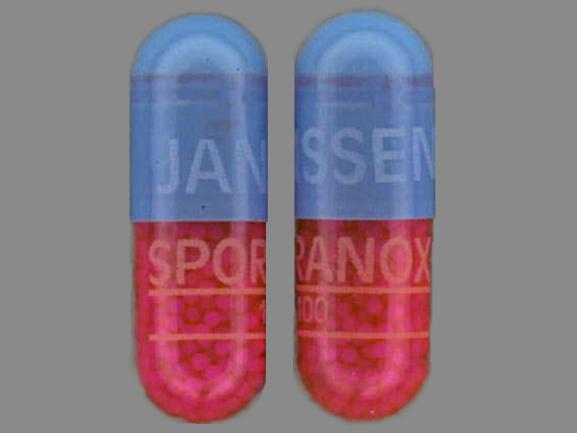
Sporanox Disease Interactions
There are 7 disease interactions with Sporanox (itraconazole).
Itraconazole (applies to Sporanox) CHF
Major Potential Hazard, High plausibility. Applicable conditions: Renal Dysfunction, Fluid Retention, Heart Disease, Chronic Obstructive Pulmonary Disease
Itraconazole may possess a dose-related negative inotropic effect. Transient, asymptomatic decreases in left ventricular ejection fraction were observed with IV administration in healthy volunteers; these resolved before the next infusion. Additionally, cases of congestive heart failure (CHF), peripheral edema, and pulmonary edema have been reported during postmarketing experience in patients treated for onychomycosis and/or systemic fungal infections. Itraconazole should not be used to treat onychomycosis in patients with evidence of ventricular dysfunction such as CHF or history of CHF; itraconazole should not be used for other indications in such patients unless the benefit clearly outweighs the risk. The risks and benefits of itraconazole therapy should be reviewed carefully in patients with risk factors for CHF (including cardiac disease [e.g., ischemic and valvular disease], significant pulmonary disease [e.g., chronic obstructive pulmonary disease], renal failure and other edematous disorders). Patients with risk factors for CHF should be advised of the signs/symptoms of CHF, treated with caution, and monitored for signs/symptoms of CHF during therapy.
Itraconazole (applies to Sporanox) hepatotoxicity
Major Potential Hazard, Moderate plausibility. Applicable conditions: Liver Disease
Limited data are available on the use of oral itraconazole in patients with liver dysfunction. Itraconazole has been associated with rare cases of serious hepatotoxicity (including liver failure and death). Caution is recommended when this drug is used in patients with liver dysfunction; such patients should be carefully monitored during therapy. Treatment with itraconazole is strongly discouraged in patients with elevated or abnormal liver enzymes, with active liver disease, or who had liver toxicity with other drugs unless the situation is serious or life-threatening and the expected benefit exceeds the risk. Liver function monitoring is recommended for patients with preexisting hepatic function abnormalities or those who had liver toxicity with other drugs.
Azole antifungals (applies to Sporanox) QT prolongation
Moderate Potential Hazard, Moderate plausibility. Applicable conditions: Arrhythmias
Some azole antifungals have been associated with prolongation of the QT interval on the ECG. Rare cases of QT prolongation and torsade de pointes have been reported during postmarketing experience; such reports usually involved seriously ill patients with multiple confounding risk factors, such as structural heart disease, electrolyte abnormalities, and concomitant medications. These drugs should be administered with caution to patients with potentially proarrhythmic conditions, such as congenital/acquired QT prolongation, cardiomyopathy (especially when heart failure is present), sinus bradycardia, and existing symptomatic arrhythmias. Concomitant use with other medications that have potential to increase the risk of cardiotoxicity should be avoided.
Itraconazole (applies to Sporanox) achlorhydria
Moderate Potential Hazard, High plausibility.
Itraconazole 100-mg capsules should be administered after a full meal. Under fasted conditions, absorption of itraconazole from the 100-mg capsule formulation was diminished with decreased gastric acidity. Studies conducted under fasted conditions showed that taking the 100-mg capsule formulation with 8 ounces of a non-diet cola beverage enhanced absorption of itraconazole in AIDS patients with relative or absolute achlorhydria; this increase relative to the effects of a full meal is unknown.
Itraconazole (applies to Sporanox) cystic fibrosis
Moderate Potential Hazard, Moderate plausibility.
In a study using itraconazole oral solution in cystic fibrosis patients, therapeutic drug levels varied and were not reached in some patients. Alternative therapy should be considered for patients who do not respond to itraconazole oral solution or itraconazole 100-mg capsules.
Itraconazole (applies to Sporanox) immunodeficiency
Moderate Potential Hazard, Moderate plausibility. Applicable conditions: Neutropenia, Organ Transplant
The oral bioavailability of itraconazole 100-mg capsules may be decreased in some immunocompromised patients (e.g., neutropenic patients, AIDS patients, organ transplant recipients); in addition, since hypochlorhydria has been reported in HIV-infected patients, the absorption of itraconazole may be reduced in these patients. The dose of itraconazole 100-mg capsules should be adjusted based on the clinical response of such patients.
Itraconazole oral solution is not recommended for initial treatment in severely neutropenic patients at immediate risk of systemic candidiasis.
Itraconazole (applies to Sporanox) renal dysfunction
Moderate Potential Hazard, Moderate plausibility.
Limited data are available on the use of oral itraconazole in patients with renal dysfunction; itraconazole exposure may be lower in some of these patients. Caution is advised when using itraconazole in patients with renal dysfunction and dose adjustment may be needed. Patients with renal dysfunction should be carefully monitored when using the 65-mg capsule formulation.
Sporanox drug interactions
There are 539 drug interactions with Sporanox (itraconazole).
Sporanox alcohol/food interactions
There is 1 alcohol/food interaction with Sporanox (itraconazole).
Report options

More about Sporanox (itraconazole)
- Sporanox consumer information
- Check interactions
- Compare alternatives
- Pricing & coupons
- Reviews (18)
- Drug images
- Side effects
- Dosage information
- During pregnancy
- Generic availability
- Drug class: azole antifungals
- Breastfeeding
- En español
Related treatment guides
Drug Interaction Classification
| Highly clinically significant. Avoid combinations; the risk of the interaction outweighs the benefit. | |
| Moderately clinically significant. Usually avoid combinations; use it only under special circumstances. | |
| Minimally clinically significant. Minimize risk; assess risk and consider an alternative drug, take steps to circumvent the interaction risk and/or institute a monitoring plan. | |
| No interaction information available. |
Further information
Always consult your healthcare provider to ensure the information displayed on this page applies to your personal circumstances.