
Pulmonary Fibrosis
Medically reviewed by Drugs.com. Last updated on Aug 4, 2025.
Pulmonary fibrosis is the scarring of your lung tissues over time. It is also called interstitial lung disease. The air sacs and tissues in your lungs swell, scars form, and the tissues become thick and stiff. This affects how much oxygen you get and makes it hard to breathe.
 |
WHILE YOU ARE HERE:
Informed consent
is a legal document that explains the tests, treatments, or procedures that you may need. Informed consent means you understand what will be done and can make decisions about what you want. You give your permission when you sign the consent form. You can have someone sign this form for you if you are not able to sign it. You have the right to understand your medical care in words you know. Before you sign the consent form, understand the risks and benefits of what will be done. Make sure all your questions are answered.
You may need extra oxygen
if your blood oxygen level is lower than it should be. You may get oxygen through a mask placed over your nose and mouth or through small tubes placed in your nostrils. Ask your healthcare provider before you take off the mask or oxygen tubing.
Pulse oximeter:
A pulse oximeter is a device that measures the amount of oxygen in your blood. A cord with a clip or sticky strip is placed on your finger, ear, or toe. The other end of the cord is hooked to a machine that records the oxygen level.
Medicines:
Steroid medicine will help open your air passages so you can breathe easier.
Tests:
- Arterial blood gases (ABGs) are done to test your blood for the amount of oxygen and carbon dioxide. The results can tell healthcare providers how well your lungs are working.
- Blood tests may show damage to your organs from a lack of oxygen.
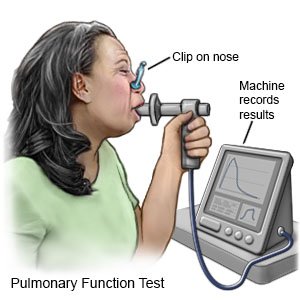
- Pulmonary function tests (PFTs) will show how much oxygen your body is getting. You breathe into a mouthpiece connected to a machine. The machine measures how much air you breathe in and out over a certain amount of time.
- CT scan pictures of your lungs may show tissue damage. You may be given contrast liquid before the pictures are taken to help healthcare providers see your lungs better. Tell the healthcare provider if you have ever had an allergic reaction to contrast liquid.
- An echocardiogram is a type of ultrasound used to check for high blood pressure in your lungs and heart. It may also show damage to your heart tissue.
- A bronchoscopy is a procedure to look inside your airway. A bronchoscope (thin tube with a light) is inserted into your mouth and moved down your throat to your airway. You may be given medicine to numb your throat and help you relax during the procedure. Tissue and fluid may be collected from your airway or lungs to be tested.
- A sample of lung tissue may be sent to a lab for tests. The sample may be taken during a bronchoscopy, through surgery, or frozen and removed through a procedure called cryobiopsy.
Treatment:
- Surgery may be needed if you have severe trouble breathing. You may need part of your lung removed or a lung transplant.
- A ventilator is a machine that gives you oxygen and breathes for you when you cannot breathe well on your own. An endotracheal (ET) tube is put into your mouth or nose and attached to the ventilator. You may need a trach if an ET tube cannot be placed. A trach is a tube put through an incision and into your windpipe.
Treatment options
The following list of medications are related to or used in the treatment of this condition.
RISKS:
Even with treatment, your condition may get worse. You may develop a lung infection. You may break a rib because of strong, long-term coughing. High pressure in your lungs can cause holes or air leaks. You may also have high pressure in your heart, which can damage it. Your lungs may fail. This can be life-threatening.
CARE AGREEMENT:
You have the right to help plan your care. Learn about your health condition and how it may be treated. Discuss treatment options with your healthcare providers to decide what care you want to receive. You always have the right to refuse treatment.© Copyright Merative 2025 Information is for End User's use only and may not be sold, redistributed or otherwise used for commercial purposes.
The above information is an educational aid only. It is not intended as medical advice for individual conditions or treatments. Talk to your doctor, nurse or pharmacist before following any medical regimen to see if it is safe and effective for you.
Learn more about Pulmonary Fibrosis
Treatment options
Care guides
Further information
Always consult your healthcare provider to ensure the information displayed on this page applies to your personal circumstances.