Open Splenectomy
WHAT YOU SHOULD KNOW:
Open Splenectomy (Inpatient Care) Care Guide
- Open Splenectomy Aftercare Instructions
- Open Splenectomy Discharge Care
- Open Splenectomy Inpatient Care
- Open Splenectomy Precare
- En Espanol
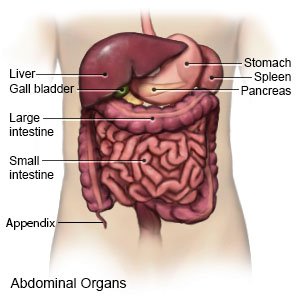
- Open splenectomy is surgery to take out all or a part of your spleen. The spleen is a bean-shaped organ found under the ribs on the left upper side of your abdomen (stomach). As blood passes through the spleen, old and damaged blood cells are removed. The spleen also makes immune system cells called lymphocytes, which help fight germs and infections. You may need an open splenectomy when your spleen is damaged by blood diseases, infections, or injury. Cysts (sacs filled with fluids) and tumors may also damage the spleen and prevent the production of new lymphocytes. A damaged spleen can swell and block the flow of blood in your abdomen. This may cause problems in the other organs of your body, such as the liver. Open splenectomy can help stop the destruction of blood cells and restore normal blood flow.

- You will have this procedure done before your condition gets worse or when symptoms appear. It is done through a large incision (cut) through the abdomen above the spleen. In some cases, you may start with a procedure called laparoscopic splenectomy (LS), but then have an open splenectomy. LS is a procedure that uses several small incisions and special instruments, such as a laparoscope, to remove your spleen. You may have an open splenectomy if your caregiver finds he cannot do the procedure with the smaller incisions and tools of LS. With open splenectomy, your symptoms may be relieved and further damage to other organs prevented.
CARE AGREEMENT:
You have the right to help plan your care. Learn about your health condition and how it may be treated. Discuss treatment options with your caregivers to decide what care you want to receive. You always have the right to refuse treatment.
RISKS:
- You may have trouble breathing, or get pneumonia after having an open splenectomy. Nerves, blood vessels, muscles, and other organs near the spleen may be damaged. Surgical risks of infection or bleeding too much are higher with this surgery and may be life-threatening. Even after a successful surgery, your symptoms may not disappear at once. If your spleen is completely removed, you will always have a higher risk of getting infections from bacteria.
- You may get a blood clot in your leg or arm. This can cause pain and swelling, and it can stop blood from flowing where it needs to go in your body. The blood clot can break loose and travel to your lungs. A blood clot in your lungs can cause chest pain and trouble breathing. This problem can be life-threatening.
- If left untreated, your spleen can continue to swell and block normal blood flow in your abdomen. The spleen may continue destroying normal blood cells and damaging organs, such as your liver. The immune system cells that fight infection (lymphocytes) are also destroyed. This can make you get sick very easily, and make you feel very weak and dizzy. Your spleen may also burst and cause hemorrhage (very bad bleeding), which can cause death. Call your caregiver if you are worried or have questions about your condition, treatment, or care.
WHILE YOU ARE HERE:
Before your surgery:
- Informed consent is a legal document that explains the tests, treatments, or procedures that you may need. Informed consent means you understand what will be done and can make decisions about what you want. You give your permission when you sign the consent form. You can have someone sign this form for you if you are not able to sign it. You have the right to understand your medical care in words you know. Before you sign the consent form, understand the risks and benefits of what will be done. Make sure all your questions are answered.
- Pre-op care: You may be given medicine right before your procedure or surgery. This medicine may make you feel relaxed and sleepy. You are taken on a stretcher to the room where your procedure or surgery will be done, and then you are moved to a table or bed.
- An IV (intravenous) is a small tube placed in your vein that is used to give you medicine or liquids.
- Monitoring:
- Heart monitor: This is also called an ECG or EKG. Sticky pads placed on your skin record your heart's electrical activity.
- Pulse oximeter: A pulse oximeter is a device that measures the amount of oxygen in your blood. A cord with a clip or sticky strip is placed on your finger, ear, or toe. The other end of the cord is hooked to a machine. Never turn the pulse oximeter or alarm off. An alarm will sound if your oxygen level is low or cannot be read.
- Vital signs: Caregivers will check your blood pressure, heart rate, breathing rate, and temperature. They will also ask about your pain. These vital signs give caregivers information about your current health.
- Heart monitor: This is also called an ECG or EKG. Sticky pads placed on your skin record your heart's electrical activity.
- General anesthesia: Caregivers use this medicine to keep you asleep and free from pain during surgery. They give you anesthesia through your IV or as a gas. You may breathe in the gas through a mask or through a breathing tube placed down your throat. The tube may cause you to have a sore throat when you wake up.
- Tests:
- Blood tests: You may need blood taken to give caregivers information about how your body is working. The blood may be taken from your hand, arm, or IV.
- Computerized tomography scan: This is also called a CT or CAT scan. An x-ray machine uses a computer to take pictures of your abdomen to look for problems and abnormal changes.
- Magnetic resonance imaging: This is also called an MRI. During the MRI, pictures of your abdomen are taken. An MRI may be used to check around your spleen for other problems.
- X-rays: Before surgery, caregivers may want to have an x-ray (picture) of your abdomen to see any other problems.
- Blood tests: You may need blood taken to give caregivers information about how your body is working. The blood may be taken from your hand, arm, or IV.
During your surgery:
After you go to sleep, your body will be moved into position for your surgery. Your skin is cleaned with soap and water and covered with sheets. An incision (cut) is made in your abdomen to reach the spleen. Once it is seen, the blood vessels attached to it are tied off and cut. The spleen is removed by carefully cutting tissues covering and attached to it. Your caregiver may also remove only the damaged part of your spleen. Bleeding blood vessels are tied, and the other organs near the spleen are checked. Your caregiver may place a drain (small tube) to let fluid flow out from your abdomen. The incision is closed with sutures (stitches) and covered with a bandage.
After your surgery:
You may be taken to a recovery room, where you will stay until you are fully awake. Caregivers will watch you closely for problems. Do not attempt to get out of bed until your caregiver says it is okay. When caregivers see that you are okay, you will be taken back to your hospital room. The bandages covering your incision keep the area clean and dry to prevent infection. A caregiver may remove the bandages soon after your surgery to check your incision.
- Activity: You may need to walk around the same day of surgery, or the day after. Movement will help prevent blood clots. You may also be given exercises to do in bed. Do not get out of bed on your own until your caregiver says you can. Talk to caregivers before you get up the first time. They may need to help you stand up safely. When you are able to get up on your own, sit or lie down right away if you feel weak or dizzy. Then press the call light button to let caregivers know you need help.
- Deep breathing and coughing: This will help decrease your risk for a lung infection after surgery.
- Hold a pillow tightly against your incision when you cough to help decrease pain. Take a deep breath and hold it for as long as you can. Deep breaths help open your airways. Let the air out and follow with a strong cough. Spit out any mucus you cough up. Repeat the steps 10 times every hour.
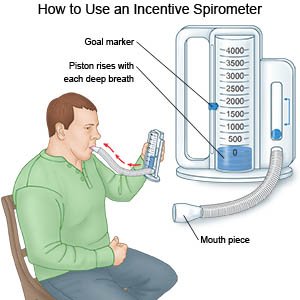
- You may be given an incentive spirometer to help you take deep breaths. Put the plastic piece into your mouth and take a slow, deep breath. Let out your breath and cough. Repeat the steps 10 times every hour.
- Hold a pillow tightly against your incision when you cough to help decrease pain. Take a deep breath and hold it for as long as you can. Deep breaths help open your airways. Let the air out and follow with a strong cough. Spit out any mucus you cough up. Repeat the steps 10 times every hour.
- Food and drink after surgery: You will be able to drink liquids and eat certain foods once your stomach function returns after surgery. You may be given ice chips at first. Then you will get liquids such as water, broth, juice, and clear soft drinks. If your stomach does not become upset, you may then be given soft foods, such as ice cream and applesauce. Once you can eat soft foods easily, you may slowly begin to eat solid foods.
- Drains: These are thin rubber tubes put into your skin to drain fluid from around your incision. The drains are taken out when the incision stops draining.
- Medicines: You may be given the following medicines:
- Antibiotics: This medicine is given to help treat or prevent an infection caused by bacteria.
- Antinausea medicine: This medicine may be given to calm your stomach and to help prevent vomiting.
- Medicines to treat pain, swelling, or fever: These medicines are safe for most people to use. However, they can cause serious problems when used by people with certain medical conditions. Tell caregivers if you have liver or kidney disease or a history of bleeding in your stomach.
- Stool softeners: This medicine makes it easier for you to have a bowel movement. You may need this medicine to treat or prevent constipation.
- Antibiotics: This medicine is given to help treat or prevent an infection caused by bacteria.
© 2013 Truven Health Analytics Inc. Information is for End User's use only and may not be sold, redistributed or otherwise used for commercial purposes. All illustrations and images included in CareNotes® are the copyrighted property of the Blausen Databases or Truven Health Analytics.
The above information is an educational aid only. It is not intended as medical advice for individual conditions or treatments. Talk to your doctor, nurse or pharmacist before following any medical regimen to see if it is safe and effective for you.