Consumer Information
Carenotes > Mmr Vaccine

Mmr Vaccine

Advertisement

GENERAL INFORMATION:

What is the MMR vaccine? The MMR vaccine is a combined shot of medicine that helps prevent M easles, M umps, and R ubella. These three diseases are common childhood infections caused by three different viruses (germs).

  • Measles: Measles, also known as rubeola, causes skin rashes to appear in the head and upper neck. The skin rashes slowly spread down into the hands and feet. Measles can lead to ear infections, pneumonia (lung infection and swelling), seizures (convulsions), brain damage, and even death.

  • Mumps: The mumps virus infects many parts of the body and usually causes inflammation (swelling) of the parotid glands. These glands make saliva and are found in the cheeks, in the area between the ear and jaw. Mumps can lead to hearing problems, meningitis (swelling of the brain covering), or orchitis (swelling of the testicles).

  • Rubella: Rubella, also called German measles, causes skin rashes that usually starts in the face. The skin rashes spread down to the chest, abdomen (stomach), back, and then to the arms and legs. Pregnant women who get rubella could have a miscarriage or the baby could be born with serious birth defects. These include deafness (loss of hearing) or having eye, heart, or learning problems.

How does the MMR vaccine work?

  • The MMR vaccine helps decrease your risk of becoming infected with measles, mumps, and rubella. Vaccines work by causing your body to make antibodies against certain germs. Antibodies are special cells in your blood that protect the body and fight infection. After you receive the MMR vaccine, these antibodies remember the MMR germs. Once you are exposed to these types of germs, your body quickly recognizes them. The antibodies become active and your body is better able to fight the germs.

  • The vaccine is made from live MMR germs that are weakened. It is injected into subcutaneous (fatty) tissue, and is usually given in the upper arm. This may be given as a single MMR vaccine or combined with other vaccines. In very few cases, the vaccine can cause actual infection to the patient. Ask your caregiver for more information on the types of MMR vaccine that may be given.

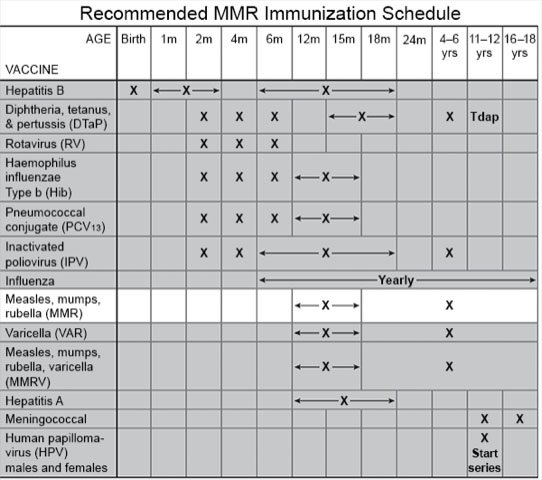
Who should get the MMR vaccine? Children one year old and older may begin to receive the MMR vaccine. Adults (18 years of age and above) born in 1957 and later should receive at least one dose of the MMR vaccine.

When should the MMR vaccine be given? The number and schedule (time) of the MMR vaccine doses will depend on the person’s age. The schedule may also depend whether previous shots have been received. MMR vaccine may be given at the same time as other vaccines.

  • Children: The first dose of the MMR vaccine should be given on or after the first birthday. The second dose is usually given at 4 to 6 years of age, before a child enters kindergarten or primary school. The second dose may also be given any time after 28 days from the first dose.

  • Adults: At least one dose may be given to adults who have never received the vaccine or had MMR infections. The second dose may be needed by those at a higher risk of getting measles, mumps, or rubella. The following are likely to be exposed to these viruses or a have a higher risk of getting an infection:

    • College students.

    • Health caregivers who may treat or are in close contact with those who have measles, mumps, or rubella.

    • People who are in or traveling to areas where measles, mumps, or rubella is common or there is an outbreak.

    • Those who have been vaccinated with killed measles vaccine or with an unknown type of measles vaccine during 1963 to 1967.

What if a child missed a shot of the MMR vaccine? If a child misses a scheduled dose of the MMR vaccine, the rest of the recommended doses should be completed. The schedule is continued from the last dose as soon as possible. Those children who have not received the second dose should complete the MMR vaccine schedule by 11 to 12 years of age. Ask your child's caregiver what to do if a dose of the MMR vaccine is missed.

Who should not get the MMR vaccine? MMR vaccine should not be given if there is a high risk of the vaccine causing bad effects. People may not get the MMR vaccine at all or may need to receive the vaccine at a later date. Children who have asthma or have had a severe allergic reaction to eggs may need to be vaccinated in the hospital. Caregivers may consider any of the following before giving the MMR vaccine:

  • MMR vaccine should not be given if a person has a life-threatening allergy to any of the following:

    • Antibiotic medicine, especially neomycin.

    • Gelatin.

    • Previous shot of the MMR vaccine.

  • Receiving the MMR vaccine may be delayed in the following:

    • Children who are less than one year old.

    • Being moderately or severely (badly) ill with or without fever. Your caregiver may wait until your condition improves.

    • Pregnant women should wait to get the vaccine until after giving birth. Those who are trying to get pregnant should also delay their shot. Women should not get pregnant for one month after getting the vaccine.

  • Ask caregivers whether you should get the MMR vaccine if you:

    • Are being treated with medicine that affects the immune system, such as steroids.

    • Have diseases that weaken the immune system. The immune system is the part of our bodies that normally fights off sickness and disease. A weak immune system may be caused by cancer, HIV or AIDS, or an inborn immune deficiency.

    • Have an untreated, active tuberculosis (TB) or history of blood problems, particularly thrombocytopenia.

    • Have received antibody-containing blood products during the past 3 to 11 months.

What are the risks of getting the MMR vaccine? As with any medicine, this vaccine has some risks. You may have fever, mild rash, or swollen glands in the cheeks or neck after receiving the vaccine. Two to three weeks after vaccination, you may also have pain, redness, or swelling of the joints. The MMR vaccine may also decrease the platelet count and cause bleeding problems. The area where the injection was given may develop swelling, tenderness, or infection. As with any vaccine, there is a very small chance that it could cause serious harm or death.

What are the signs and symptoms of a serious reaction to the MMR vaccine? A serious allergic reaction may have any of the following signs and symptoms:

  • Hives (red, itchy bumps with burning feeling on the skin) that have spread all over the body.

  • Loss of consciousness.

  • Redness or swelling of the face.

  • Swelling of the mouth and throat.

  • Weakness, dizziness, or a fast heartbeat.

  • Wheezing or trouble breathing.

What should I do if I develop a serious reaction to the MMR vaccine?

  • If you develop signs and symptoms of a serious reaction, seek medical care immediately . If you are having an allergic reaction, lie down with your legs up and have someone drive you to the nearest hospital or call 911. Make sure you tell the caregivers that you received the MMR vaccine. Tell them the date and time it was given. Ask your caregiver to put in a Vaccine Adverse Event Report or contact the following:
    • Vaccine Adverse Event Report
      Center for Biologics Evaluation and Research
      1401 Rockville Pike, Ste 200N
      Rockville, MD 20852-1448
      Phone: 1-800-835-4709
      Web Address: www.fda.gov/cber/vaers/vaers.htm


  • If you were injured after receiving the MMR vaccine, you may file a claim to the National Vaccine Injury Compensation Program . This is a federal program that helps pay for the care of anyone seriously injured or harmed by a vaccine. Contact information:
    • Health Resources and Services Administration National Vaccine Injury Compensation Program
      Parklawn Building, Room 11C-26, 5600 Fishers Lane
      Rockville , MD 20857
      Phone: 1-800-338-2382
      Web Address: http://www.hrsa.gov/vaccinecompensation/

Where can I get more information on the MMR vaccine?

  • The National Immunization Program Public Inquiries
    1600 Clifton Road, Mailstop E-05
    Atlanta, GA 30333
    Phone: 1-800-232-4636
    Web Address: http://www.cdc.gov/vaccines/
  • American Academy of Family Physicians
    PO Box 11210
    Shawnee Mission, KS 66207-1210
    Phone: 1-913-906-6000
    Web Address: http://www.aafp.org
  • American Academy of Pediatrics
    141 Northwest Point Boulevard
    Elk Grove Village, IL 60007-1098
    Phone: 1-847-434-4000
    Web Address: http://www.aap.org

CARE AGREEMENT:

You have the right to help plan your care. To help with this plan, you must learn about your health condition and how it may be treated. You can then discuss treatment options with your caregivers. Work with them to decide what care may be used to treat you. You always have the right to refuse treatment.

Copyright © 2008 Thomson Healthcare Inc. All rights reserved. Information is for End User's use only and may not be sold, redistributed or otherwise used for commercial purposes.

The above information is an educational aid only. It is not intended as medical advice for individual conditions or treatments. Talk to your doctor, nurse or pharmacist before following any medical regimen to see if it is safe and effective for you.


MedNotes
Advertisement

(web1)