Lay Person Cpr On Infants
GENERAL INFORMATION:
What is lay person CPR for infants?
- CPR is also called cardiopulmonary resuscitation. CPR is used when a person stops breathing and his heart has stopped beating. Infant CPR should be used on children who are about one year old and younger. "Lay person" refers to anyone who is not a trained healthcare worker. If you start CPR early and do it correctly, you may be able to save someone from dying. Practice the steps of CPR and know them well.
- Rescue breathing means breathing into the mouth, nose, or both of an infant who is unable to breathe well enough on his own. A chest compression is the placement of pressure on and off the chest of an infant with your fingers. A compression presses the heart between the spine (backbone) and sternum (breastbone). This forces blood out of the heart and into the rest of the body. Chest compressions done with rescue breathing is called CPR.
Why might an infant need CPR?
- SIDS (Sudden Infant Death Syndrome).
- Foreign body airway obstruction (an object blocking the airway), suffocation, or strangulation.
- Drowning.
- Injuries.
- Poisoning.
- Infection.
- Heart disease, brain disease or medical conditions that affect breathing.
What can I do to help prevent respiratory and cardiac arrest in children?
- Foreign body airway obstruction: Do not leave small objects around that your child can pick up and put in his mouth. Examples include batteries, coins, marbles, buttons, balloons and small toys or toy parts. A good rule is to not allow your child near anything small enough to fit through a toilet paper roll. Airway obstruction can also be caused by foods such as hot dogs, grapes, nuts, popcorn and hard candy.
- Suffocation: Do not leave plastic bags within reach of a child. Children tend to put plastic bags over their heads, making them unable to breathe.
- Strangulation: Keep drapery and extension cords out of the your child's reach. Do not put any type of cord or string around a child's neck. Examples include cords or strings with pacifiers or jewelry attached to them.
- Drowning: Do not leave your child alone in or near water. This includes a pool, bathtub or pail of water.
- Car Safety:
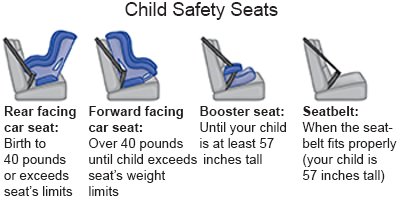
- Keep your child secured in a car safety seat while driving. Ask your caregiver for more information on car safety seats.
- Never leave your child in a car alone, especially when the windows are rolled up.
- Do not drive if you have been drinking alcohol, taken illegal drugs or medicines that make you sleepy.
- Keep your child secured in a car safety seat while driving. Ask your caregiver for more information on car safety seats.
- Falls: Do not leave your child alone on a high surface from which he may fall, such as a changing table. Use toddler gates at the top of stairs. Watch children while they play on playgrounds.
- Gun injuries: If you must keep guns in the house, store them out of your child's reach. All guns should have a safety lock on them, be locked up out of reach of your child, and be kept unloaded. Store and lock all bullets in a place out of reach, and different from where the gun is locked.
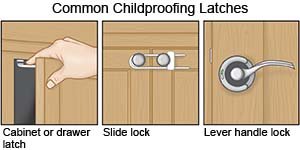
- Poisoning: Keep cleaning supplies and other harmful products out of your child's reach and locked up tightly.
What should I do if I find an infant who may need help? When you find an infant who is unresponsive (does not speak or move when spoken to), follow these steps:
- Make sure the area is safe to enter, and approach the infant. Move the infant only if the area is dangerous.
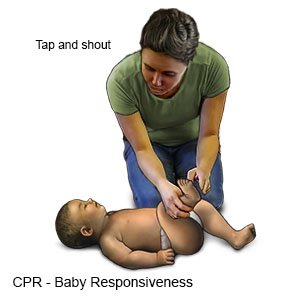
- Find out if the infant is OK. Tap his shoulder, speak to him, and look for a response such as moving or crying.
- If the infant responds, call 911 immediately, send someone to call for help, or call from a cell phone. If you leave the infant to call, return as soon as possible and stay with him until help arrives. Allow the infant to move into a position that he chooses. Check often to see if the infant is having trouble breathing or other problems.
- If the infant does not respond and you are alone, shout loudly for help. Begin the steps of CPR and do them for about two minutes. Give two breaths followed immediately with 30 chest compressions. Do breaths followed by compressions five times. After about two minutes or five cycles, call 911 from a cell phone, or leave to call 911. If anyone is nearby, send them to call 911. If the infant is not injured and he is light weight enough to carry, take the infant with you to call 911. Stay on the telephone with the 911 operator until they tell you to hang up.
How do I give CPR to an infant? By following the "ABC's", you can remember the steps to use when giving CPR. The letter A stands for airway, B stands for breathing, and C stands for circulation.
- A irway:
- Kneel beside the infant and look at him to check if his head, neck, or back may be hurt. Carefully turn the infant onto his back, while supporting his head and neck. Keep the child's body in a straight line (with no twisting) as you turn him onto his back. If there are no signs of injury and the infant is on a soft surface, carefully move him to a hard surface such as a table or the floor.
- Open the airway by gently tilting the head back and lifting the chin. Look into the child's mouth. Check for something blocking the airway, such as food or a small toy. If you see something that appears easy to grab, scoop it out with your finger.
- Kneel beside the infant and look at him to check if his head, neck, or back may be hurt. Carefully turn the infant onto his back, while supporting his head and neck. Keep the child's body in a straight line (with no twisting) as you turn him onto his back. If there are no signs of injury and the infant is on a soft surface, carefully move him to a hard surface such as a table or the floor.
- B reathing:
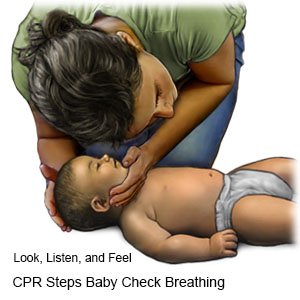
- Check for breathing: Look, listen and feel for breathing while keeping the airway open. Look at the infant's chest and abdomen (belly) to see if they go up and down with breathing. Listen near the infant's nose and mouth for breath sounds. Feel for movement of air from the infant's mouth by putting your face close to his face. Take only 10 seconds or less to check for breathing.
- If the infant is breathing on his own and there are no signs of head or neck injury, carefully turn him on his side. Support the head and neck as you turn the child onto his side. Position his lower arm to rest in front of his body. This is called the recovery position. It may help to keep the infant from choking if he throws up. If there are signs of head or neck injury, leave the infant on his back. Hold the airway open by tilting his head and lifting his chin slightly. Wait for caregivers to arrive.
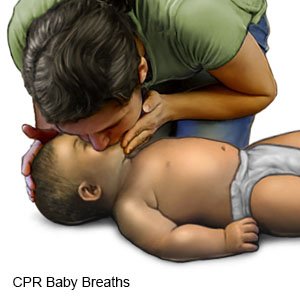
- If the child is not breathing, you should begin CPR: Begin by giving two breaths to the infant.
- Keep the airway open by keeping the head slightly tilted and the chin lifted. Take a breath for yourself. Place your mouth over both the mouth and the nose of the infant. This stops air from escaping from the nose. Try to make an airtight seal with your mouth. If your mouth is too small to cover the infant's mouth and nose, cover the infant's nose with your mouth. Close the infant's mouth so that air does not escape through it. You can also try covering the infant's mouth with your mouth. In this case, pinch the infant's nose closed.
- Give two breaths (about one second for each breath). Do not give very large breaths, or breathe hard or fast. Take a normal breath for yourself after giving each breath. If you do not see the child's chest rising with each breath, the airway may not be open. Gently move the child's head to open the airway and try to breathe for him again. If you still cannot get air into the child, the airway may be blocked by something such as food. Look into the child's mouth for something that may be blocking the airway. If you see something that would be easy to remove, carefully scoop it out with your finger.
- If you carry a special mask or device for giving breaths during CPR and you have it with you, use it. If you do not have it with you, give rescue breaths without it.
- Keep the airway open by keeping the head slightly tilted and the chin lifted. Take a breath for yourself. Place your mouth over both the mouth and the nose of the infant. This stops air from escaping from the nose. Try to make an airtight seal with your mouth. If your mouth is too small to cover the infant's mouth and nose, cover the infant's nose with your mouth. Close the infant's mouth so that air does not escape through it. You can also try covering the infant's mouth with your mouth. In this case, pinch the infant's nose closed.
- Check for breathing: Look, listen and feel for breathing while keeping the airway open. Look at the infant's chest and abdomen (belly) to see if they go up and down with breathing. Listen near the infant's nose and mouth for breath sounds. Feel for movement of air from the infant's mouth by putting your face close to his face. Take only 10 seconds or less to check for breathing.
- C irculation:
- After giving rescue breaths, begin compressions immediately:
- Hand position for chest compressions:
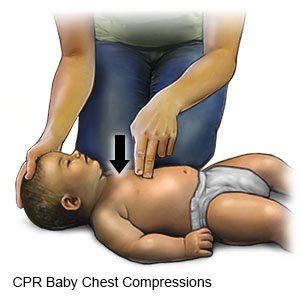
- To find the right place to do compressions, imagine a line between the infant's nipples. At about one finger's width below the nipple line, you will find the area of the sternum where you should do compressions. Place two fingers of one hand in this area to start compressions. Correct hand positioning for chest compressions is important. Incorrect hand positioning can cause injury during compressions.
- Chest compressions:
- With the pads of your fingers, press straight down on the infant's chest one-half to one inch in depth. This should be about one-half to one-third of the depth of the chest. Take pressure off the chest and allow the chest to relax (return to its normal position) between compressions. This is necessary because it allows blood to come back into the heart before you compress again. Leave your fingers in place on the infant's chest between compressions. Keep your other hand on the infant's forehead.
- Do 30 chest compressions at a rate of about 100 every minute (almost two compressions per second). Push hard and push fast. Do not delay or stop the compressions. Count the compressions out loud if that will help you do them at a steady, even speed. Counting may also help you remember how many compressions you have done.
- With the pads of your fingers, press straight down on the infant's chest one-half to one inch in depth. This should be about one-half to one-third of the depth of the chest. Take pressure off the chest and allow the chest to relax (return to its normal position) between compressions. This is necessary because it allows blood to come back into the heart before you compress again. Leave your fingers in place on the infant's chest between compressions. Keep your other hand on the infant's forehead.
- Hand position for chest compressions:
- After giving rescue breaths, begin compressions immediately:
- Putting it all together:
- After 30 compressions, quickly move up to the infant's head. Open his airway by tilting the head and lifting the chin. Give two rescue breaths (about one second for each breath).
- Give 30 compressions and two rescue breaths. Keep doing this until the infant starts to move around or caregivers arrive.
- If the infant begins to respond or move around, stop doing CPR. Carefully turn the infant on his side if there are no signs of head or neck injury. Support the head and neck as you turn the child onto his side. Place his lower arm out in front of him in the recovery position. This position will help prevent choking if the infant throws up. If there are signs of injury, leave the infant on his back and hold the airway open. Stay with him and watch him closely until caregivers arrive.
- After 30 compressions, quickly move up to the infant's head. Open his airway by tilting the head and lifting the chin. Give two rescue breaths (about one second for each breath).
When should I stop doing CPR on an infant?
- When someone else that knows CPR or trained caregivers show up to take over for you.
- If you are exhausted and unable to continue.
- If the scene suddenly becomes unsafe, such as if a fire starts or spreads.
- When the child becomes responsive. He may move around, cry, or make noises.
What else should I know about CPR?
- Do not delay giving CPR. When an infant stops breathing, his heart may continue to beat for several minutes. After that, the heart will not beat, and brain damage is possible. Brain damage happens because there is no oxygen going to the brain. To avoid brain damage, and death in some cases, begin the steps of CPR right away.
- Do chest compressions. The risk of catching a disease or getting sick from giving rescue breaths is very low. If you are unable to, or do not want to give rescue breaths, do chest compressions. Chest compressions alone make it more likely that the infant will live than if you do nothing at all.
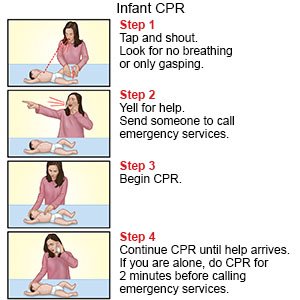
- When giving chest compressions, push hard and push fast. Hard, fast compressions are more likely to keep the infant's brain and heart muscle alive.
Where can I get support and more information? To become a certified CPR provider, you must take classes through an organization such as the following. Never practice CPR on another person if they do not need it. You can seriously hurt someone if you practice CPR on him. Contact the following for more information:
- American Red Cross National Headquarters
2025 E Street NW
Washington, DC 20006
Phone: 1-202-303-4498
Web Address: http://www.redcross.org
- American Heart Association National Center
7272 Greenville Avenue
Dallas, TX 75231-4596
Phone: 1-800-242-8721
Web Address: http://www.americanheart.org
CARE AGREEMENT:
You have the right to help plan your baby's care. To help with this plan, you must learn about your baby's health condition and how it may be treated. You can then discuss treatment options with your baby's caregivers. Work with them to decide what care may be used to treat your baby.
| Link to this page | ![]() |
Printable Version | ![]() |
Email Page |