Laparoscopic Cholecystectomy
WHAT YOU SHOULD KNOW:
Laparoscopic Cholecystectomy (Inpatient Care) Care Guide
- Laparoscopic Cholecystectomy Aftercare Instructions
- Laparoscopic Cholecystectomy Discharge Care
- Laparoscopic Cholecystectomy Inpatient Care
- Laparoscopic Cholecystectomy Precare
- En Espanol
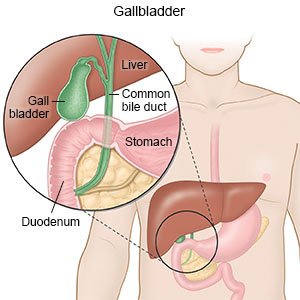
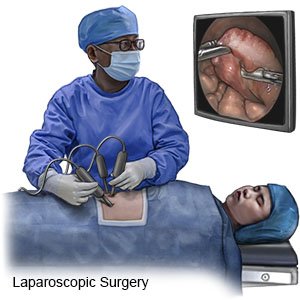
Laparoscopic cholecystectomy is surgery to remove your gallbladder. The gallbladder stores liquid called bile. Bile helps your body digest fat. After surgery, your bile ducts will widen to hold the bile once held by your gallbladder. During the surgery, small incisions are made in your abdomen. Surgical tools and a small scope are inserted through the incisions. A scope is a flexible tube with a light and camera on the end.
CARE AGREEMENT:
You have the right to help plan your care. Learn about your health condition and how it may be treated. Discuss treatment options with your caregivers to decide what care you want to receive. You always have the right to refuse treatment.
RISKS:
- You may have pain in your abdomen and around your incisions. Any carbon dioxide gas that remains in your abdomen can rise and cause neck and shoulder pain. Nausea and vomiting are also common after surgery. There is a small risk that your bile duct, liver, small intestine, or other organs could be damaged during surgery. You could bleed more than expected or get an infection. Bile or bowel movement in your abdomen can cause a severe infection or abscess. Your gallbladder may leak bile and gallstones before it is removed, or bile may leak into your abdomen after surgery. Your pancreas could become inflamed.
- Your surgery incisions may not heal properly and cause a hernia (bulge of tissue). The carbon dioxide could cause your heart to beat too fast or too slow, or cause trouble breathing. You may still have gallstones after surgery, and you may need a different procedure to remove them. During the operation, your laparoscopic surgery may need to be converted to open surgery. This means that a larger incision will be made in your abdomen. There is risk that you could get a blood clot in your leg, which could break loose and travel to your lungs or brain. This can be life-threatening.
WHILE YOU ARE HERE:
Before your surgery:
- Informed consent is a legal document that explains the tests, treatments, or procedures that you may need. Informed consent means you understand what will be done and can make decisions about what you want. You give your permission when you sign the consent form. You can have someone sign this form for you if you are not able to sign it. You have the right to understand your medical care in words you know. Before you sign the consent form, understand the risks and benefits of what will be done. Make sure all your questions are answered.
- Vital signs: Caregivers will check your blood pressure, heart rate, breathing rate, and temperature.
- An IV (intravenous) is a small tube placed in your vein that is used to give you medicine or liquids.
- Antibiotics: You may be given antibiotics to prevent infection.
- Anticoagulants: You may be given this medicine to thin your blood if you are at risk for a blood clot.
- Empty your bladder: You may be asked to urinate just before surgery.
- General anesthesia: Caregivers use this medicine to keep you asleep and free from pain during surgery. They give you anesthesia through your IV or as a gas. You may breathe in the gas through a mask or through a breathing tube placed down your throat. The tube may cause you to have a sore throat when you wake up.
- After the anesthesia has put you to sleep, you may need the following:
- Foley catheter: This is a tube put into your bladder to drain your urine into a bag. When you wake up after surgery, do not move the catheter or pull on it. This may cause pain and bleeding, and the catheter could come out. Caregivers will remove the catheter as soon as possible to help prevent infection.
- Pneumatic boots: Inflatable boots are put on your legs. The boots are connected to an air pump. The pump tightens and loosens different areas of the boots. This helps improve blood flow to prevent clots.
- Nasogastric (NG) tube: An NG tube is put into your nose, and passes down your throat until it reaches your stomach. Food and medicine may be given through an NG tube if you cannot take anything by mouth. The tube may instead be attached to suction if caregivers need to keep your stomach empty.
- Foley catheter: This is a tube put into your bladder to drain your urine into a bag. When you wake up after surgery, do not move the catheter or pull on it. This may cause pain and bleeding, and the catheter could come out. Caregivers will remove the catheter as soon as possible to help prevent infection.
During your surgery:
Your abdomen will be cleaned. The surgeon will make between 1 and 4 small incisions on your abdomen or navel. Each incision will be about ½ inch to 2 inches long (1.25 cm to 5 cm). He will insert the surgical tools and laparoscope into the incisions. The camera attached to the laparoscope will display images of your abdominal organs on a nearby monitor. He will then fill your abdomen with carbon dioxide gas to make it swell. This allows him to see your organs better. It also gives him more room to move the surgical tools and laparoscope around. Your surgeon will search for and remove gallstones in and around your gallbladder. X-rays or ultrasound may be used during surgery to see your abdominal organs better or look for gallstones. Your surgeon will carefully separate your gallbladder and remove it through an incision, usually the navel incision. The carbon dioxide will be released from your abdomen. Your surgeon may inject medicine into your abdomen or incisions to reduce your pain after surgery. Your incisions will be stitched or closed with adhesive strips, then covered with bandages.
After your surgery:
You will be taken to a recovery room until you are fully awake. Caregivers will watch you closely for any problems. Tell your caregiver if you are in pain or feel like you might vomit. Your caregiver may help position you on your left side with your arm behind your back and your leg flexed. This helps release any carbon dioxide gas that remains in your abdomen. Do not get out of bed until your caregiver says it is okay. You may be able to go home later the same day, or you may stay in the hospital overnight.
- Medicines: You may need any of the following:
- Pain medicine: Caregivers may give you medicine to take away or decrease your pain.
- Do not wait until the pain is severe to ask for your medicine. Tell caregivers if your pain does not decrease. The medicine may not work as well at controlling your pain if you wait too long to take it.
- Pain medicine can make you dizzy or sleepy. Prevent falls by calling a caregiver when you want to get out of bed or if you need help.
- Do not wait until the pain is severe to ask for your medicine. Tell caregivers if your pain does not decrease. The medicine may not work as well at controlling your pain if you wait too long to take it.
- Antinausea medicine: This medicine may be given to calm your stomach and to help prevent vomiting.
- Pain medicine: Caregivers may give you medicine to take away or decrease your pain.
- Monitoring:
- Heart monitor: This is also called an ECG or EKG. Sticky pads placed on your skin record your heart's electrical activity.
- Intake and output: Caregivers will keep track of the amount of liquid you are getting. They also may need to know how much you are urinating. Ask how much liquid you should drink each day. Ask caregivers if they need to measure or collect your urine.
- Heart monitor: This is also called an ECG or EKG. Sticky pads placed on your skin record your heart's electrical activity.
- Deep breathing and coughing: This will help decrease your risk for a lung infection after surgery.
- Hold a pillow tightly against your incision when you cough to help decrease pain. Take a deep breath and hold it for as long as you can. Deep breaths help open your airways. Let the air out and follow with a strong cough. Spit out any mucus you cough up. Repeat the steps 10 times every hour.
- You may be given an incentive spirometer to help you take deep breaths. Put the plastic piece into your mouth and take a slow, deep breath. Let out your breath and cough. Repeat the steps 10 times every hour.
- Hold a pillow tightly against your incision when you cough to help decrease pain. Take a deep breath and hold it for as long as you can. Deep breaths help open your airways. Let the air out and follow with a strong cough. Spit out any mucus you cough up. Repeat the steps 10 times every hour.
- Activity: Your caregiver will tell you how soon to get out of bed and walk around after surgery. Follow directions about how much and how often you should move around. Movement will help prevent blood clots. Walking will decrease gas and help you have a bowel movement.
- Food and drink: You will begin with ice chips or clear liquids such as water, broth, juice, and clear soft drinks. If your stomach does not become upset, you may then eat soft foods, such as ice cream and applesauce. Once you can eat soft foods easily, you may slowly begin to eat solid foods.
© 2013 Truven Health Analytics Inc. Information is for End User's use only and may not be sold, redistributed or otherwise used for commercial purposes. All illustrations and images included in CareNotes® are the copyrighted property of the Blausen Databases or Truven Health Analytics.
The above information is an educational aid only. It is not intended as medical advice for individual conditions or treatments. Talk to your doctor, nurse or pharmacist before following any medical regimen to see if it is safe and effective for you.