
Laparoscopic Cholecystectomy
Medically reviewed by Drugs.com. Last updated on Sep 1, 2024.
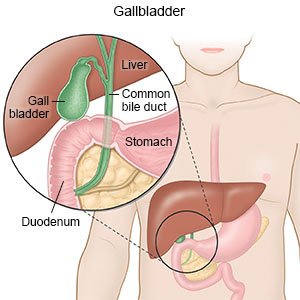
Laparoscopic cholecystectomy is surgery to remove gallstones and your gallbladder. You will get self-care instructions to follow at home. These will include when it is okay to do daily activities, drive, and lift heavy objects. You will get instructions for how to care for the surgery area and check for infections. You will also be told which foods to eat and how much liquid to drink each day. Follow all instructions to help you heal after surgery.
 |
DISCHARGE INSTRUCTIONS:
Call your local emergency number (911 in the US) if:
- You feel lightheaded, short of breath, and have chest pain.
- You cough up blood.
Seek care immediately if:
- Your arm or leg feels warm, tender, and painful. It may look swollen and red.
- You cannot stop vomiting.
- Your bowel movements are black or bloody.
- You have pain in your abdomen and it is swollen or hard.
- You have a fever over 101°F (38°C) or chills.
Call your doctor or surgeon if:
- You have pain or nausea that is not relieved by medicine.
- You have redness and swelling around your incision sites.
- You have blood or pus leaking from your incision sites.
- You are constipated, have diarrhea, or your bowel movements are pale.
- Your skin or eyes are yellow.
- You have questions or concerns about your surgery, condition, or care.
Medicines:
You may need any of the following:
- Prescription pain medicine may be given. Ask your healthcare provider how to take this medicine safely. Some prescription pain medicines contain acetaminophen. Do not take other medicines that contain acetaminophen without talking to your healthcare provider. Too much acetaminophen may cause liver damage. Prescription pain medicine may cause constipation. Ask your healthcare provider how to prevent or treat constipation.
- NSAIDs help decrease swelling and pain or fever. This medicine is available with or without a doctor's order. NSAIDs can cause stomach bleeding or kidney problems in certain people. If you take blood thinner medicine, always ask your healthcare provider if NSAIDs are safe for you. Always read the medicine label and follow directions.
- Take your medicine as directed. Contact your healthcare provider if you think your medicine is not helping or if you have side effects. Tell your provider if you are allergic to any medicine. Keep a list of the medicines, vitamins, and herbs you take. Include the amounts, and when and why you take them. Bring the list or the pill bottles to follow-up visits. Carry your medicine list with you in case of an emergency.
Take deep breaths and cough 10 times each hour:
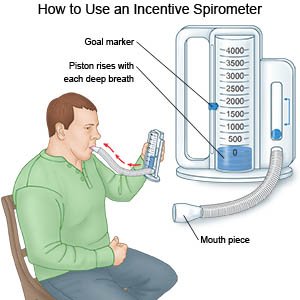
This will decrease your risk for a lung infection. Take a deep breath and hold it for as long as you can. Then let the air out and cough strongly. You may be given an incentive spirometer to help you take deep breaths. Put the plastic piece in your mouth and take a slow, deep breath. Then let the air out and cough. Repeat these steps 10 times every hour.
 |
Care for the surgery area:
- Remove the bandages as directed. Your surgeon may tell you to remove the bandages the day after surgery.
- Keep the area clean and dry. You may take a shower the day after your surgery. Do not take baths, swim, or soak in a hot tub until your surgeon says it is okay.
- Check for signs of infection each day. Check the area for swelling, red streaks, or pus. Tell your surgeon right away if you see any of these.
- Hug a pillow against the surgery area before you sneeze or cough. This will help prevent pain and protect the surgery area.
What to eat after surgery:
- Eat low-fat foods for 4 to 6 weeks while your body learns to digest fat without a gallbladder. Slowly increase the amount of fat that you eat.
- Drink more liquids. Ask how much liquid to drink and which liquids are best for you.
When to return to work and other activities:
- Rest often and slowly increase your activity level each day. If an activity causes pain, wait several days before you do that activity again.
- Do not drive for the first 24 hours after surgery. Your surgeon will tell you when it is okay to drive after the first 24 hours. This is usually after you have stopped taking narcotic pain medicine for a few days.
- Do not lift anything heavier than 10 pounds for 4 to 6 weeks, or as directed.
- You may return to work or other activities as soon as your pain is controlled and you feel comfortable. This is usually 5 to 7 days after surgery.
Follow up with your doctor or surgeon as directed:
Write down your questions so you remember to ask them during your visits.
© Copyright Merative 2024 Information is for End User's use only and may not be sold, redistributed or otherwise used for commercial purposes.
The above information is an educational aid only. It is not intended as medical advice for individual conditions or treatments. Talk to your doctor, nurse or pharmacist before following any medical regimen to see if it is safe and effective for you.
Further information
Always consult your healthcare provider to ensure the information displayed on this page applies to your personal circumstances.