
Jaundice in Newborns
Medically reviewed by Drugs.com. Last updated on Apr 2, 2024.
What is jaundice?
Jaundice is yellowing of your newborn's eyes and skin. It is caused by too much bilirubin in the blood. Bilirubin is a yellow substance found in red blood cells. It is released when the body breaks down old red blood cells. Bilirubin usually leaves the body through bowel movements. Jaundice happens because your newborn's body breaks down cells correctly, but it cannot remove the bilirubin. Jaundice is common in newborns. It usually happens during the first week of life.
What increases my newborn's risk for jaundice?
- A parent or sibling needed phototherapy or exchange transfusion
- A family history of a red blood cell disorder
- Down syndrome
- Birth weight over 10 pounds because his or her mother has diabetes
- Sepsis (blood infection) or a blood disorder, such as the mother and newborn having different blood types
- Passing through a narrow birth canal and developing a large bruise on the head
- Not enough breast milk
- Premature birth that prevents the liver from developing correctly
- Liver disease, biliary atresia (bile duct disorder), or an infection
How is jaundice diagnosed?
Your newborn's healthcare provider will check your newborn's skin and eyes. Tell the provider how long your newborn has had signs of jaundice. Tell the provider if you or your newborn have a blood disease, different blood types, or if any siblings also had jaundice. Tell the provider if your newborn was bruised during birth or has trouble breastfeeding. Your newborn may also need blood tests to check for bilirubin and to measure red blood cell levels. These tests will show if he or she has jaundice or is at risk for developing it.
How is jaundice treated in newborns?
Jaundice often goes away on its own. If it continues or becomes severe, your newborn may need treatment. This may happen at home or in the hospital. You will be able to stay with him or her in the hospital so you can continue to breastfeed. Treatment for jaundice includes the following:
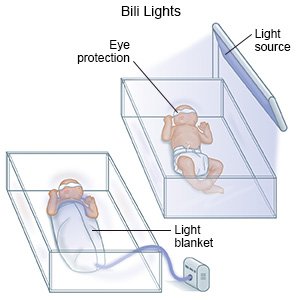
- Phototherapy is a procedure that uses light to turn bilirubin into a form that your newborn's body can remove. One or more lights will be placed above your newborn. He or she will be placed on his or her back to absorb the most light. Your newborn may also lie on a flexible light pad, or his or her healthcare provider may wrap him or her in the light pad. Eye covers may be used to protect his or her eyes from the light. Do not put your newborn in direct sunlight. He or she may get a sunburn or become dehydrated. The only light therapy your newborn should have is phototherapy guided by a healthcare provider.
- Exchange transfusion is a procedure used to replace part of your newborn's blood with blood from a donor. This will be done in the hospital and may be used if your newborn has severe jaundice.
Treatment options
The following list of medications are related to or used in the treatment of this condition.
How can I help decrease my newborn's risk for jaundice?
Breastfeed your newborn as early and as often as possible. Talk to your newborn's healthcare provider about using formula along with breast milk if you do not produce enough breast milk alone. Look for signs of thirst in your newborn, such as lip smacking and restlessness. Try to breastfeed 8 to 12 times daily for the first few days to boost your milk supply. Ask your healthcare provider for help if you have trouble breastfeeding.
Call your local emergency number (911 in the US) if:
- Your newborn has a seizure, or you cannot wake him or her.
When should I seek immediate care?
- Your newborn has a fever.
- Your newborn is limp (too weak to move).
- Your newborn moves his or her legs in a cycling motion.
- Your newborn changes his or her sleep patterns.
- Your newborn has trouble feeding, or he or she will not feed at all.
- Your newborn is cranky, hard to calm, arches his or her back, or has a high-pitched cry.
When should I call my newborn's pediatrician?
- Your newborn has new or worsened yellow skin or eyes.
- You think your newborn is not drinking enough breast milk, or he or she is losing weight.
- Your newborn has pale, chalky bowel movements.
- Your newborn has dark urine that stains his or her diaper.
Care Agreement
You have the right to help plan your baby's care. Learn about your baby's health condition and how it may be treated. Discuss treatment options with your baby's healthcare providers to decide what care you want for your baby. The above information is an educational aid only. It is not intended as medical advice for individual conditions or treatments. Talk to your doctor, nurse or pharmacist before following any medical regimen to see if it is safe and effective for you.© Copyright Merative 2024 Information is for End User's use only and may not be sold, redistributed or otherwise used for commercial purposes.
Learn more about Jaundice in Newborns
Treatment options
Further information
Always consult your healthcare provider to ensure the information displayed on this page applies to your personal circumstances.
