How To Count Respirations
WHAT YOU SHOULD KNOW:
How To Count Respirations (Aftercare Instructions) Care Guide
- How To Count Respirations
- How To Count Respirations Aftercare Instructions
- How To Count Respirations Discharge Care
- En Espanol
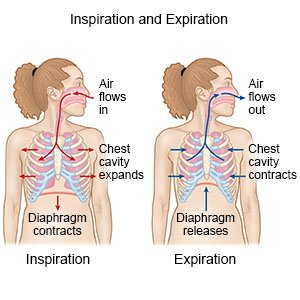
- Respiration happens when you breathe air in and out. It allows oxygen to enter your body and carbon dioxide to go out. As you inhale (breathe in), your chest cavity (space) expands, making your chest bigger. Your chest cavity decreases in size as you exhale (breathe out). The number of times you breathe in and out in one minute is called your respiratory or breathing rate.
- Respirations (breaths) may need to be counted because of an illness, such as a lung or heart disease. A person's breathing rate may show how his body is doing. Most people breathe 12 to 20 times in a minute. A change in a person's breathing rate may be an early warning sign that his condition is getting worse. Breaths may also need to be counted when taking certain medicines.
INSTRUCTIONS:
Checking a person's respirations:
- How to watch respirations: When a person's breathing is being checked, he should sit upright, if possible. It is also better if he is checked under natural light (daylight), without his shirt on. This helps show his chest movements better. It is important that the person does not know that his breathing is being checked. Letting him know will make him consciously control his breathing, giving a false breathing rate. The person may be asked questions that can be answered by 'yes' or 'no' to help him relax.
- Things needed: When counting a person's breathing rate, a non-digital watch or clock is needed. It must have a hand that shows the seconds, often called a "second hand." A pen and paper will also be needed.
- Counting breaths: Breathing should be counted for one full minute (60 seconds). If breathing is regular, it can also be counted for 30 seconds and the number multiplied by two. A person's breathing may be checked and counted through any of the following:
- Look at his chest rise and fall. One rise and one fall are counted as one breath.
- Feel his chest rise and fall by placing your hand on the person's chest.
- Listen to the breaths he makes. This may be done if the person is breathing loud enough.
- Look at his chest rise and fall. One rise and one fall are counted as one breath.
- Things needed: When counting a person's breathing rate, a non-digital watch or clock is needed. It must have a hand that shows the seconds, often called a "second hand." A pen and paper will also be needed.
- Other things to look for:
- Pattern of breathing: When checking a person's breathing, note if his breathing is regular or irregular. Check also if there are periods of no breathing.
- Depth of breathing: Check if the breaths he takes are deep or shallow. Deep breathing is when one inhales a large amount of air. Shallow breathing is when one inhales a small amount of air. Checking for depth of breathing may give an idea how much air goes into the lungs with each breath.
- Equal chest movement: Check if both sides of his chest look the same when breathing.
- Abnormal breath sounds: Check for any noises made when breathing. These include grunting, gurgling (bubbling), crowing, wheezing (high-pitched noise), or snoring-like sounds. Listen whether the abnormal breath sound comes as the person inhales or exhales.
- Pattern of breathing: When checking a person's breathing, note if his breathing is regular or irregular. Check also if there are periods of no breathing.
- Signs of trouble breathing:
- Bluish color of the nail beds, lips, underside of the tongue, or inside of the cheek. This is a sign that the person is not taking in enough oxygen.
- Cold and clammy skin, or is sweating more than usual.
- Increased effort when breathing. This may be seen as:
- Lifting of shoulders when breathing in.
- Nostrils (openings of the nose) that open wider when breathing in.
- Pursing (whistle-like position) of lips when breathing.
- Retractions (pulling in of the skin between the ribs and around the neck with each breath).
- Lifting of shoulders when breathing in.
- Needing to sit up to be able to breathe more comfortably.
- Shortness of breath. This may show as having a hard time speaking or needing to catch his breath.
- Bluish color of the nail beds, lips, underside of the tongue, or inside of the cheek. This is a sign that the person is not taking in enough oxygen.
Factors that can affect how fast or how easily a person breathes:
Breathing may be affected by many things. A person may control his breathing when needed, such as while talking or singing. Too much carbon dioxide or too little oxygen in the blood may cause a person to breathe faster. Breathing may also be affected by the following:
- Age: Older people may breathe at a slower rate. They may also have breathing that is more shallow.
- Activity: Certain activities such as listening to fast-paced music, exercising, or other strenuous activities may result in a higher breathing rate. Breathing may be slower when a person is resting or asleep.
- Altitude: Being up in the mountains at a higher altitude may affect breathing rate. Breathing in the mountains may be faster than at sea level.
- Emotions: Being excited, anxious (worrying too much), or afraid may cause breathing to be faster. Being calm and relaxed may result in a slower breathing rate.
- Medical problems: Fever, anemia (low red blood cell count), or heart, liver, and brain problems may make breathing faster. Lung problems, brain swelling, or being very sick may cause a person to breathe slower. Narrowed or blocked airways due to smoking and certain lung problems may make it harder to breathe. Chest trauma and bowel (gut) obstruction (blockage) may also cause trouble breathing.
- Medicines: Certain medicines may affect a person's breathing. Narcotic medicine (strong pain medicine) may cause breathing to become slower.
- Physical condition: This includes conditions where the size of the abdomen (stomach) is increased, such as pregnancy or obesity. Pregnancy or obesity may make it harder for a person to breathe. A person is obese when he weighs more than his caregiver suggests for him.
CONTACT A CAREGIVER IF:
- The person you are checking has a breathing rate of more than 25 or less than 12.
- The person you are checking feels dizzy or more tired than usual.
- You have questions or concerns about the breathing or condition of the person you are checking.
SEEK CARE IMMEDIATELY IF:
- The person you are checking had a seizure (convulsion).
- The person you are checking has a hard time staying awake or thinking clearly.
- The person you are checking has pounding and fast heartbeats, or chest pain.
- The person you are checking has trouble breathing.
Copyright © 2012. Thomson Reuters. All rights reserved. Information is for End User's use only and may not be sold, redistributed or otherwise used for commercial purposes.
The above information is an educational aid only. It is not intended as medical advice for individual conditions or treatments. Talk to your doctor, nurse or pharmacist before following any medical regimen to see if it is safe and effective for you.