
The originating document has been archived. We cannot confirm the completeness, accuracy, or currency of the content.
Hemorrhoids
Medically reviewed by Drugs.com. Last updated on Feb 21, 2024.
WHAT YOU SHOULD KNOW:
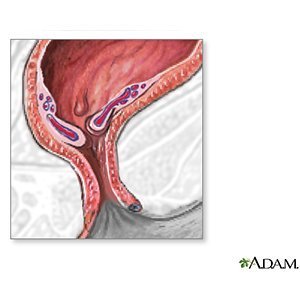
Hemorrhoids are swollen blood vessels inside your rectum (internal hemorrhoids) or on your anus (external hemorrhoids). Sometimes a hemorrhoid may prolapse, which means it extends out of your anus.
 |
CARE AGREEMENT:
You have the right to help plan your care. Learn about your health condition and how it may be treated. Discuss treatment options with your caregivers to decide what care you want to receive. You always have the right to refuse treatment.RISKS:
Treatment for hemorrhoids may cause pain, infection, or incontinence. Treatment can also cause liver problems, heavy bleeding, and difficulty getting an erection. Surgery may cause scarring or damage to the tissue in your anus or rectum. Without treatment, your hemorrhoids may become bigger or more painful. You may develop a blood clot. The clot may travel to your heart or brain and cause life-threatening problems, such as a heart attack or stroke.
WHILE YOU ARE HERE:
Informed consent
is a legal document that explains the tests, treatments, or procedures that you may need. Informed consent means you understand what will be done and can make decisions about what you want. You give your permission when you sign the consent form. You can have someone sign this form for you if you are not able to sign it. You have the right to understand your medical care in words you know. Before you sign the consent form, understand the risks and benefits of what will be done. Make sure all your questions are answered.
Medicines:
- Topical medicine: This may come as pads, creams, ointments, or lotions. This medicine may help decrease pain and swelling.
- Stool softeners: This medicine makes it easier for you to have a bowel movement. You may need this medicine to treat or prevent constipation.
- Pain medicine: You may be given a prescription medicine to decrease pain. Do not wait until the pain is severe before you ask for more medicine.
- Antibiotics: This medicine is given to help treat or prevent an infection caused by bacteria.
Tests:
- Anoscopy: This test helps your healthcare provider look inside your anus and rectum. A short plastic or metal tube is put into your anus and up into the rectum.
- Barium enema: A barium enema is an x-ray of the colon. A tube is put into your anus, and a liquid called barium is put through the tube. Barium is used so that caregivers can see your colon better on the x-ray film.
- Anorectal manometry: This test helps healthcare providers see if there are problems with how your anus and rectum are working. A small, flexible tube is put inside your anus into your rectum to check its pressure. This tool is used to see if there are problems with the muscles controlling your bowel movements.
- Endorectal ultrasound: This test uses sound waves to show pictures of the inside of your rectum. A small tube is placed into your rectum and pictures are seen on a monitor.
- Sigmoidoscopy or colonoscopy: These are tests done to look at your colon. A tube with a light on the end will be put into your anus, and then moved forward into your colon.
Treatment:
- Photocoagulation: This procedure uses special light to help stop blood flow to your hemorrhoids. The lack of blood flow will cause your hemorrhoids will shrink.
- Rubber band ligation: Your healthcare provider will place a rubber band around your hemorrhoids to stop blood flow. After a few days, the hemorrhoid tissues should die and fall off.
- Sclerotherapy: A chemical will be given as a shot into your hemorrhoids to make them smaller.
- Stapled hemorrhoidopexy: This procedure staples your hemorrhoid to the wall of your rectum or anal canal. This cuts off the blood supply to your hemorrhoids. This surgery also tightens up the wall of your rectum or anal canal.
- Hemorrhoidectomy: This is surgery to remove your hemorrhoids.
Learn more about Hemorrhoids
Treatment options
Care guides
Symptoms and treatments
Further information
Always consult your healthcare provider to ensure the information displayed on this page applies to your personal circumstances.
