
Hamstring Exercises
Medically reviewed by Drugs.com. Last updated on Sep 1, 2024.
What do I need to know about hamstring exercises?
Hamstring exercises help strengthen and stretch the muscles that support your lower back, hips, and knee. This decreases pain, improves movement, and lowers your risk for another injury.
What do I need to know about exercise safety?
- Move slowly and smoothly. Avoid fast or jerky motions to help prevent another injury.
- Breathe normally. Do not hold your breath. It is important to breathe in and out so you do not tense up during exercise. Tension could prevent your muscles from stretching.
- Do the exercises and stretches on both legs. Do this so the muscles on both legs remain strong and flexible.
- Stop if you feel sharp pain or an increase in pain. You may feel discomfort during exercise, such as a dull ache, but you should not feel pain. Discomfort should get better with regular exercise. Pain may be a sign of an injury that needs to be treated. Let your healthcare provider or physical therapist know about your pain.
- Warm up before you stretch and exercise. This will help prevent an injury. Walk or ride a stationary bike for 5 to 10 minutes.
How do I perform stretching exercises?
Ask your healthcare provider or physical therapist how often to do these stretches:
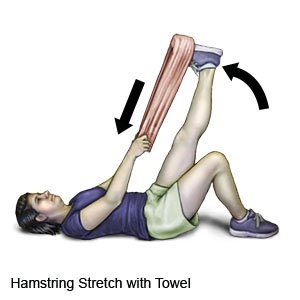
- Hamstring stretch with a towel: Lie on your back on the floor. Bend both legs so your feet rest on the floor. Lift one leg off the floor and loop a towel around your foot. Grasp the ends of the towel and slowly straighten your lifted leg. Use the towel to gently pull your leg toward you until you feel a stretch. Keep your leg straight and your foot flexed toward your body. Hold for 30 seconds. Use a longer towel if needed.
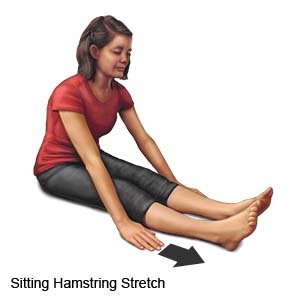
- Sitting hamstring stretch: Sit on the floor with both legs straight in front of you. Do not point your toes or flex your feet. Place your palms on the floor and slide your hands forward until you feel the stretch. Keep your back straight and do not lock your knees. Hold the stretch for 30 seconds.
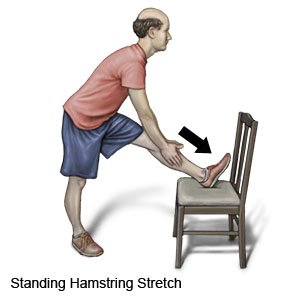
- Standing hamstring stretch: Stand with your feet hips distance apart. Life one leg and rest it on a firm surface, such as a table or chair. Keep your toes pointing up. Slide your hands forward along the side of your leg until you feel a stretch. Keep your chest lifted and your back straight. Hold for 30 seconds.
- Sitting wide-leg stretch: Sit on the floor and extend your legs as wide as possible. Do not let your feet roll in or out. Keep your legs straight and lean over one leg. Slide your hands forward until you feel a stretch. Keep your chest lifted and your back straight. Hold for 30 seconds.
How do I perform strengthening exercises?
Always do strengthening exercises after you stretch. As you get stronger, your healthcare provider or physical therapist may tell you to you add weights or more repetitions to your strengthening exercises. He or she will tell you how much weight to use.
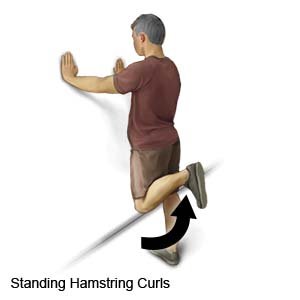
- Hamstring curls: Put an ankle weight on your injured leg. Place your hand on a wall or the back of a chair for balance. Lift the leg and raise your heel toward your buttocks. Hold for 5 seconds. Slowly lower your foot until it is a few inches off the floor. Do 3 sets of 10. Repeat on other side.
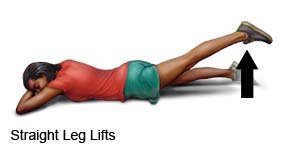
- Straight leg raise: Lie on the floor with your face down. Rest your forehead on your folded arms. Keep your body in a straight line. Keep your hip bones on the floor, and tighten the butt and thigh muscles of your injured leg. Keep one leg straight and raise it toward the ceiling as high as you can. Hold for 5 seconds. Slowly return to the starting position. Do 3 sets of 10. Repeat on other side.
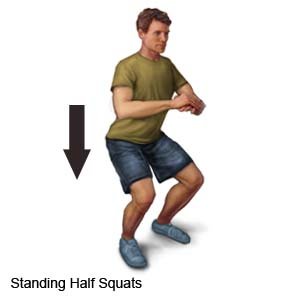
- Half squats: Stand with your feet shoulder distance apart. Rest your hands on the front of your thighs or reach them out in front of you. You may hold on to the back of a chair or wall for balance. Keep your chest lifted and lower your hips about 10 inches, as if you are going to sit. Make sure your weight is in your heels and hold for 5 seconds. Keep your weight in your heels and slowly stand. Do 3 sets of 10.
When should I call my doctor or physical therapist?
- You have sharp or worsening pain during exercise or at rest.
- You have questions or concern about your condition, care, or exercise program.
Care Agreement
You have the right to help plan your care. Learn about your health condition and how it may be treated. Discuss treatment options with your healthcare providers to decide what care you want to receive. You always have the right to refuse treatment. The above information is an educational aid only. It is not intended as medical advice for individual conditions or treatments. Talk to your doctor, nurse or pharmacist before following any medical regimen to see if it is safe and effective for you.© Copyright Merative 2024 Information is for End User's use only and may not be sold, redistributed or otherwise used for commercial purposes.
Further information
Always consult your healthcare provider to ensure the information displayed on this page applies to your personal circumstances.