Consumer Information
Carenotes > Gastrostomy Care For Neonates

Gastrostomy Care For Neonates

Advertisement

GENERAL INFORMATION:

What is a gastrostomy tube?

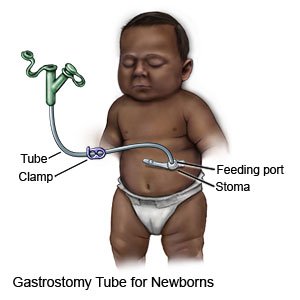
  • A gastrostomy tube is a tube that goes through an opening in your baby's skin into his stomach. A gastrostomy tube is also called a G-tube. A G-tube may be used to feed your baby or give him medicine. It may also be used to let air or liquid out of your baby's stomach. The G-tube is placed inside an opening that is made in your baby's abdomen. This opening is called a stoma.

  • The internal portion of the G-tube is inside your baby's stomach and keeps the tube in place. The external portion may be a tube that sticks out of your baby's skin. It may also look like a button that rests on top of your baby's skin. Your caregiver may first give your baby an external tube and then later replace it with a button. With a G-tube, feeding your baby may become easier. Your baby may gain weight, get enough nutrition, and become healthier.

What are reasons my baby may need a G-tube? Your baby may need a G-tube if has trouble eating or swallowing. He may also need a G-tube if he has trouble keeping food down. Your caregiver may want your baby to have a G-tube to help him get a lot of calories. Your baby may have feeding problems with any of the following conditions:

  • Deformities: Your baby may need a G-tube if his body has a deformity. A deformity is a part of your baby's body that was not correctly formed when he was born. Your baby may have a feeding problem if his mouth, jaw, throat, or stomach is deformed. He may also have a heart defect or other problem that may make him too weak to swallow.

  • Brain problems: Your baby may have a problem with his brain that makes it hard for him to swallow. Cerebral palsy is a brain condition that makes it hard for your baby to eat.

  • Diseases: There are many diseases that may make it hard for your baby to eat or swallow. Different kinds of cancer may make it hard for your baby to eat. Your baby may have heart or kidney problems that might cause feeding problems. A condition called gastroesophageal reflux disease (GERD) may cause your baby to vomit (throw up) after he eats.

  • Prematurity: Your baby may have been born earlier than expected and cannot swallow properly.

How do I feed my baby through his G-tube? Your baby's caregiver will give you instructions for feeding your baby. Make sure you follow the correct feeding schedule. Ask your baby's caregiver how much milk or formula you should give your baby.

  • Things you will need: Keep the following items within easy reach:

    • Breast milk or formula.

    • Feeding pump (optional).

    • Feeding set.

    • Syringe. A syringe is a small hollow tube that pushes milk, formula or medicine into your baby's G-tube. It can also be used to take fluid or air out of your baby's stomach.

    • Water.

  • Feeding your baby: Do the following step-by-step instructions:

    • Measure the correct amount of breast milk or formula for your baby's feeding.

    • Raise your baby's head a few inches if he is lying down.

    • Put some water into the syringe. Push the water from the syringe into the tube to clean it. This helps keep the tube from getting blocked. Ask your caregiver how much water to put into your baby's tube. Never put too much water into your baby's tube.

    • Put the milk into the feeding set or pump.

    • Follow your caregiver's instructions for how much to feed your baby.

    • After feeding your baby, push water through the syringe to clean the tube again.

    • Write down how much milk or formula you gave your baby. Also write down how much water you used to clean the tube.

    • Keep the G-tube open for a few minutes after feeding to help decrease pressure inside your baby's stomach. This will allow your baby to burp.

How will I know that my baby is getting enough food and liquid? If your baby is getting enough food and liquid, he may become less fussy after a feeding. His stomach may also become slightly bigger. If your baby is getting enough nutrition then he should begin to gain weight and grow.

How do I care for the skin around my baby's G-tube?

  • Things you will need:

    • Bandages.

    • Soap.

    • Special skin care powders.

    • Warm water.

  • Cleaning the skin around your baby's G-tube:

    • Clean your baby's tube site with soap and warm water. Check your baby's skin for redness or swelling at the tube site. You may clean the skin around the tube while giving your baby a bath.

    • If your baby's original G-tube has already been replaced, you may gently turn the new tube. This may help relieve the pressure on your baby's skin and prevent skin infection. It may help keep the tip of the tube in place. Ask your caregiver when it will be OK to start turning the tube or button.

    • Use skin care powder and bandages to keep the skin around the tube dry.

How do I care for my baby's G-tube?

  • G-tube care: The following things may help you care for your baby's G-tube:

    • Clean your baby's tube before and after feeding your baby. Always follow your caregiver's instructions on how much water to use. Never put too much water into your baby's tube.

    • If your baby's tube has a balloon tip then make sure that there is enough air inside it. Ask your caregiver how much air should be inside the balloon.

    • Your baby may need to have the external tube replaced every two weeks. Your caregiver may show you how to replace the tube. Your caregiver may also ask you to come to his office to replace the tube.

What can I do to help prevent problems with my baby's G-tube?

  • Follow your caregiver's instructions for the proper care of your baby's gastrostomy tube.

  • Make sure that your baby's tube is in its proper place.

  • Put the tube under your baby's clothes to keep the tube from accidentally coming out.

  • Make sure that the tube is not blocked.

  • Keep your baby's skin clean and dry around the tube.

  • Watch your baby's skin for redness, swelling, and pus.

  • Measure the length of the external tube from the stoma to the end. Ask your baby's caregiver how long this part of the tube should be and measure it every day. This will help you see if the tube has moved inside your baby's abdomen.

What problems can happen after my baby has a G-tube put in?

  • Your baby's stomach might hurt and he may be more fussy than usual. He may get diarrhea or vomiting (throwing up). He may get a fever (high body temperature). The skin around your baby's stoma may become infected. The tube may leak fluid, blood, or pus. Your baby may have food or liquid go into his lungs by mistake. His G-tube may fall out and he may need to have another tube put into his stomach. Your baby's tube may shift and block other organs in your baby's abdomen.

  • Your baby's skin may turn yellow if organs near the liver are blocked. Your baby's tube may also cause fistulas (abnormal passageways) in your baby's abdomen. Your baby may get a hernia, which may cause the stomach to squeeze through the muscle wall. Your baby may also get air or fluid trapped in the lining of his abdomen (his peritoneum). This may cause his peritoneum to be swollen (peritonitis). If peritonitis is not treated, your baby may get sepsis (blood infection) and die. Call your caregiver if you have concerns or questions about your baby's G-tube, condition, or care.

Why might my baby's G-tube need to be replaced or removed?

  • First replacement: Between 6 and 12 weeks, your caregiver may replace your baby's tube. At this time, the skin is usually strong enough to have the tube replaced.

  • The tube has fallen out: If the tube falls out, your baby may need to have the procedure again. A different tube may be put in another place in your stomach. If enough time has passed, your caregiver may replace the tube or instruct you how to do it.

  • The tube has moved inside the abdomen: If this happens, other organs in your baby's abdomen may be blocked or injured. Your baby's caregiver may place the tube back into the correct position. He may also put another tube into a different position in your baby's stomach.

  • Recovery from illness or condition: Your baby may not need the tube anymore once he becomes healthier. This may mean that your baby is now able to swallow and feed on his own.

What can I do to make my baby more comfortable when he has a G-tube?

  • Hold or talk to your baby during feeding time. You may put a pacifier into your baby's mouth during feeding. This may help your baby learn how to use his mouth.

  • Wash the tube site with soap and water.

  • Keep the tube site dry.

  • Put bandages around the stoma if there are problems with your baby's skin.

What should I do if my baby's G-tube falls out? Do the following if your baby's G-tube falls out or moves out of place.

  • Cover the stoma with a clear bandage.

  • Call your caregiver right away. If you do not call your caregiver right away then the hole may close. If this happens, your baby will need to have the procedure again.

  • Your caregiver may instruct you how to replace the tube. He may also ask you to seek care immediately.

Where can I find support and more information? You may feel frustrated, anxious, or afraid because of your baby's G-tube. You may get support from your baby's caregivers. You may also contact any of the following for more information:

  • American Society for Gastrointestinal Endoscopy (ASGE)
    1520 Kensington Road
    Oak Brook, IL 60523
    Phone: 1-630-573-0600
    Web Address: http://www.asge.org
  • American Academy of Pediatrics
    141 Northwest Point Boulevard
    Elk Grove Village, IL 60007-1098
    Phone: 1-847-434-4000
    Web Address: http://www.aap.org

When should I call my baby's caregiver? Call your baby's caregiver if:

  • The tube is blocked or broken.

  • Fluid is leaking from your baby's stoma.

  • The tube is not properly in place.

  • There is redness, swelling, or thickened skin at the site of your baby's stoma.

  • Your baby has watery or milk-colored stool.

  • Your baby has more bowel movements than usual.

  • You have questions or concerns about your baby's condition, treatment or care.

When should I seek immediate help? Seek care immediately or call 911 if:

  • Your baby's tube falls out.

  • Blood or pus is coming out of your baby's tube.

  • Your baby has trouble breathing.

  • Your baby has a fever or is more irritable (cranky) than usual.

  • Your baby's abdomen feels stiff or tight.

  • Your baby has yellow-tinged skin.

  • Your baby is vomiting (throwing up).

  • Your baby suddenly has a larger or harder abdomen.

  • If any of these problems occur, do not feed your baby until your caregiver says it is OK.

CARE AGREEMENT:

You have the right to help plan your baby's care. To help with this plan, you must learn about your baby's health condition and how it may be treated. You can then discuss treatment options with your baby's caregivers. Work with them to decide what care may be used to treat your baby.

Copyright © 2008 Thomson Healthcare Inc. All rights reserved. Information is for End User's use only and may not be sold, redistributed or otherwise used for commercial purposes.

The above information is an educational aid only. It is not intended as medical advice for individual conditions or treatments. Talk to your doctor, nurse or pharmacist before following any medical regimen to see if it is safe and effective for you.


MedNotes
Advertisement

(web3)