Consumer Information
Carenotes > Fever In Children (Discharge Care)

Fever In Children

Advertisement

WHAT YOU SHOULD KNOW:

  • "Fever" is a word used for a temperature that is higher than normal for the body. A fever is not a disease. It is a common sign of illness, infection or other conditions. Although there are many reasons for a fever, most fevers are caused by a viral (germ) infection (in-FEK-shun). Your child's body may use a fever to actually help fight the infection. Most fevers go away in a few days, but they may last longer. The signs and symptoms of a fever depend upon what caused your child's fever.

  • Sometimes a child whose fever rises or falls very fast may become very confused or have a seizure (SE-zhur). Febrile seizures happen more often in children under five years old than they do in older children. Febrile seizures are not common, and usually do not cause brain damage or harm to your child. Always call your child's caregiver right away if your child has a seizure. The caregiver may want to see your child to be sure the seizure was not caused by another medical condition.

AFTER YOU LEAVE:

Medicines: If your baby is under three months old and has a fever, always call his caregiver. Ask your child's caregiver what you should do. If your child has a fever below 101°F (38.3 °C) and feels OK, he may not need medicine. However if your child feels sick or uncomfortable, medicine may help him feel better. Ask the caregiver about giving medicine if your child or another family member has had a febrile seizure in the past.

  • Always give your child's medicine as directed by caregivers: If you think a medicine is not helping or is causing side effects, call your child's caregiver. Keep a written list of what medicines your child takes, the amounts, and when and why they are taken. Bring the list of your child's medicines or the pill bottles when you visit your child's caregivers. Ask your child's caregiver for more information about the medicines. Do not give any medicines to your child without first asking your child's caregiver. This includes prescriptions, over-the-counter drugs, vitamins, herbs, or food supplements.

  • Give your child fever medicine if he needs it:

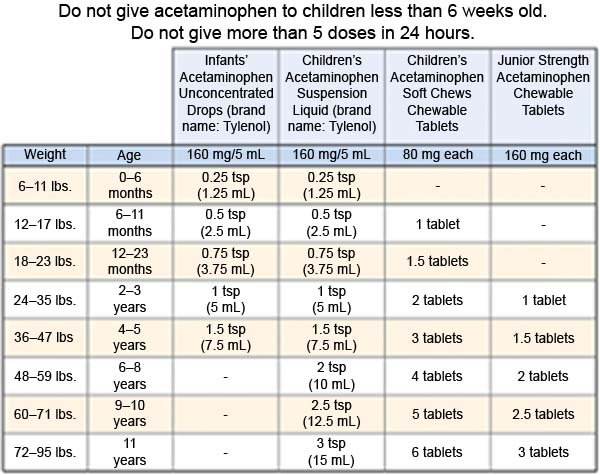
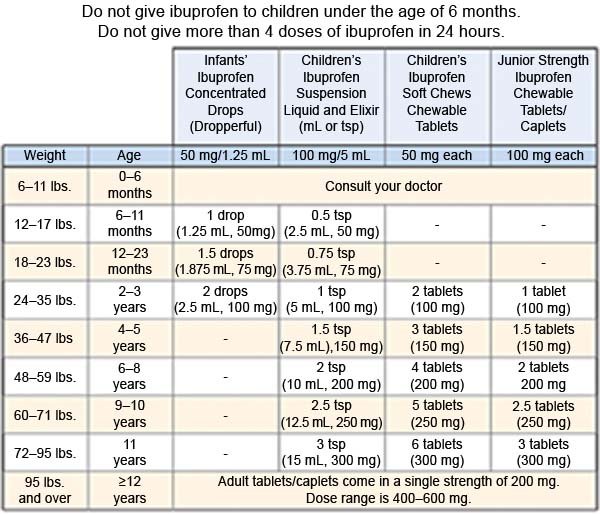
    • Acetaminophen (a-seet-a-MIN-oh-fen) and ibuprofen (eye-bu-PROH-fen) are over-the-counter medicines that may decrease your child's fever or discomfort. Some children, especially those under six months old, may be too young to take certain medicines. Be sure to read the label on the medicine bottle before giving the medicine to your child. Ask your child's caregiver to help you choose the best medicine and right amount to give your child.

    • Give the medicine time to work. Take your child's temperature 30 to 45 minutes after you give him fever medicine. Remember that fever medicine may not cause your child's fever to completely go away. It may only lower the fever.

  • Do not give aspirin to children under 18 years of age: Giving aspirin to your child when he is ill may cause a very serious illness called Reye's Syndrome. This could lead to brain and liver damage. Read medicine labels to see if your child's medicine has aspirin in it.

  • Read the ingredient labels of all medicines that you give to your child: If your child is using medicine for other symptoms such as cough or cold, read the medicine labels carefully. Many of these medicines may also have acetaminophen or ibuprofen in them. If you give these medicines and the fever medicines, you may be giving your child too much medicine. This could harm your child.

  • Your child may or may not need antibiotics: If your child has an infection caused by a virus, antibiotics (an-ti-bi-OT-iks) will not make it go away. Antibiotics may help your child's body fight infection if the infection is caused by bacteria (bak-TEE-ree-ah). If the caregiver prescribes antibiotics for your child, always use this medicine exactly as ordered. Keep giving this medicine until it is completely gone, even if your child feels better. Stopping an antibiotic without the caregiver's OK may make it unable to kill the bacteria causing the infection.

Follow-up visit information: Keep all appointments. Write down any questions you and your child may have. This way you will remember to ask these questions during your child's next visit.

How can I make my child more comfortable while he has a fever?

  • Help your child to rest.

    • Some children who have a fever do not feel tired or sick. If your child feels OK, allow him to do play that will not make him too tired. If your child feels sick, help him to rest. Give him books or a drawing pad for quiet play, or let him watch TV or a movie. Once your child begins to feel better, let him do more.

    • If your baby has a fever, keep him quiet and rested. Hold him quietly while sitting in a rocking chair, or singing or speaking softly to your baby.

  • Give your child plenty of liquids. Help your child drink at least six to eight cups of clear liquids each day. Give your child liquids such as water, juice, broth or decaffeinated sports drinks.

  • Give your baby or toddler plenty of liquids.

    • If you are breast feeding or feeding your child formula, continue to do so. Your baby may not feel like drinking his regular amounts with each feeding. If so, feed him smaller amounts of breast milk or formula more often.

    • Do not give sports drinks to babies and toddlers. If you think your child is becoming dehydrated (dee-HEYE-drayt-ed), talk to his caregiver. Ask if you should give your child oral rehydration solution (ORS) to drink. An ORS has the right amounts of water, salts, and sugar your child needs to replace body fluids. This may help prevent dehydration.

  • Dress your child in lightweight clothing. Shivering during a fever may be a sign that your child's fever is rising. Putting extra blankets or clothes on your child may cause his fever to rise even higher. Dress your child in one layer of comfortable clothing such as thin pajamas or a tee shirt and soft pants. Cover your child with a lightweight blanket or sheet. Change your child's clothes, blanket or sheets if they become damp (wet).

  • Keep the room cool, but not cold. If the room is warm or stuffy, turn on a fan to keep air circulating (blowing through). Turn the fan off if you see your child shivering.

  • Use cool compresses. You may place a cool compress on your child's forehead. Dip a clean washcloth into cool or lukewarm water. Wring it out and place it on your child's forehead or on the back of his neck.

  • Keep your child away from others if his fever is caused by a contagious illness. Ask the caregiver if your child's fever is a sign of contagious illness (able to be spread to others). Try to keep your child away from others in your household while he has a fever and feels bad. Do not take your child to school or daycare until his fever is gone, and he is feeling better. Wash your and your child's hands often with soap and water.

Should I sponge bathe my child when he has a fever? Sponging may be a good way to cool down your child if he is vomiting a lot or cannot take fever medicine. Sometimes sponging is used together with fever medicines to help decrease fever and discomfort. The American Academy of Pediatrics suggests sponging one hour after giving fever medicine if:

  • Your child's temperature is 104°F (40°C) or higher.

  • Your child or another family member has had febrile seizures caused by fevers in the past.

  • Your child feels very uncomfortable because of his fever.

  • Your child has been vomiting and you do not know how much medicine he has kept in his stomach.
Use lukewarm water to sponge bathe. Never use rubbing alcohol, ice or cold water to give a sponge bath. Check your child's temperature about 30 to 45 minutes after you started sponging. Ask your child's caregiver for more information about when and how to sponge bathe your child.

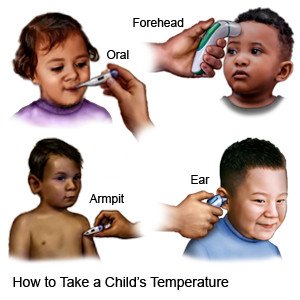
How do I check a temperature? The type of thermometer and how you check your child's temperature may depend on your child's age and how well he can help. The best routes (places where a thermometer can be used) include the ear, mouth, armpit and rectum (rear-end). Use a digital, tympanic (ear), or glass thermometer. Follow the label or your caregiver's instructions when preparing the thermometer for use. For example, a glass thermometer should be shaken until it reads less than 96°F (35.6°C) before you use it. Do the following when taking your child's temperature:

  • Rectal temperature: You may use this route if your child is under five years old. The rectal temperature is the most exact way to know if your child has a fever. It is the closest way to finding the body's true temperature. Rectal temperatures are higher than those taken in the mouth or armpit (axilla) because the rectum is warmer. The normal rectal temperature of a child is between 97° and 100° F (36.0 to 37.7° C). Take a rectal temperature as follows:

    • Use a digital or glass thermometer. Read the package instructions and make sure the glass thermometer is made for taking rectal temperatures.

    • Put a small amount of water-based lubricating jelly on the colored or silver tip of the thermometer.

    • Help your child to lie on his stomach.

    • Insert the tip of the thermometer into the rectum one-half inch to one inch. Slide the thermometer in gently, but stop if it becomes difficult to insert. Never force a thermometer into the rectum.

    • Hold the thermometer the entire time you are taking the temperature. Always stay with your child while taking the temperature.

    • A digital thermometer should be held in place until the thermometer beeps. A glass thermometer should be held in your child's rectum for two to three minutes.
    Picture of glass rectal thermometer

  • Oral (mouth) temperature: You may use this route if your child is five years and older. The normal oral (by mouth) temperature for a child is between 97.6° and 99.3° F (36.4° and 37.4° C). Do not allow your child to put anything hot or cold in his mouth for 10 minutes before taking his temperature. Otherwise, you may get a temperature reading that is falsely high or low. Take an oral temperature as follows:

    • Use a digital or glass thermometer. Read the package instructions and make sure the glass thermometer is made for taking oral temperatures.

    • Tell your child to open his mouth. Put the colored or silver tip of the thermometer under your child's tongue.

    • Tell your child to close his lips gently around the thermometer. This will help hold it in place. Tell your child that he should not bite the glass thermometer.

    • A digital thermometer tip should be kept under your child's tongue until the thermometer beeps. A glass thermometer should be kept under your child's tongue for three minutes.
    Digital Thermometer

  • Axillary (armpit) temperature: You may use this route if your child is over three months old. A normal axillary temperature is between 96.6° (35.9° C) and 98° F (36.7° C). Axillary temperature may be one degree lower than oral temperature, and as much as two degrees lower than rectal temperature. If your child just took a bath or has been actively playing, wait at least 15 minutes before taking an axillary temperature. Take an axillary temperature as follows:

    • Use a digital or glass thermometer.

    • Put the colored or silver tip of the thermometer in the middle of your child's armpit.

    • Gently hold your child's arm down so that the tip stays in the middle of the armpit.

    • If you are using a digital thermometer, leave the tip in place until the thermometer beeps. Keep a glass thermometer under your child's arm for at least five minutes.

  • Tympanic (ear) temperature: Do not use a tympanic thermometer for children three months old or younger. Read the label instructions carefully before using. Make sure you use the right tympanic thermometer for your child's size and age. Children may like this way of checking their temperature because it is so quick. Do not use an ear thermometer if your child has a lot of "wax" in his ears. Do not use an ear thermometer on a child whose ear is sore, infected, or who just had ear surgery. Take a tympanic (tim-PAH-nik) temperature as follows:

    • Use a tympanic thermometer only.

    • Hold your child's head so it does not move, or tell him not to move his head. Gently pull your child's ear straight back.
      Picture of an ear thermometer


    • Put the thermometer tip into the ear opening. Do not use force or push hard. The thermometer tip should not touch the eardrum.

    • Press the button to turn on the thermometer. Hold the button until the thermometer beeps, or follow the instructions for your thermometer.

    • Remove the thermometer from the ear opening.

  • Always read the temperature, and clean and store the thermometer according to the caregiver's or label instructions. Knowing how to check your child's temperature correctly is important. Ask your child's caregiver to watch you check your child's temperature during a medical appointment. If you need help or do not know how to check a temperature, your child's caregiver can teach you. Note: digital thermometers are recommended, but if you still use a glass thermometer please see precautions below.

  • Glass thermometer precautions: Glass thermometers contain mercury. Mercury is the silver-colored liquid metal inside the thermometer. Mercury is a toxic (poisonous) substance. For this reason, you need to be very careful when using a glass thermometer. If you accidently drop it, it may break and release the mercury in it. If you have a glass thermometer with mercury, you should consider getting rid of it. Contact your local health department for information on how to do this. It is not safe to simply put it in your trash for collection.

    • Mercury spills: If you break a glass thermometer containing mercury, you need to clean it up quickly. Mercury can release toxic fumes that can harm people and animals. Mercury forms small beads when released and can spread over a wide area. Use the following steps to remove the spill:

      • Contain the spill: Close the doors to the room where the spill happened. Get other people and animals out of the room. Open the windows in the room.

      • Gather supplies: You will need several zippered plastic bags, trash bags, and rubber or latex gloves. You will also need damp paper towels, a piece of cardboard, an eyedropper, a piece of duct tape, and a flashlight.

      • Remove the glass: Put on the gloves. Carefully pick up the broken pieces of glass. Place them on a paper towel and into one of the zippered bags.

      • Find the mercury: Search for the mercury. You may need to use the flashlight. Use the cardboard piece to sweep the small beads of mercury together. You want to push them together to form a larger bead. Make sure you have found all of the mercury.

      • Remove the mercury: Use the eyedropper to suck up as much of the mercury as you can. Squeeze it out onto a damp paper towel. Place the paper towel in a zippered plastic bag. Use the duct tape on any mercury beads too small for the eyedropper. Place it in a zippered bag. Place the cardboard and eyedropper in a zippered bag. Remove any rugs, curtains or other items the mercury may have spilled on and place them in a separate trash bag.

      • Disposal: Seal the zippered bags you have used and place them in a trash bag. Seal your gloves in a zippered plastic bag and place it in the trash bag. Tightly close the trash bags. Contact your local health department for information on where to take the trash bags.

      • Precautions: Do not attempt to vacuum up the mercury, even with a HEPA filter vacuum cleaner. Do not use a broom to clean up the mercury. Do not put the mercury down a drain or in the household trash. Do not put items the mercury spilled on in the washing machine. Do not continue to wear shoes or clothing that may have mercury on them. Put them in a trash bag and dispose of it with the other trash bags as directed by your local health department.

    • Additional information: Contact your local health department, waste disposal authority, or fire department for more information.

CONTACT A CAREGIVER IF:

  • Your baby has a fever, and he is less than three months old.

  • Your newborn baby is wrapped or dressed as he usually is, but he has a low rectal temperature. A low rectal temperature is 95°F (35°C) or lower. This may be sign of infection.

  • Your baby is two months old or less , and his rectal temperature is 100.2 °F (37.9 °C) or higher.

  • Your child is three to six months old , and his temperature is 101°F (38.3°C) or higher.

  • Your child is over six months old , and his temperature is 103°F (39.4°C) or higher.

  • Your child had a fever that went away for 24 hours (one full day) and then came back again.

  • Your child's fever has not gone away after three days.

  • Your child has a fever and burning or pain when he urinates. Also call if your child has a fever and ear pain or severe (very bad) throat pain.

  • Your child is less alert, less active, or is acting very different than he usually does.

  • Your child has a dry mouth, cracked lips, cries without tears, or is dizzy. Your child may be dehydrated, which is a loss of too much body water and salts. Call if your baby has a dry diaper (no urine) for eight hours or more.

  • You have questions or concerns about your child or his fever.

SEEK CARE IMMEDIATELY IF:

  • Your child has a rectal temperature over 105°F (40.6°C).

  • Your child looks or acts very sick.

  • Your child has a seizure (convulsion) or starts having abnormal movements of the face, arms or legs.

  • Your child has trouble breathing, or if he is drooling and not able to swallow.

  • Your child has stiffness of the neck, confusion or will not wake up.

  • Your child will not stop crying even after you have tried all your usual ways to calm him.

Copyright © 2008 Thomson Healthcare Inc. All rights reserved. Information is for End User's use only and may not be sold, redistributed or otherwise used for commercial purposes.

The above information is an educational aid only. It is not intended as medical advice for individual conditions or treatments. Talk to your doctor, nurse or pharmacist before following any medical regimen to see if it is safe and effective for you.


MedNotes
Advertisement

(web4)