
Core Needle Breast Biopsy
Medically reviewed by Drugs.com. Last updated on Sep 1, 2024.
What do I need to know about a core needle breast biopsy (CNBB)?
A CNBB is a procedure to remove a sample of fluid or tissue from your breast. The samples are sent to a lab and tested for cancer or infection. The needle used in a core needle biopsy is larger than the one used in a fine needle aspiration. This lets your healthcare provider take a larger sample of tissue.
How do I prepare for a CNBB?
- Your healthcare provider will talk to you about how to prepare for your procedure. You may need to stop taking blood thinner medicine or aspirin 3 days before your procedure. The provider may tell you not to eat or drink anything 8 hours before your procedure. The provider will tell you what medicines to take or not take on the day of your procedure.
- You may be given contrast liquid during your procedure to help the tissue show up better in the pictures. Tell the healthcare provider if you have ever had an allergic reaction to contrast liquid. Tell your healthcare provider if you are pregnant or think you are pregnant. Contrast liquid can harm your unborn baby. An MRI may also be used during your procedure. Do not enter the procedure room with anything metal. Metal can cause serious injury. Tell the healthcare provider if you have any metal in or on your body. If you are pregnant, your healthcare provider may use a shield during the procedure to keep your baby safe.
- Do not put on lotions or powders on the day of your procedure. Do not put on deodorant if your biopsy will be taken near your armpit. These products may cause particles to appear on your x-ray. Wear loose-fitting clothing to your procedure. Arrange for someone to drive you home and stay with you after your procedure.
What will happen during a CNBB?
- You may be given IV sedation to help you relax during your procedure. You may also be given local anesthesia to numb the surgery area. With local anesthesia, you may still feel pressure or pushing during your procedure, but you should not feel any pain. You may be given contrast liquid through your IV to help your breast tissue show up better in pictures.
- Your healthcare provider may make a small incision in your breast. He or she will insert a needle through your skin and into the tissue or fluid. The provider may use x-ray, ultrasound, or MRI pictures to help guide the needle to the correct place. When the needle reaches the fluid or tissue, multiple samples will be taken. Your healthcare provider may use a small vacuum to help remove the fluid or tissue.
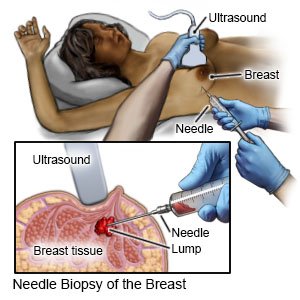
- After your healthcare provider takes samples, he or she may mark the area with a small wire or metal clip. The provider may also inject the area with liquid dye. This will help other healthcare providers find the abnormal tissue at a later time. The provider will remove the needle and apply pressure to the area. You will not need stitches. A small bandage will be placed over your biopsy site. Your healthcare provider may also wrap a tight-fitting bandage across both breasts. This may prevent bleeding, swelling, and pain at the biopsy site.
What will happen after a CNBB?
Healthcare providers will monitor you until you are awake. You may need a mammogram if a marker was inserted during your procedure. This will make sure that it is in the correct place. You may be sore or have bruising or swelling in your breast for a few days. Do not breastfeed for 24 to 48 hours if you received contrast liquid. The contrast liquid may harm your baby. You may go home after your procedure or you may need to spend a night in the hospital.
What are the risks of a CNBB?
You may bleed more than expected or get an infection. A pocket of blood or fluid may form under your skin. You may need surgery to drain or remove it. The biopsy needle may make a hole in your lung and cause trouble breathing. You may need other treatments to fix the hole.
Care Agreement
You have the right to help plan your care. Learn about your health condition and how it may be treated. Discuss treatment options with your healthcare providers to decide what care you want to receive. You always have the right to refuse treatment. The above information is an educational aid only. It is not intended as medical advice for individual conditions or treatments. Talk to your doctor, nurse or pharmacist before following any medical regimen to see if it is safe and effective for you.© Copyright Merative 2024 Information is for End User's use only and may not be sold, redistributed or otherwise used for commercial purposes.
Learn more about Core Needle Breast Biopsy
Care guides
Further information
Always consult your healthcare provider to ensure the information displayed on this page applies to your personal circumstances.