Coarctation Of The Aorta
What is it?
Coarctation Of The Aorta Care Guide
- Coarctation Of The Aorta
- Coarctation Of The Aorta Discharge Care
- En Espanol
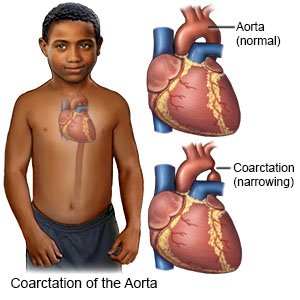
Coarctation (ko-ark-TA-shun) of the aorta is when your child is born with the aorta too narrow at one spot. It is often found when a baby is less than 1 year old. It may not be found until later childhood or adulthood. Children born with coarctation often have other heart problems too.
How does the heart normally work?
The heart has 4 chambers or rooms called the right and left atria (A-tree-uh) and ventricles (VEN-trik-ulls). Blood vessels bring blood from your child's body to the right atrium in your child's heart. The blood moves into the right ventricle where it is pumped into the lungs to get oxygen. The oxygen-rich blood goes into the left atrium and down into the left ventricle. The left ventricle pumps the blood into the aorta and then out to the body where the oxygen can be used.
How does the heart and aorta work with coarctation?
The aorta is the large blood vessel that takes blood away from the heart and out to the body. The narrowed area of the aorta slows blood flow and makes the heart work too hard. The heart muscle may get larger from pumping hard. It must pump harder than usual to push enough blood through the small, narrow area of the aorta. If this happens, the area of the aorta in front of the coarctation may swell up like a balloon. With time, new blood vessels can grow to bypass (go around) the narrow area. There can still be problems even though other blood vessels are helping to move blood. These problems may include heart failure (heart wears out) or a ruptured (burst) aorta.
![]() |
Causes:
No one knows what causes coarctation. Most people with coarctation are born with it. They may not have symptoms until they are in later childhood or even into adulthood. Some diseases like Turner's Syndrome or aortic heart valve problems may cause the aorta to become narrow. Nothing you did caused your child to have coarctation.
Signs and Symptoms:
Some children have problems caused by coarctation while they are babies. Other children may have no symptoms until they are older. Your child may have 1 or more of the following signs and symptoms:
- Very faint or no pulses (feeling of heartbeats) in the groin. The groin is the area where the upper leg meets the belly.
- Blood pressure in your child's arms that is higher than the blood pressure in his legs.
- Cramps and fatigue (tiredness) in the legs. Also, cold legs and feet.
- Dizziness or fainting.
- Eating problems, poor weight gain, and slow growth.
- Fast breathing, shortness of breath, or swollen feet or legs.
- Fatigue (tiredness).
- Heart murmur or other extra heart sounds when caregivers listen to your child's heartbeat.
- Nosebleeds or pounding headaches.
Tests:
Caregivers may order 1 or more of the following tests to see if your child has coarctation. These tests may be done more than once over time. Ask your child's caregiver for the CareNotes™ handouts for more information about the following tests:
- Cardiac Catheterization (kath-uh-ter-ih-ZA-shun): This is a test used to see how well your child's heart is working. It is also used to see how well the arteries and veins connected to the heart are doing. A special tube is threaded into your child's heart through a blood vessel in his arm, leg, or neck. Dye may be given so x-ray pictures of your child's arteries show up better on a TV-like screen. Caregivers may also measure the pressure inside your child's heart.
- Chest X-ray: This is a picture of your child's lungs and heart. Caregivers use it to show if your child's aorta or heart is too large. Caregivers may also use the x-ray to look for abnormal ribs.
- CT Scan:
- This test is also called a "CAT" scan. A special x-ray machine uses a computer to take pictures of your child's heart. Your child's caregivers look at the pictures to look for a notch in the aorta where it is narrow. The CT scan also can show if other blood vessels have grown to take over the work of the aorta.
- Before taking the pictures, your child may be given dye through an IV in his vein. The dye helps the inside and outside of your child's heart show up better in the pictures. People who are allergic to shellfish (lobster, crab, or shrimp) may be allergic to this dye. Tell your child's caregiver if your child is allergic to any of these.
- This test is also called a "CAT" scan. A special x-ray machine uses a computer to take pictures of your child's heart. Your child's caregivers look at the pictures to look for a notch in the aorta where it is narrow. The CT scan also can show if other blood vessels have grown to take over the work of the aorta.
- Esophagogram (e-SOF-uh-go-gram): This type of x-ray uses dye to make the chest, lungs, stomach, and esophagus show up better. The esophagus is the tube that goes from the mouth to the stomach. Problems that babies with coarctation often have, such as trouble eating, can show up on an esophagogram.
- 12 Lead EKG: This test helps caregivers look for damage or problems in different areas of the heart. It can also show if the left or right sides of your child's heart have grown larger. Sticky pads (10) are placed on your child's chest, arms, and legs. Each pad has a wire that is hooked to a machine. This machine prints a paper tracing of your child's heart working. This test takes about 5 to 10 minutes. It is important that your child lie as still as possible during the test. This will help make the best tracing.
- MRI: This test is also called magnetic resonance (REH-zuh-nuns) imaging. During the MRI, pictures are taken of your child's heart. Caregivers use these pictures to look for a notch in your child's aorta where it is narrow. The MRI also can show if other blood vessels have developed to take over the work of your child's aorta.
- Transesophageal (trans-e-SOF-uh-g-ull) echocardiogram (eh-ko-KAR-d-o-gram):
- This test is also called a "TEE". Sound waves are used to show pictures of the size and shape of your child's heart. It also looks at how your child's heart moves when it is beating. These pictures are seen on a TV-like screen. The test is done in a quiet room with the lights turned off. A caregiver gives your child anesthesia medicine to make him go to sleep. If your child is older, numbing medicine can be sprayed into your child's throat.
- A flexible (bendable) tube is put into your child's throat over the area of your child's heart. A transducer is on the end of the tube. It sends out sound waves so caregivers can look at your child's heart and aorta. This test can tell how well your child's heart is pumping. A TEE shows how blood flows in and out of the heart. These tests can also show the size of your child's coarctation.
- This test is also called a "TEE". Sound waves are used to show pictures of the size and shape of your child's heart. It also looks at how your child's heart moves when it is beating. These pictures are seen on a TV-like screen. The test is done in a quiet room with the lights turned off. A caregiver gives your child anesthesia medicine to make him go to sleep. If your child is older, numbing medicine can be sprayed into your child's throat.
- Ultrasound with Color Flow Doppler: This is a test using sound waves to look at your child's heart and aorta. Pictures show up on a TV-like screen. Doppler adds color and sound to show blood flow. Your child may need the ultrasound to see how much the blood flow is obstructed (blocked) by his coarctation.
Treatment Options:
- Medicine: Your child may need 1 or more of the following medicines. Some medicines may be given to your child before surgery. These may be given to keep blood flowing through the narrow part of the aorta.
- Antibiotics (an-ti-bi-AH-tiks): This medicine is used to treat or prevent infections, such as infections of the heart valves. Your child may have to take antibiotics before having dental care or other types of procedures.
- Heart Medicine: This medicine may be needed to decrease the work of the heart if your child's heart is failing.
- Antibiotics (an-ti-bi-AH-tiks): This medicine is used to treat or prevent infections, such as infections of the heart valves. Your child may have to take antibiotics before having dental care or other types of procedures.
- Surgery: Most children need their coarctation repaired by surgery. During surgery, the narrowed part of the aorta is removed. The two ends of the aorta are then sewn together if the gap is small. If the gap is large, a man-made tube graft can be sewn to the two ends of the aorta. A piece of an artery may be used to patch the area instead of using the man-made graft. Surgery is usually done before your child turns 1 or 2 years old.
- Balloon Angioplasty (AN-g-o-plas-tee): Sometimes it is possible to open the coarctation during this procedure. Then your child may not need surgery. Caregivers put a catheter into an artery. Usually an artery in your child's groin is used. Caregivers gently push the catheter up into the coarctation. A balloon at the tip of the catheter is inflated and deflated repeatedly until the coarctation is opened.
Support:
- Coarctation is a life-changing disease for your child and your family. Accepting that your child has heart disease is hard. Your child and those close to you may feel angry, sad, or frightened. These feelings are normal. Talk to your child's caregivers, family, or friends about your feelings. Let them help your child. Encourage those close to your child to talk to caregivers about how things are at home. Your child's caregiver can help your family better understand how to support a person with heart problems.
- You may also want to join a support group. This is a group of people who also have a child with heart problems. Ask your child's caregiver for the names and numbers of support groups in your town. You can contact the following national organizations for more information.
- American Heart Association
7272 Greenville Avenue
Dallas , TX 75231-4596
Phone: 1- 800 - 242-8721
Web Address: http://www.heart.org
- National Heart, Lung and Blood Institute
Health Information Center
P.O. Box 30105
Bethesda , MD 20824-0105
Phone: 1- 301 - 592-8573
Web Address: http://www.nhlbi.nih.gov/health/infoctr/index.htm
- American Heart Association
Risks:
Coarctation can be cured with surgery. If surgery is done while your child is less than 1 year old, your child may lead a normal life. People who do not have their coarctation repaired usually die before they are 40 years old. Unrepaired coarctation can cause the following problems:
- Bleeding in the brain.
- Heart failure.
- High blood pressure.
- Infection (in-FEK-shun) in the heart.
- Stroke.
- Aorta rupture. With time, the aorta could rupture (burst) if the heart pumps so hard that the pressure inside the aorta gets too high.
Care Agreement
You have the right to help plan your child's care. Learn about your child's health condition and how it may be treated. Discuss treatment options with your child's caregivers to decide what care you want for your child.
© 2013 Truven Health Analytics Inc. Information is for End User's use only and may not be sold, redistributed or otherwise used for commercial purposes. All illustrations and images included in CareNotes® are the copyrighted property of the Blausen Databases or Truven Health Analytics.
The above information is an educational aid only. It is not intended as medical advice for individual conditions or treatments. Talk to your doctor, nurse or pharmacist before following any medical regimen to see if it is safe and effective for you.
Learn more about Coarctation Of The Aorta
Drugs associated with:
Related encyclopedia articles: