Thomson Reuters Micromedex

Coarctation Of The Aorta

WHAT YOU SHOULD KNOW:

Coarctation Of The Aorta (Discharge Care) Care Guide

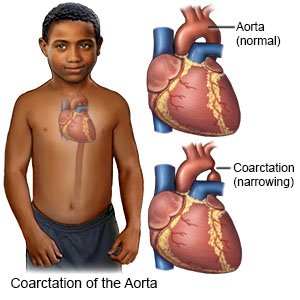
  • Coarctation (ko-ark-TA-shun) of the aorta is when your child is born with the aorta too narrow at one spot. The aorta is the large blood vessel that takes blood away from the heart and out to the body. The narrowed area of the aorta slows blood flow and makes the heart work too hard. The heart muscle may get larger from pumping hard to push enough blood through the small, narrow area of the aorta. If this happens, the area of the aorta in front of the coarctation may swell up like a balloon.

  • With time, new blood vessels can develop to bypass (go around) the narrow area. There can still be problems even though other blood vessels are helping to move blood. These problems may include heart failure or a ruptured (burst) aorta. Children born with coarctation often have other heart problems too. It is often found when a baby is less than one year old. It may not be found until later childhood or adulthood.

  • Some babies with coarctation have eating problems, slow growth, and breathing problems. Some people have no symptoms until they are an older child or adult. Some of these symptoms may be fatigue (tiredness), pounding headaches, dizziness, and nosebleeds. Your child may also have leg fatigue and cramps with exercise, cold feet and legs, and extra heart sounds. Your child may need tests to help plan his care. These tests may include chest x-rays, EKG, echo, esophagogram (e-SOF-uh-go-gram), or an MRI. Treatment may change as your child gets older and may include medicines or surgery.
    Picture of coarctation of the aorta and blood flow

AFTER YOU LEAVE:

Medicines:

  • Keep a written list of what medicines your child takes and when and why your child takes them. Bring the list of your child's medicines or the pill bottles when you visit your child's caregivers. Ask your child's caregiver for more information about the medicines. Do not give any medicines to your child without first asking your child's caregiver. This includes prescriptions, over-the-counter drugs, vitamins, herbs, or food supplements.

  • Always give your child's medicine as directed by caregivers. Call your child's caregiver if you think your child's medicines are not helping. Call if you feel your child is having side effects. Do not quit giving the medicines to your child until you discuss it with your child's caregiver.

  • Never give aspirin to your child without first asking your child's caregiver. Giving aspirin to your child when he is ill may cause a very serious illness called Reye's syndrome. Read medicine labels to see if your child's medicine has aspirin in it.

  • Antibiotics (an-ti-bi-AH-tiks): Your child may be given antibiotics before having dental care or other procedures. Taking antibiotics first may help prevent bacterial (bak-TEER-e-ull) endocarditis (end-o-kar-DI-tis), which is an infection of the heart. When you give your child antibiotics, make sure you give them until they are all gone.

  • Heart Medicine: Your child may be given heart medicine to decrease the work of the heart if your child's heart is failing.

Appointment:

Ask for more information about where and when to take your child for follow-up visits:

For continuing care, treatments, or home services for your child, ask for information.

Providing a balanced diet:

  • Make sure your child eats healthy foods from all of the 5 food groups: fruits, vegetables, breads, dairy products, meat and fish. Eating healthy foods may help your child feel better and have more energy.

  • You may also be told to limit the amount of salt your child eats. This may mean that salt should not be added to food during meals or when you cook. Ask for the CareNotes™ handout about low sodium diets for more information.

  • It can take time getting used to a new diet. Special cook books may help the cook in the family find new recipes.

Drinking enough liquids:

Follow caregiver's advice if your child must change the amount of liquid he drinks. For most people, healthy liquids to drink are water, juices, and milk. Limit the amount of caffeine your child drinks and eats. Caffeine may make your child urinate too much and lose too much body fluid. Caffeine may be found in coffee, tea, soda pop, and some sports drinks and foods. Help your child drink enough liquid each day, and not just when your child feels thirsty. Ask your caregiver how much liquid he should drink each day.

High blood pressure:

Your child may have high blood pressure because of the coarctation. Caregivers may want you to learn how to take your child's blood pressure. You may be asked to measure the blood pressure in each arm and thigh (upper leg). Ask for the CareNotes™ handout about how to take a blood pressure.

Changes in your child's normal living:

If the coarctation is not repaired, your child may have serious problems with how blood flows through his aorta. These problems may cause your child to be tired and have leg and foot pain. This may force your child to be less physically active. Work with caregivers to find ways to keep your child as active as possible without making your child's symptoms worse.

Wellness Hints:

  • Smoking around your child harms the lungs and the blood and can make coarctation worse. You are more likely to have a heart attack, lung disease, and cancer if you smoke. You will help yourself and your child by not smoking. It is never too late to quit smoking if you smoke. Ask your child's caregiver for the CareNotes™ handout on how to stop smoking if you are having trouble quitting.

  • Stress may cause heart problems to worsen. Since it is hard to avoid stress, help your child learn to control it. Help your child learn new ways to relax (deep breathing, relaxing muscles, meditation, or biofeedback). Talk to someone about things that upset your child. Help your child talk about his thoughts and feelings about having heart problems.

Support:

  • Coarctation is a life-changing disease for your child and your family. Accepting that your child has heart disease is hard. Your child and those close to you may feel angry, sad, or frightened. These feelings are normal. Talk to your child's caregivers, family, or friends about your feelings. Let them help your child. Encourage those close to your child to talk to his or her caregivers about how things are at home. Your child's caregiver can help your family better understand how to support a person with heart problems.

  • You may also want to join a support group. This is a group of people who also have a child with heart problems. Ask your child's caregiver for the names and numbers of support groups in your town. You can contact the following national organizations for more information.
    • American Heart Association
      7272 Greenville Avenue
      Dallas , TX 75231-4596
      Phone: 1- 800 - 242-8721
      Web Address: http://www.heart.org
    • National Heart, Lung and Blood Institute
      Health Information Center
      P.O. Box 30105
      Bethesda , MD 20824-0105
      Phone: 1- 301 - 592-8573
      Web Address: http://www.nhlbi.nih.gov/health/infoctr/index.htm

CONTACT A CAREGIVER IF:

  • Your child has a fever.

  • You cannot feel a pulse in one of your child's wrists, feet, or groin. The groin is where the top of your child's leg meets his belly.

  • Your child has chills, a cough, or feels weak and achy. These are signs that your child may have an infection.

  • Your child's skin is itchy, swollen, or has a rash. Medicine may be causing these symptoms. This may mean your child is allergic (uh-LER-jik) to his medicine.

  • Your child's coarctation symptoms return or get worse.

  • You have questions or concerns about your child's heart problems or medicine.

SEEK CARE IMMEDIATELY IF:

  • Your child has trouble breathing all of a sudden.

  • Your child is too dizzy to stand.

  • Your child has severe pain in the chest or belly.

Copyright © 2012. Thomson Reuters. All rights reserved. Information is for End User's use only and may not be sold, redistributed or otherwise used for commercial purposes.

The above information is an educational aid only. It is not intended as medical advice for individual conditions or treatments. Talk to your doctor, nurse or pharmacist before following any medical regimen to see if it is safe and effective for you.

Learn more about Coarctation Of The Aorta (Discharge Care)

Advertisement
Close

Recommended

(web2)