close :

:

Forgotten your password?
 
Consumer Information
Print Print   
Carenotes > Children And Hearing Aids

Children And Hearing Aids

GENERAL INFORMATION:

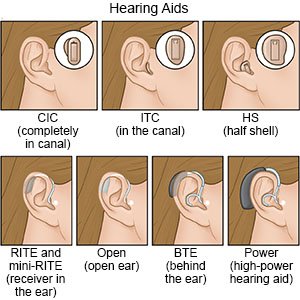
What is a hearing aid? A hearing aid is a small electronic device placed behind or in your child's ear. A hearing aid will help him hear sounds better. It contains a small microphone, an amplifier, and a speaker. The microphone receives sound and changes it into an electrical signal. The amplifier increases the loudness of the signal. The speaker receives the signal, changes it back to sound waves, and sends the sound waves to the inner ear. A hearing aid can help your child if he has mild to moderate hearing loss.

How does an ear work? The outer ear flap catches sound waves and sends them to your child's eardrum. The eardrum separates your child's outer ear from his middle ear. Sound strikes the eardrum and is sent through three bones in the middle ear to the inner ear. The inner ear is a fluid-filled space containing the cochlea. The cochlea has many cells that can feel the fluids move. When the cells feel the fluid move, nerve impulses (messages) are sent to the nervous system. The impulses travel through the hearing part of the nervous system before they reach your child's brain. Hearing loss may be caused by problems in any part of the ear or nervous system. Hearing loss may be present in one or both ears.

What causes hearing loss? The cause of hearing loss may be unknown. In some cases, the following may cause hearing loss in children:

  • Congenital causes: This means that your child was born with hearing loss. Genes are tiny pieces of information in the body that tell it what to do or what to make. Your child may have genes that cause hearing loss. Congenital hearing loss may be caused by infections, or the use of drugs or alcohol by a woman when she is pregnant. Babies that are born earlier than expected and weigh very little are at higher risk of having hearing loss.

  • Acquired causes: This means that your child lost his normal hearing at some point after he was born. Childhood infections such as mumps, use of certain medicines, and head injuries can cause acquired hearing loss. The immune system of the body works to protect a person from germs. Diseases of your child's immune system may cause hearing loss. Loud noise, objects such as toys stuck in his ear, or lots of ear wax can cause hearing loss. Growths in his ear canal, radiation treatment, or surgery around the head area can also cause hearing loss.

What are the signs and symptoms of hearing loss? Your baby may be checked for hearing loss as soon as he is born. Even if no hearing loss is found right away, children can show signs of hearing loss over time. Hearing problems may not be seen until your child is at the age when he should be talking. You may see other signs, such as problems walking, that are related to your child's hearing loss. You may find that your baby does not respond to noises as you would expect, or as other children do. Your older child may have trouble understanding or learning speech. He may have problems learning things at school.

How is hearing loss tested for and measured? You may need to take your child to see caregivers that specialize in hearing loss in children. The following may be used to test for and measure the amount of hearing loss:

  • Behavioral observation audiometry: This is a test used for infants (less than one year of age) to see their behavior when they hear certain sounds.

  • Visual reinforcement audiometry: This test is used for children who are very young. Lights or toys are used to make the child respond. Caregivers watch how he responds, which tells them more about his hearing loss.

  • Play audiometry: This is a test that uses a machine to send sounds at different volumes and pitches into your child's ears. Your child wears earphones and is asked to touch or move a toy every time a sound is heard.

  • Tympanometry: This test helps see how the middle ear is working by looking for pressure changes in the ear.

What types of hearing aids are used for children?

  • Behind the ear: A small plastic case rests behind your child's ear. It is connected to a tube that goes to a mold. A mold is a small plastic piece that fits into your child's ear. This type of hearing aid is the style that is most often selected for infants and young children.

  • In the ear: This small plastic piece fits in your child's outer ear. This style is usually not used until children are 7 or 8 years old, when their ears are bigger.

  • Completely in the ear: This is a tiny plastic piece that fits entirely in your child's ear canal. It is rarely used in children.

  • In the ear canal: This type has a very small plastic piece that fits half way into your child's ear canal. It is rarely used in children.

  • Body aid: This type of aid has a small box and a cord that goes to an earpiece. This style is not best for children because of the different pieces and the cord. It is bulky and hard for children to manage. It cannot be tailored to meet your child's needs, and children may have trouble hearing well with it. While it may be used for a short amount of time, it is usually replaced with a different hearing aid.

What can I do to help my child hear better?

  • Avoid having your child around loud noise, as this can prevent more hearing loss. This includes the noise of guns being fired, fireworks, loud music, motorcycles, and power tools.

  • Decrease background noise at places such as restaurants by having your child sit at a table with his back to the wall. Place him in the center of where most people are talking. Have him sit in a location where he can clearly see the faces of the people who are talking.

  • Face your child when you speak to him, and do not cover your mouth as you speak. Ask people not to shout or mumble when they speak to your child. People should speak using their usual tone and volume.

  • Hearing aid molds need to be replaced as your child grows. The ear molds must fit well in your child's ears to prevent feedback. Feedback is sound that leaks around or through the ear mold, making it harder for your child to hear.

  • If your child has hearing loss in both ears, it is better to have an aid for each ear. Using two aids will help him hear better than using only one aid.

  • If your child has hearing loss, yet is able to hear some things, he should still get a hearing aid. Even a small amount of hearing loss makes it harder for a child to speak and learn.

  • It may be hard to make sure your child wears the hearing aids. Have your child wear the aids as much as possible. When a small infant is feeding, or during a child's tantrum, you may leave the aids out if needed for a period of time. Ask your caregivers about headbands and other devices that can help hold the hearing aids in place on your child.

  • Keep your child's ears clean. Ear wax and dirt in your child's ears make feedback worse. Watch your child for signs of an ear infection. Ear infections can worsen feedback and lead to pain and more hearing loss. Ask caregivers for more information about signs of an ear infection.

  • Make and attend all appointments with your child's caregivers. Your child's hearing loss may change as he grows, so he will need regular appointments to check for changes. You may need appointments with an audiologist or speech-language pathologist. These caregivers may work with your child and your family. If you have a school-age child with hearing loss, ask caregivers about aids that will work with listening devices in a classroom. These listening aids will make it easier for your child to hear a teacher and other classmates.

How do I care for my child's hearing aid? Ask caregivers to talk to you about the following:

  • A warranty for the aid, and insurance in case it is lost or broken.

  • Changing the volume of the hearing aid (if needed).

  • Charging and changing the batteries in the hearing aid. Batteries may need to be changed every 1 to 2 weeks.

  • Cleaning and care of the hearing aid.

  • How to teach older children to use the telephone with the aid in place.

  • Putting in and taking out the hearing aid.

  • Turning the aid on and off.

  • Using the remote control and memory (if the aid has these features).

Where can I find support and more information? Having a child with hearing loss can be hard for your and your family. Talk to caregivers about your feelings. You may want to see a family counselor. This caregiver may suggest ways to help you and your family support and understand a child who has hearing loss. Contact the following for more information:

  • American Hearing Research Foundation
    8 South Michigan Avenue, Suite 814
    Chicago, IL 60603-4539
    Phone: 1-312-726-9670
    Web Address: http://www.american-hearing.org
  • Better Hearing Institute
    515 King Street, Suite 420
    Alexandria, VA 22314
    Phone: 1-703-684-3391
    Web Address: www.betterhearing.org

CARE AGREEMENT:

You have the right to help plan your child's care. To help with this plan, you must learn about your child's health condition and how it may be treated. You can then discuss treatment options with your child's caregivers. Work with them to decide what care may be used to treat your child.


Join Drugs.com
Click here to see what benefits you can get by joining our FREE membership programme.
Drugs.com is the most popular, comprehensive, and up-to-date source of drug information online. Providing advice on more than 24,000 prescription drugs and over-the-counter medicines for consumers and professionals .
Advertisement
In The Pipeline
Save bookmark to...