Thomson Reuters Micromedex

Bronchiectasis In Children

WHAT YOU SHOULD KNOW:

Bronchiectasis In Children (Inpatient Care) Care Guide

  • Bronchiectasis is a lung condition where your child's bronchi become too wide and build up mucus in them. Your child's bronchi are medium-sized airways (tubes) that carry air in and out of his lungs. Your child's lungs make mucus to trap and remove germs and irritants that he breathes in. The mucus made in his lungs is also called phlegm. Your child's airways are lined with ciliated cells that help move the mucus out of his lungs. With bronchiectasis, your child's airways are damaged and he will have trouble clearing the mucus out. The mucus stays in his airways and germs may grow in it, causing new and repeated lung infections. Over time, this can cause your child's airways to swell, stretch out, and scar.
    Picture of the normal respiratory system


  • Bronchiectasis is caused by having repeated infections and inflammation (swelling) in the lungs. Inflammation can be caused by diseases that damage your child's lungs, infections, and immune system problems. Other causes include things that irritate or block your child's airways. Your child may have an ongoing cough, trouble breathing, or cough up large amounts of phlegm (mucus). Your child may feel tired and weak, wheeze when breathing, have sinus or nasal drainage, and chest pain. A chest x-ray, computed tomography (CT) scan, and sputum samples may help learn more about your child's condition. Treatment includes medicines, chest physiotherapy, and possibly oxygen and surgery if other treatments fail. Early treatment may improve your child's symptoms and prevent further damage to his airways.

CARE AGREEMENT:

You have the right to help plan your child's care. Learn about your child's health condition and how it may be treated. Discuss treatment options with your child's caregivers to decide what care you want for your child.

RISKS:

Medicines to treat bronchiectasis may cause an allergic response. The medicines may also make your child dizzy, increase his heartbeat, and cause weight gain and skin problems. If your child needs surgery, he may bleed more than usual and get an infection. If bronchiectasis is left untreated, your child's airways may thicken and fill with mucus. Too much mucus in your child's airways may make it hard for him to move air through them. The pressure in your child's pulmonary artery (blood vessel) may increase and lead to right-sided heart failure. Your child may have chronic (long-lasting or repeated) respiratory failure, life-threatening lung bleeding, and he may die. Ask your child's caregiver if you have questions about his condition, medicines, or care.

WHILE YOU ARE HERE:

Informed consent:

A consent form is a legal document that explains the tests, treatments, or procedures that your child may need. Informed consent means you understand what will be done and can make decisions about what you want. You give your permission when you sign the consent form. You can have someone sign this form for you if you are not able to sign it. You have the right to understand your child's medical care in words you know. Before you sign the consent form, understand the risks and benefits of what will be done to your child. Make sure all of your questions are answered.

Blood tests:

Your child may need blood tests to give caregivers information about how his body is working. The blood may be taken from your child's arm, hand, finger, foot, heel, or IV.

Oxygen:

Your child may need oxygen if his blood oxygen level is lower than it should be. Oxygen will help your child breathe easier. Your child may get oxygen through small tubes placed in his nostrils, or through a mask. He may instead be placed in an oxygen tent. Never take off your child's oxygen tubes or mask or remove him from the tent without asking his caregiver first.

IV:

An IV is a small tube placed in your child's vein. Caregivers use the IV to give your child medicine or liquids.

Vital signs:

Caregivers will check your child's blood pressure, heart rate, breathing rate, and temperature. They will also ask you or your child about his pain. These vital signs give caregivers information about your child's current health.

Medicines:

Your child may have any of the following:

  • Antibiotics: This medicine is given to help prevent or treat an infection caused by bacteria.

  • Anti-inflammatory medicines: These are also known as non-steroidal anti-inflammatory drugs or NSAIDs. They may help decrease your child's pain and inflammation. Some NSAIDs may be given to decrease your child's high body temperature (fever). This medicine can cause stomach bleeding or kidney problems in certain people. Always read the medicine label and follow the directions before giving this medicine to your child.

  • Bronchodilators: Bronchodilators may be given to help open the air passages in your child's lungs to help him breathe easier.

  • Expectorants: These medicines will help thin your child's sputum (mucus from the lungs). When sputum is thin, it may be easier for him to cough it up and spit it out. This may help your child breathe easier, and may help him get better faster.

  • Immune globulins: This may be given to help your child's immune system fight infection. Ask your caregiver for more information about how immune globulin medicine may help your child.

  • Steroid medicine: Steroid medicine may help to open your child's air passages so he can breathe easier.

Tests:

  • Chest x-ray: This is a picture of your child's lungs and heart. A chest x-ray may be used to check your child's heart, lungs, and chest wall. It can help caregivers diagnose your child's symptoms, or suggest or monitor treatment for medical conditions.

  • Fiber-optic bronchoscopy: A bronchoscopy test may be done to look inside your child's airways and lungs. His caregiver will use a bronchoscope to do this test. A bronchoscope is a long tube with a light and magnifying glass on the end. Your child's caregiver may give him medicine for pain or to help him relax during the test. The scope will be put in your child's mouth and down into his lungs. Caregivers may also do a bronchoalveolar lavage (BAL) through the scope. This is when fluid and cells are sucked up from your child's lungs and tested in a lab. Ask your child's caregiver for more information about this test.

  • High resolution computed tomography scan: This test is also called a CT scan or HRCT scan. A special x-ray machine uses a computer to take pictures of your child's chest and airways. It may also be used to look at other body organs such as bones, tissues, or blood vessels. Your child may be given dye before the pictures are taken. The dye helps your child's caregiver see the pictures better. People who are allergic to shellfish (lobster, crab, or shrimp) may be allergic to some dyes. Tell your child's caregiver if he is allergic to shellfish or has other allergies.

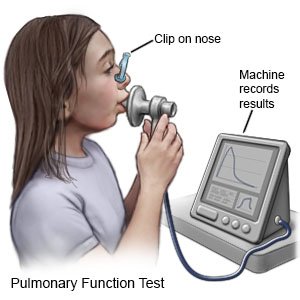
  • Pulmonary function test: This test helps your child's caregiver learn how well your child's lungs move and work. It also helps your child's caregiver decide on the best treatment for him. During the test, your child breathes into a mouthpiece connected to a machine. The machine measures how much air he breathes in and out over a certain amount of time.

  • Sputum sample: Your child's sputum (mucus) is collected in a special cup and sent to a lab for tests. The sputum may show what germ is causing your child's illness. It may also help your child's caregiver choose what medicine is best for him.

Treatment options:

  • Airway clearance techniques: Airway clearance techniques (ACTs) can be used to help loosen mucus in your child's airways. Once the mucus is loose, he will be able to cough it up and out, and he may breathe better. Your child may need to use special devices to help with his ACTs. Doing these therapies on a set schedule may help decrease your child's symptoms quicker.

    • Airway oscillation: This is a device that works by vibrating your child's airways as he breathes out through it. Your child will need to breathe in and fill his lungs, and hold his breath for 2 to 3 seconds. He then puts the device tightly to his mouth and breathes out normally through it.

    • Chest wall oscillation: This therapy uses a special vest that your child can wear. It is attached to a machine that causes the vest to vibrate your child's chest.

    • Percussion: You will need to forcefully pat on your child's back with a cupped hand or soft plastic cup. This is done to loosen mucus that is stuck in his airways. Ask your child's caregiver to show you how to do percussion on your child.

    • Positive expiratory pressure therapy: PEP therapy uses a device that keeps some air in your child's airways when he breathes out. This helps him prevent trapping mucus in his small airways so he can more easily cough it up.

    • Postural drainage: This therapy is designed to help drain mucus from different areas of your child's lung. Your child's caregiver will show you to help position your child for this therapy.

  • Surgery: This is done to remove the damaged part of your child's lung that is causing his symptoms. Surgery is normally only done if treatment with medicines has failed. Ask your caregiver for more information about this treatment.

Copyright © 2012. Thomson Reuters. All rights reserved. Information is for End User's use only and may not be sold, redistributed or otherwise used for commercial purposes.

The above information is an educational aid only. It is not intended as medical advice for individual conditions or treatments. Talk to your doctor, nurse or pharmacist before following any medical regimen to see if it is safe and effective for you.

Learn more about Bronchiectasis In Children (Inpatient Care)

Advertisement
Close

Recommended

(web6)