
Atrial Septal Defect in Children
Medically reviewed by Drugs.com. Last updated on Sep 1, 2024.
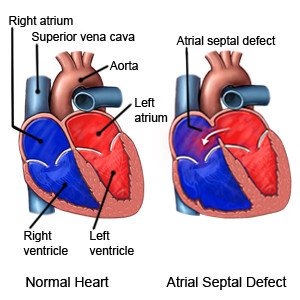
An atrial septal defect (ASD) is a hole in the septum (wall) between the upper chambers (atria) of your child's heart. The hole may be small or large. An ASD causes a problem with the way blood moves through your child's heart. This makes his or her heart work harder to pump blood. Over time, an ASD can damage your child's heart and lungs. An ASD can also lead to a stroke if a blood clot is pumped out to a blood vessel in your child's brain.
 |
WHILE YOU ARE HERE:
Informed consent
is a legal document that explains the tests, treatments, or procedures that your child may need. Informed consent means you understand what will be done and can make decisions about what you want. You give your permission when you sign the consent form. You can have someone sign this form for you if you are not able to sign it. You have the right to understand your child's medical care in words you know. Before you sign the consent form, understand the risks and benefits of what will be done to your child. Make sure all of your questions are answered.
Stay with your child for comfort and support
as often as possible while he or she is in the hospital. Ask another family member or someone close to the family to stay with your child when you cannot be there. Bring items from home that will comfort your child, such as a favorite blanket or toy.
Your child may need extra oxygen
if his or her blood oxygen level is lower than it should be. Oxygen may be given through a mask or through small tubes placed in your child's nostrils. Ask a healthcare provider before you take off the mask or tubing.
Monitoring:
- A heart monitor is an EKG that stays on all of the time to record your child's heart's electrical activity.
- A pulse oximeter is a device that measures the amount of oxygen in your child's blood.
Medicines:
- Medicines may be given to control your child's heartbeat or decrease stress on his or her heart. Medicines may also be given to lower pressure in your child's lungs.
- Blood thinners may be given to prevent blood clots. This medicine may make your child bleed or bruise more easily.
- Diuretics help remove extra fluid from your child's body. Your child may urinate more than usual while he or she is taking this medicine.
Tests:
- Blood and urine tests show your child's kidney function and give information about his or her overall health.
- An EKG test records your child's heart rhythm and how fast his or her heart beats. It is used to check for abnormal heartbeats and other heart problems.
- X-ray, CT, or MRI pictures will show the size and location of your child's ASD. It may also show problems in his or her heart or lungs, such as enlarged heart. Do not let your child enter the MRI room with anything metal. Metal can cause serious injury. Tell the healthcare provider if he or she has any metal in or on his or her body.
- An echocardiogram is a type of ultrasound. Sound waves are used to show the size of the ASD and how blood flows through your child's heart. It can also show how well his or her heart is pumping. Your child may need a transthoracic or transesophageal echocardiogram. Ask his or her healthcare provider about these types of echocardiogram.
- A cardiac catheterization is a test used to show how well your child's heart is working or to measure pressure. A tube is guided into his or her heart through a blood vessel in his or her leg or arm. He or she may be given contrast liquid to help his or her heart show up better in pictures. Tell his or her healthcare provider if he or she has ever had an allergic reaction to contrast liquid.
Treatment:
- Open heart surgery may be needed to close the ASD with stitches or a patch.
- Cardiac catheterization is a procedure that is used to close the ASD through a catheter (thin tube). The catheter is placed into an artery in your child's groin and guided up to his or her heart. A small stitch or patch is used to close the hole.
RISKS:
An ASD may cause your child to have an abnormal heartbeat. It may also cause damage to his or her lungs, or heart failure. As your child gets older, blood clots can develop and cause a stroke. Any of these problems can become life-threatening.
CARE AGREEMENT:
You have the right to help plan your child's care. Learn about your child's health condition and how it may be treated. Discuss treatment options with your child's healthcare providers to decide what care you want for your child.© Copyright Merative 2024 Information is for End User's use only and may not be sold, redistributed or otherwise used for commercial purposes.
The above information is an educational aid only. It is not intended as medical advice for individual conditions or treatments. Talk to your doctor, nurse or pharmacist before following any medical regimen to see if it is safe and effective for you.
Learn more about Atrial Septal Defect
- Atorvastatin (Lipitor): Top 12 Drug Facts You Need to Know
- Do blood pressure drugs interact with alcohol?
Treatment options
Care guides
- Adult Congenital Heart Disease
- Atrial Septal Defect
- Atrial Septal Defect in Children
- Congenital Heart Disease in Children
Medicine.com guides (external)
Further information
Always consult your healthcare provider to ensure the information displayed on this page applies to your personal circumstances.