Home CareNotes Asthma In Children
Thomson Reuters Micromedex

Asthma In Children

WHAT YOU SHOULD KNOW:

Asthma In Children (Discharge Care) Care Guide

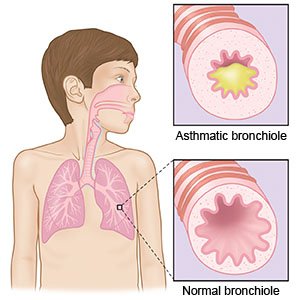
  • Asthma is a long-term condition of inflammation (irritation, redness, and swelling) in the airways of the lungs. The airways are small tubes where air passes through to go in and out of your child's lungs. An asthma attack (episode of asthma) usually happens after your child is exposed to triggers. Triggers are things that may cause your child's airways to react by getting smaller and becoming inflamed. Being around pets, dust, or smoke, or playing too hard are some things that may trigger asthma attacks. During an asthma attack your child's airways tighten, make too much mucus, and swell even more. A very bad asthma attack is known as an asthma exacerbation. With these attacks, your child's symptoms last longer and are more serious.

  • Coughing, trouble breathing, and wheezing are the most common signs and symptoms of asthma. Your child may have a hard time doing physical activities. To find out if your child has asthma, his caregiver will ask about his symptoms and examine him. His caregiver may do tests for peak flow, pulmonary function, allergy and imaging tests. Your child's caregivers will teach you about your child's asthma, including how to control and treat it. They will give your child asthma medicines and teach him when and how to use them. Your child's medicines may be changed if his symptoms get better or worse. There is no cure for asthma, but the condition can be controlled and asthma attacks can be prevented.

AFTER YOU LEAVE:

Medicines:

  • Keep a current list of your child's medicines: Include the amounts, and when, how, and why they are taken. Bring the list and the medicines in their containers to follow-up visits. Carry your child's medicine list with you in case of an emergency. Throw away old medicine lists. Give vitamins, herbs, or food supplements only as directed.

  • Give your child's medicine as directed: Call your child's primary healthcare provider if you think the medicine is not working as expected. Tell him if your child is allergic to any medicine. Ask before you change or stop giving your child his medicines.

  • Short-acting bronchodilators: Short-acting bronchodilators may be given to your child to help open his airways. These medicines start to work right away and are used to relieve sudden, severe symptoms, such as trouble breathing. These medicines may be called relievers or rescue inhalers. This type of medicine may come in a device called an inhaler, or given using a nebulizer (breathing machine).

  • Long-acting bronchodilators: Long-acting bronchodilators may be called controllers. This medicine helps open the airways over time, and is used to decrease and prevent breathing problems. Long-acting bronchodilators should not be used to treat your child for sudden, severe symptoms, such as trouble breathing. This type of medicine may come in a device called an inhaler.

  • Leukotriene inhibitors: These medicines can decrease the swelling in your child’s lungs. They may stop your child from having more wheezing or shortness of breath. They may also prevent your child’s attacks from lasting for long periods.

  • Mast cell stabilizers: Mast cells are found in the smaller tubes in your child’s lungs. They are in charge of releasing some chemicals that can cause your child’s airways to narrow. This kind of medicine may help prevent your child’s lungs from having more swelling.

  • Corticosteroids: These medicines help decrease swelling and open your child's air passages so he can breathe easier. They can be inhaled (breathed in) or taken by mouth (swallowed). Your child may need higher doses of corticosteroids if he has very bad asthma attacks. Give this medicine as ordered by your child's caregiver. Stopping this medicine without the caregiver's OK may cause a bad response.

Ask for more information about where and when to take your child for follow-up visits:

For continuing care, treatments, or home services for your child, ask for information.

Helping your child control his asthma or prevent asthma attacks:

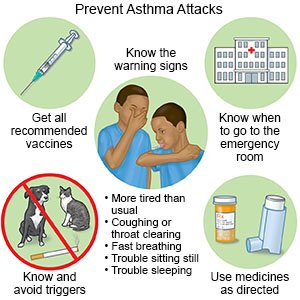
  • Avoid asthma triggers. Your child needs to stay away from things that trigger an asthma attack or make his symptoms worse.

    • Foods: Do not let your child eat foods to which he is allergic. Tell other people with whom he may eat or share meals about his food allergies.

    • Smoking: Never smoke cigarettes or tobacco products around your child or let others smoke around him. Do not let your adolescent-aged (teenager) child smoke cigarettes.

    • Remove triggers in your child's living areas: You child's caregiver may recommend taking things out of your child's bedroom and other areas of your home. These are things that could hold allergens or other asthma triggers. This may include removing carpeting, fabric-covered furniture, drapes, and stuffed animals.

      • Bedding: Keeping your child's bedding free of allergens and irritants is very important. You may need to use special covers for your child's mattresses and pillows. These covers do not let dust mites pass through or live inside the pillow or mattress. Wash your child's bedding at least once a week in very hot water (at least 130 degrees).

      • Cleaning: You may want to clean your floors and carpets with a vacuum that traps dust and allergens. Try not to use harsh cleaning products in your home that give off irritating fumes.

      • Pets: Keep pets, such as cats and dogs, out of your child's bedroom and outside if possible. Cat dander is a bad asthma trigger for many children.

      • Pests: If you have cockroaches or other insect or rodent pests in your home, get rid of them right away. Clean the floors and other surfaces in your home often to remove dead pest parts and droppings.

      • Reduce triggers in the air: Keep windows closed during the seasons when pollens and molds are at the highest, such as spring. Make sure air flows freely through all the rooms in your house. Use air conditioning to control the temperature and humidity in your house. Keep your child away from wood burning stoves and fireplaces, and from chemical fumes (gas vapors) and dust. You may want to use special filters on your furnace to help clean the air inside your house.

  • Follow the written asthma action plan for your child and teach him about it. An asthma action plan is the plan made by your child's caregiver for controlling your child's asthma. Keep a copy of this action plan with you and with your child at all times. Meet with your child's school nurses, teachers, coaches, and give them a copy of your child's action plan. Make a kit with a copy of the action plan and the medicines your child would need in case of an asthma attack.

  • Help your child use his medicines exactly as ordered by his caregiver. If your child is given controller medicines, make sure he uses them as ordered by his caregiver. Your child should carry his rescue inhaler with him at all times.

  • Protect your child from getting respiratory infections. If your young child gets this type of infection, he can have a bad asthma attack. Keep your child away from people with colds and the flu. He may also need vaccines to help protect his body from infection. Ask your child's caregiver if your child should get shots to help prevent the flu and pneumonia.

Asthma action plan:

An action plan is the plan made by your child's caregiver for controlling your child's asthma. Keep a copy of this action plan with you and with your child at all times. Meet with your child's school nurses, teachers, coaches, and give them a copy of your child's action plan. Make a kit with a copy of the action plan and the medicines your child would need in case of an asthma attack. The plan should include the following:

  • Early warning signs and symptoms: These are the early signs your child often shows when his asthma is starting to get worse. These may include a drop in your child's peak flow meter reading. Other signs, such as chest tightness, coughing, shortness of breath, and wheezing may also be included.

  • Asthma triggers: The plan should include a list of triggers that may cause your child's asthma attack. This can help you and your child know which triggers to avoid.

  • Medicines and dosage amount to give: The medicine information should include a list of all the medicines your child takes regularly to control his asthma. It should also include a list of rescue (quick-relief) medicines to give if your child has an asthma attack. It should also include instructions on how and when to use each medicine. Help your child use his medicines exactly as ordered by his caregiver.

  • Treatment instructions for worsening symptom: These should explain what your child's symptoms may be and how to know if his asthma is getting worse. It should tell you how to increase his medicines if his asthma symptoms get worse. It should also tell you when you should call 911 or seek immediate care for your child.

  • Emergency contact telephone numbers: These include the telephone numbers for you and your family members. This should also include numbers for your child's caregiver, an ambulance service, and the nearest hospital.

  • When to follow up with your child's caregiver: Information about when to follow up with your child's caregiver should be easy to find. If you are not sure or this information is missing, ask your child's caregivers.

Warning signs of an asthma attack:

Your child may have warning signs before an asthma attack happens. Warning signs are signs and symptoms that your child feels when his asthma is getting worse. These warning signs are not the same for every child. Your child's own warning signs may even be different from time to time. You and your child should learn what his usual warning signs are. By learning his warning signs, your child can take his medicines, or get help right away. Doing this may help prevent serious asthma attacks. Warning signs of an asthma attack may be one or more of the following signs or complaints:

  • Breathing faster than normal.

  • Coughing.

  • Fast heartbeat.

  • Fussy, irritable, or feeling more tired and sleepy than usual.

  • Pain or tight feeling in the chest.

  • Shortness of breath (cannot catch his breath), causing trouble doing an activity or speaking in long sentences.

For more information:

Having asthma can be hard for your child and your family. Learning more about your child's condition can help control his asthma. You and your child may want to join a support group with other people who have asthma. Contact the following for more information:

  • American Academy of Allergy, Asthma, and Immunology
    555 E. Wells St, Suite 1100
    Milwaukee , WI 53202-3823
    Phone: 1- 800 - 822-2762
    Web Address: http://www.aaaai.org
  • National Asthma Education and Prevention Program
    National Heart, Lung and Blood Institute
    National Asthma Education and Prevention Program
    P.O. Box 30105
    Bethesda , MD 20824-0105
    Phone: 1- 301 - 592-8573
    Web Address: http://www.nhlbi.nih.gov/about/naepp/

CONTACT A CAREGIVER IF:

  • Your child is coughing more than the usual, wheezing, and has trouble breathing.

  • Your child's medicines do not relieve his symptoms like they used to.

  • Your child's symptoms slow him down or stop him from doing certain activities.

  • You and your child have questions or concerns about your child's condition or medicines.

SEEK CARE IMMEDIATELY IF:

  • Your child is having a bad asthma attack and cannot catch his breathe even after taking his rescue medicine.

  • Your child has trouble thinking or loses consciousness.

  • Your child has very bad pain in his chest.

  • Your child's lips or fingernails turn gray or blue.

Copyright © 2011. Thomson Reuters. All rights reserved. Information is for End User's use only and may not be sold, redistributed or otherwise used for commercial purposes.

The above information is an educational aid only. It is not intended as medical advice for individual conditions or treatments. Talk to your doctor, nurse or pharmacist before following any medical regimen to see if it is safe and effective for you.

Learn more about Asthma In Children (Discharge Care)

(web4)