Ruxolitinib Phosphate (Topical) (Monograph)
Brand name: Opzelura
Drug class: Janus Kinase Inhibitors
Warning
- Serious Infection
-
Serious and sometimes fatal infections, including tuberculosis (pulmonary or extrapulmonary disease), bacterial and viral infections, invasive fungal infections, and other opportunistic infections, reported in patients receiving oral Janus kinase (JAK) inhibitors to treat inflammatory conditions.
-
Avoid use in patients with a serious active infection, including localized infections. Carefully consider risks and benefits prior to initiating topical ruxolitinib therapy in patients with a chronic or recurring infection.
-
Closely monitor patients for infection during and after treatment. If a serious infection develops, interrupt ruxolitinib therapy until infection is controlled.
- Mortality
-
Higher overall mortality rate reported in patients receiving oral JAK inhibitors to treat inflammatory conditions.
- Malignancies
-
Lymphoma and other malignancies reported in patients receiving oral JAK inhibitors to treat inflammatory conditions.
- Cardiovascular Events
-
Major adverse cardiovascular events (MACE) including MI, stroke, and sudden cardiovascular death reported in patients receiving oral JAK inhibitors to treat inflammatory conditions.
- Thrombosis
-
Serious and sometimes fatal thrombotic events, including DVT, PE, and arterial thrombosis, reported in patients receiving oral JAK inhibitors to treat inflammatory conditions.
-
Promptly evaluate patients if symptoms of thrombosis develop.
Introduction
Selective inhibitor of Janus kinase (JAK) 1 and 2.
Uses for Ruxolitinib Phosphate (Topical)
Atopic Dermatitis
Used topically as a 1.5% cream for short-term and non-continuous chronic treatment of mild to moderate atopic dermatitis in non-immunocompromised adults and pediatric patients ≥12 years of age whose disease is not adequately controlled with topical prescription agents or when these therapies are not advisable.
Concomitant use of ruxolitinib with therapeutic biologics, other JAK inhibitors, or potent immunosuppressants (e.g., azathioprine or cyclosporine) is not recommended.
American Academy of Dermatology guideline for use of topical therapies for atopic dermatitis strongly recommends ruxolitinib cream for mild-to-moderate disease.
Vitiligo
Used topically as a 1.5% cream for treatment of nonsegmental vitiligo in adults and pediatric patients ≥12 years of age.
Concomitant use of ruxolitinib with therapeutic biologics, other JAK inhibitors, or potent immunosuppressants (e.g., azathioprine or cyclosporine) is not recommended.
Ruxolitinib Phosphate (Topical) Dosage and Administration
General
Pretreatment Screening
-
Consider benefits and risks of serious infections (observed in patients receiving oral JAK inhibitors) prior to initiating therapy. Do not initiate topical ruxolitinib therapy in patients with active HBV or HCV infection.
-
Consider evaluating for latent and active tuberculosis infection prior to initiating therapy.
-
Consider benefits and risks of increased mortality (observed in clinical trials of oral JAK inhibitors) prior to initiating therapy.
-
Consider benefits and risks of increased malignancies (observed in clinical trials of oral JAK inhibitors) prior to initiating therapy.
-
Consider benefits and risks of major adverse cardiovascular events (MACE) prior to initiating therapy, particularly in patients who are current or past smokers and those with other cardiovascular risk factors.
-
Consider benefits and risks of thrombocytopenia, anemia, and neutropenia in patients who have a known history of these events prior to initiating therapy.
Patient Monitoring
-
Monitor closely for signs or symptoms of infection, including active tuberculosis.
-
Perform dermatologic examinations periodically during therapy and following discontinuance of therapy as appropriate.
-
Perform CBC monitoring as clinically indicated.
Other General Considerations
-
Do not use concomitantly with therapeutic biologics, other JAK inhibitors, or potent immunosuppressants (e.g., azathioprine or cyclosporine).
Administration
Topical Administration
Apply topically as a 1.5% cream. Not for ophthalmic, oral, or intravaginal use.
Do not use more than a single 60 g tube per week or a single 100 g tube per 2 weeks.
Dosage
Available as ruxolitinib phosphate; dosage expressed in terms of ruxolitinib.
Pediatric Patients
Atopic Dermatitis
Topical
Pediatric patients ≥12 years of age: Apply thin layer of 1.5% cream to affected area(s) (up to 20% BSA) twice daily.
Discontinue treatment following resolution of signs and symptoms (e.g., pruritus, rash, erythema). If no improvement within 8 weeks, reevaluate patient.
Vitiligo
Topical
Pediatric patients ≥12 years of age: Apply thin layer of 1.5% cream to affected area(s) (up to 10% BSA) twice daily.
May need to treat for >24 weeks for satisfactory response. If no meaningful repigmentation by 24 weeks, reevaluate patient.
Adults
Atopic Dermatitis
Topical
Apply thin layer of 1.5% cream to affected area(s) (up to 20% body surface area) twice daily.
Discontinue treatment following resolution of signs and symptoms (e.g., pruritus, rash, erythema). If no improvement within 8 weeks, reevaluate patient.
Vitiligo
Topical
Apply thin layer of 1.5% cream to affected area(s) (up to 10% body surface area) twice daily.
May need to treat for >24 weeks for satisfactory response. If no meaningful repigmentation by 24 weeks, reevaluate patient.
Special Populations
Hepatic Impairment
No dosage recommendations at this time.
Renal Impairment
No dosage recommendations at this time.
Geriatric Patients
No dosage recommendations at this time.
Cautions for Ruxolitinib Phosphate (Topical)
Contraindications
-
None.
Warnings/Precautions
Warnings
Infectious Complications
Serious and sometimes fatal infections (including bacterial, mycobacterial, invasive fungal, viral, or other opportunistic infections) reported in patients receiving oral JAK inhibitors for inflammatory conditions (see Boxed Warning). Serious lower respiratory infections reported in patients receiving topical ruxolitinib.
Avoid use of topical ruxolitinib in patients with serious active infection, including localized infections. Consider risks and benefits prior to initiating therapy in patients with chronic or recurring infection, patients with a history of serious or opportunistic infection, patients with an underlying condition that may predispose them to infection, and patients who have been exposed to tuberculosis or have resided or traveled in regions where tuberculosis or mycoses are endemic.
Closely monitor patients for infection during and after treatment. If serious infection, opportunistic infection, or sepsis develops, interrupt therapy until infection is controlled.
Tuberculosis reported in patients receiving oral JAK inhibitors for inflammatory conditions. No cases reported in patients receiving topical ruxolitinib. Consider evaluating patients for tuberculosis prior to initiating therapy. Monitor patients for tuberculosis during therapy.
Viral reactivation, including herpes virus reactivation (e.g., herpes zoster) reported with JAK inhibitors including topical ruxolitinib. If herpes zoster develops, consider interrupting therapy until episode has resolved.
Effect of JAK inhibition on reactivation of chronic viral hepatitis not known. Clinical trials excluded patients with a history of HBV or HCV infection. Increased HBV DNA titers, with or without increased ALT/AST, reported in patients with chronic HBV infection taking oral ruxolitinib. Do not initiate topical ruxolitinib therapy in patients with active HBV or HCV infection.
Mortality
Higher all-cause mortality rate, including sudden cardiovascular death, observed in patients receiving oral JAK inhibitors for rheumatoid arthritis (see Boxed Warning). Consider risks and benefits of ruxolitinib prior to initiating or continuing therapy.
Malignancy and Lymphoproliferative Disorders
Lymphoma and other malignancies observed in patients receiving oral JAK inhibitors for inflammatory conditions (see Boxed Warning). Nonmelanoma skin cancers (e.g., basal cell and squamous cell carcinoma) reported in patients receiving topical ruxolitinib.
Consider risks and benefits of ruxolitinib prior to initiating or continuing therapy in patients who are current or past smokers, those who develop malignancy while on treatment, and in patients with a known malignancy (other than successfully treated nonmelanoma skin cancer).
Periodic dermatologic examinations recommended during and after treatment as appropriate. Advise patients to limit exposure to sunlight and UV light by wearing protective clothing and using broad-spectrum sunscreen.
Cardiovascular Effects
Major adverse cardiovascular events (MACE) including cardiovascular death, non-fatal MI, and non-fatal stroke observed in patients receiving oral JAK inhibitors for rheumatoid athritis (see Boxed Warning).
Consider risks and benefits of ruxolitinib prior to initiating or continuing therapy in patients who are current or past smokers and in patients with other cardiovascular risk factors. Discontinue ruxolitinib in patients who have experienced MI or stroke.
Thrombosis
Serious and sometimes fatal thrombotic complications, including DVT, PE, and arterial thrombosis reported in patients receiving oral JAK inhibitors for inflammatory conditions (see Boxed Warning).
Avoid use in patients at increased risk for thrombosis. Discontinue therapy in patients who have symptoms of thrombosis.
Hematologic Effects
Thrombocytopenia, neutropenia, and anemia reported.
Consider risks and benefits of ruxolitinib prior to initiating therapy in patients with a history of thrombocytopenia, neutropenia, or anemia. Monitor CBCs as clinically indicated. If clinically significant thrombocytopenia, anemia, or neutropenia occurs, discontinue therapy.
Lipid Abnormalities
Increases in total cholesterol, LDL-cholesterol, and triglycerides reported in patients receiving oral ruxolitinib.
Specific Populations
Pregnancy
Data are inadequate to assess whether use of topical ruxolitinib during pregnancy is associated with major birth defects, miscarriage, or other adverse maternal or fetal outcomes. Adverse developmental effects observed in animal reproduction studies.
Pregnancy registry is available; contact registry at 1-855-463-3463.
Lactation
Distributes into milk in rats. Not known whether ruxolitinib distributes into human milk, affects nursing infants, or affects milk production.
Because of potential for serious adverse effects in nursing infants, breastfeeding is not recommended during topical ruxolitinib therapy and for approximately 4 weeks after the last dose.
Pediatric Use
Safety and efficacy established in pediatric patients ≥12 years of age for both atopic dermatitis and nonsegmental vitiligo. No overall differences in safety or efficacy relative to adults observed.
Safety and efficacy not established in pediatric patients <12 years of age.
Geriatric Use
No overall differences in safety or efficacy observed between geriatric patients and younger adults with atopic dermatitis. Insufficient number of geriatric patients in clinical trials for vitiligo to determine whether they respond differently from younger adults.
Common Adverse Effects
Adverse effects occurring in ≥1% of patients with atopic dermatitis: Nasopharyngitis, bronchitis, ear infection, increased eosinophil count, urticaria, diarrhea, folliculitis, tonsillitis, rhinorrhea.
Adverse effects occurring in ≥1% of patients with vitiligo: Application site acne, pruritus, and erythema, nasopharyngitis, headache, urinary tract infection, pyrexia.
Drug Interactions
No formal drug interaction studies to date with topical ruxolitinib.
Metabolized mainly by CYP3A4 and to a minor extent by CYP2C9.
In vitro, does not inhibit CYP1A2, 2B6, 2C8, 2C9, 2C19, 2D6, or 3A4; does not induce CYP1A2, 2B6, or 3A4.
In vitro, does not inhibit P-glycoprotein (P-gp), breast cancer resistance protein (BCRP), organic anion-transporting polypeptides (OATP) 1B1 and 1B3, organic cation transporters (OCT) 1 and 2, and organic anion transporters (OAT) 1 and 3 at clinically relevant concentrations. Also, not a substrate for P-gp.
Drugs Affecting Hepatic Microsomal Enzymes
CYP3A4 inhibitors (e.g., erythromycin, ketoconazole): Potential pharmacokinetic interaction (increased ruxolitinib exposure and increased risk of adverse reactions). Avoid concomitant use with potent CYP3A4 inhibitors (e.g., ketoconazole). No clinical studies conducted with mild CYP3A4 inhibitors.
CYP3A4 inducers: Potential pharmacokinetic interaction (decreased ruxolitinib exposure).
Ruxolitinib Phosphate (Topical) Pharmacokinetics
Absorption
Bioavailability
Topically applied ruxolitinib cream can be absorbed through skin. Following topical application, mean bioavailability is low (approximately 6%). No evidence of drug accumulation following topical application for 28 days in patients with atopic dermatitis.
Distribution
Extent
Not known whether distributed into human milk.
Plasma Protein Binding
Approximately 97%.
Elimination
Metabolism
Metabolized principally by CYP3A4 and to a lesser extent by CYP2C9.
Elimination Route
Excreted in urine (74%) and feces (22%), mainly as metabolites (<1% excreted as unchanged drug).
Half-life
Mean half-life following topical application approximately 116 hours.
Stability
Storage
Topical
Cream
20–25°C (excursions permitted between 15–30°C).
Actions
-
Selectively inhibits JAK 1 and 2, which mediate signaling of cytokines and growth factors important for hematopoiesis and immune function.
-
JAK enzymes also mediate signaling of cytokines associated with inflammation of atopic dermatitis and may act directly on sensory neurons and mediate itch response.
-
JAK signaling involves recruitment of signal transducers and activators of transcription (STAT) to cytokine receptors, activation and subsequent localization of STATs to the nucleus leading to modulation of gene expression.
-
Relevance of inhibition of specific JAK enzymes to therapeutic efficacy of topical ruxolitinib not known.
Advice to Patients
-
Advise the patient or caregiver to read the FDA-approved patient labeling (Medication Guide).
-
Inform patients that they may be at increased risk for developing infections, including serious infections, when taking JAK inhibitors. Instruct patients to tell their healthcare provider if they develop any signs or symptoms of an infection.
-
Advise patients that JAK inhibitors may increase the risk of herpes zoster, and some cases can be serious.
-
Inform patients that JAK inhibitors may increase the risk for developing lymphomas and other malignancies including skin cancer. Instruct patients to inform their health care provider if they have ever had any type of cancer. Inform patients that periodic skin examinations should be performed during treatment with ruxolitinib and advise patients to limit exposure to sunlight and UV light by wearing protective clothing and using a broad-spectrum sunscreen.
-
Advise patients that major adverse cardiovascular events (MACE) including non-fatal myocardial infarction, non-fatal stroke, and cardiovascular death, have been reported in clinical studies with JAK inhibitors used to treat inflammatory conditions. Instruct all patients, especially current or past smokers or patients with other cardiovascular risk factors, to be alert for the development of signs and symptoms of cardiovascular events.
-
Advise patients that thrombotic events such as DVT and PE have been reported in clinical studies with JAK inhibitors. Instruct patients to tell their healthcare provider if they develop any signs or symptoms of DVT or PE.
-
Advise patients of the risk of thrombocytopenia, anemia, and neutropenia. Instruct patients to tell their healthcare provider if they develop any signs or symptoms of these hematologic disorders.
-
Advise patients or caregivers that ruxolitinib cream (Opzelura) is for topical use only.
-
Advise patients to limit treatment to 60 g of cream per week or 100 g every 2 weeks.
-
Advise females of reproductive potential to inform their clinician if they are or plan to become pregnant. Pregnant women who are exposed to ruxolitinib during pregnancy may report the exposure by calling 1-855-463-3463.
-
Advise patients not to breastfeed during treatment with ruxolitinib and for approximately 4 weeks after the last dose.
-
Advise patients to inform their clinicians of existing or contemplated concomitant therapy, including prescription and OTC drugs, as well as any concomitant illnesses.
-
Inform patients of other important precautionary information.
Additional Information
The American Society of Health-System Pharmacists, Inc. represents that the information provided in the accompanying monograph was formulated with a reasonable standard of care, and in conformity with professional standards in the field. Readers are advised that decisions regarding use of drugs are complex medical decisions requiring the independent, informed decision of an appropriate health care professional, and that the information contained in the monograph is provided for informational purposes only. The manufacturer's labeling should be consulted for more detailed information. The American Society of Health-System Pharmacists, Inc. does not endorse or recommend the use of any drug. The information contained in the monograph is not a substitute for medical care.
Preparations
Excipients in commercially available drug preparations may have clinically important effects in some individuals; consult specific product labeling for details.
Please refer to the ASHP Drug Shortages Resource Center for information on shortages of one or more of these preparations.
|
Routes |
Dosage Forms |
Strengths |
Brand Names |
Manufacturer |
|---|---|---|---|---|
|
Topical |
Cream |
1.5% (of ruxolitinib) |
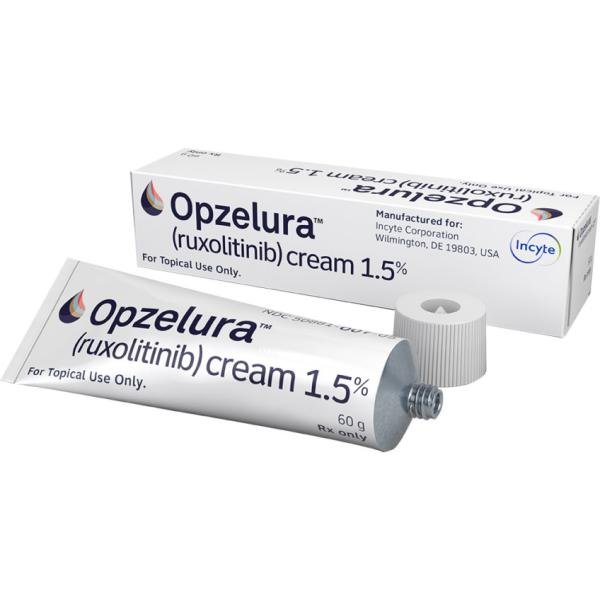
Opzelura (available in 60 and 100 g tubes ) |
Incyte |
AHFS DI Essentials™. © Copyright 2025, Selected Revisions August 10, 2024. American Society of Health-System Pharmacists, Inc., 4500 East-West Highway, Suite 900, Bethesda, Maryland 20814.
Reload page with references included
Related/similar drugs
More about ruxolitinib topical
- Check interactions
- Compare alternatives
- Reviews (6)
- Side effects
- Dosage information
- During pregnancy
- Drug class: topical antineoplastics
- Breastfeeding
- En español