Ranibizumab (EENT) (Monograph)
Brand names: Byooviz, Cimerli, Lucentis
Drug class: EENT Drugs, Miscellaneous
Introduction
Recombinant humanized immunoglobulin G1 kappa (IgG1 kappa) monoclonal antibody fragment; vascular endothelial growth factor A (VEGF-A) antagonist.
Ranibizumab-eqrn (Cimerli) and ranibizumab-nuna (Byooviz) are biosimilar to ranibizumab (Lucentis). A biosimilar is a biological that is highly similar to an FDA-licensed reference biological with the exception of minor differences in clinically inactive components and for which there are no clinically meaningful differences in safety, purity, or potency. Biosimilars are approved through an abbreviated licensure pathway that establishes biosimilarity between a proposed biological and reference biological but does not independently establish safety and effectiveness of the proposed biological. In order to be considered an interchangeable biosimilar, a biological product must meet additional requirements beyond demonstrating biosimilarity to its reference product. Both of the currently available ranibizumab biosimilars are interchangeable.
In this monograph, unless otherwise stated, the term "ranibizumab products" refers to ranibizumab (the reference drug) and its biosimilars (ranibizumab-eqrn and ranibizumab-nuna).
Uses for Ranibizumab (EENT)
Neovascular Age-related Macular Degeneration
Ranibizumab products: Treatment of neovascular (wet) age-related macular degeneration.
Macular Edema Following Retinal Vein Occlusion
Ranibizumab products: Treatment of macular edema following retinal vein occlusion.
Diabetic Macular Edema
Ranibizumab and ranibizumab-eqrn only: Treatment of diabetic macular edema.
Diabetic Retinopathy
Ranibizumab and ranibizumab-eqrn only: Treatment of diabetic retinopathy.
Myopic Choroidal Neovascularization
Ranibizumab products: Treatment of myopic choroidal neovascularization.
Ranibizumab (EENT) Dosage and Administration
General
Pretreatment Screening
-
Prior to intravitreal injection, monitor patients for elevation in intraocular pressure (IOP) using tonometry.
Patient Monitoring
-
Monitor patients 30 minutes following intravitreal injection for elevation in IOP using tonometry. Monitoring may also consist of a check for perfusion of the optic nerve head immediately after the injection.
-
Monitor patients for endophthalmitis and retinal detachment following injection; instruct patients to immediately report any manifestations suggestive of endophthalmitis.
Administration
Ophthalmic Administration
Administer by intravitreal injection only into the affected eye(s).
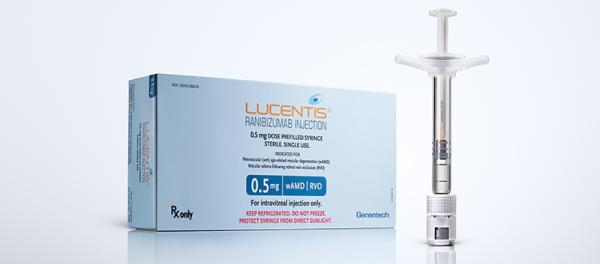
Ranibizumab is commercially available as single-dose prefilled syringes containing 0.3 or 0.5 mg of the drug for intravitreal injection. Ranibizumab-nuna is available as single-dose vials containing 0.5 mg of the drug for intravitreal injection, and ranibizumab-eqrn is available as single-dose vials containing 0.3 mg or 0.5 mg of the drug for intravitreal injection.
Prior to intravitreal administration of ranibizumab-nuna and ranibizumab-eqrn, withdraw entire contents of the appropriate strength vial through a sterile 5-µm, 19-gauge filter needle into a 1-mL sterile Luer lock syringe using aseptic technique. Next, replace filter needle with a sterile 30-gauge, ½-inch needle for intravitreal injection. To obtain appropriate dose (0.3 or 0.5 mg), expel contents in Luer lock syringe until plunger tip is aligned with the line that marks 0.05 mL on the syringe.
Prior to intravitreal administration of ranibizumab, remove the syringe from tray using aseptic technique. Do not use if the syringe cap is detached from the Luer lock, syringe is damaged, or particulates, cloudiness, or discoloration is visible. Snap off (do not turn or twist) the syringe cap. Attach a 30-gauge ½-inch sterile injection needle firmly onto syringe. Dislodge any air bubbles in syringe prior to administration.
Inject under controlled aseptic conditions (including use of sterile gloves, sterile drape, a sterile eyelid speculum [or equivalent]) following adequate anesthesia and administration of a broad-spectrum anti-infective agent.
Each vial and prefilled syringe should be used only for treatment of a single eye. If contralateral eye requires treatment, use a new vial or prefilled syringe; change sterile field, syringe, gloves, drape, eyelid speculum, and filter and injection needles before administering to the other eye.
Dosage
Adults
Neovascular Age-related Macular Degeneration
Ophthalmic
Ranibizumab products: recommended dosage is 0.5 mg (0.05 mL of a solution containing 10 mg/mL) by intravitreal injection into the affected eye(s) once a month (approximately every 28 days).
After the first several months of therapy, may reduce dosing frequency to decrease treatment burden; however, less frequent dosing regimens are not as effective as continuous monthly dosing and patients should be evaluated regularly.
After the first 3 monthly injections, may reduce to as-needed dosing with regular clinical assessment; while a regimen averaging 4–5 injections over the 9 months after the initial 3 monthly doses is expected to maintain visual acuity, continuous monthly dosing can result in additional gains (by 1–2 letters).
After the first 4 monthly injections, may reduce dosing frequency to one injection every 3 months; compared with continuous monthly dosing, such a regimen has been shown to result in an approximate 5-letter (1-line) loss of visual acuity over 9 months.
Macular Edema Following Retinal Vein Occlusion
Ophthalmic
Ranibizumab products: 0.5 mg (0.05 mL of a solution containing 10 mg/mL) by intravitreal injection into the affected eye(s) once a month (approximately every 28 days).
Diabetic Macular Edema
Ophthalmic
Ranibizumab or ranibizumab-eqrn: 0.3 mg (0.05 mL of a solution containing 6 mg/mL) by intravitreal injection into the affected eye(s) once a month (approximately every 28 days).
Diabetic Retinopathy
Ophthalmic
Ranibizumab or ranibizumab-eqrn: 0.3 mg (0.05 mL of a solution containing 6 mg/mL) by intravitreal injection into the affected eye(s) once a month (approximately every 28 days).
Myopic Choroidal Neovascularization
Ophthalmic
Ranibizumab products: 0.5 mg (0.05 mL of a 10 mg/mL solution) by intravitreal injection into the affected eye(s) once a month (approximately every 28 days) for up to 3 months. Patients may be retreated if needed.
Special Populations
Hepatic Impairment
No specific dosage recommendations.
Renal Impairment
No dosage adjustment required.
Geriatric Patients
No specific dosage recommendations.
Cautions for Ranibizumab (EENT)
Contraindications
-
Ocular or periocular infections.
-
Known hypersensitivity (e.g., severe intraocular inflammation) to ranibizumab products or any ingredient in the formulation.
Warnings/Precautions
Endophthalmitis and Other Serious Ocular Effects
Intravitreal injections, including those with ranibizumab, associated with endophthalmitis and retinal detachments. Always use proper aseptic injection technique. Monitor patients closely for signs of endophthalmitis (e.g., redness, sensitivity to light, pain, changes in vision) following injection to permit early treatment.
Traumatic cataract and tearing of retinal pigment epithelium also reported.
Increased IOP
Increased IOP observed both before and following (60 minutes after) intravitreal injection. Monitor IOP prior to and folllowing intravitreal injection, and manage appropriately.
Thromboembolic Events
Potential risk of arterial thromboembolic events following intravitreal injection of VEGF antagonists. Arterial thromboembolic events (i.e., nonfatal stroke, nonfatal MI, vascular death [including deaths from unknown causes]) reported at low rates. Patients with diabetic macular edema and diabetic retinopathy had higher rates typical of this patient population.
Potentially higher rate of stroke associated with the 0.5- versus 0.3-mg dose in patients with neovascular age-related macular degeneration; additional postmarketing surveillance and clinical studies are being conducted to further evaluate this finding.
Fatal Events
In clinical studies in patients with diabetic macular edema and diabetic retinopathy, fatal events occurred more frequently with ranibizumab than sham treatment. Although the fatality rate was low and included causes typical of patients with advanced diabetic complications, a potential relationship to the drug cannot be excluded.
Retinal Vasculitis
Retinal vasculitis with or without occlusion, typically in presence of preexisting intraocular inflammation or post-treatment with other intravitreal agents, reported. If retinal vasculitis occurs, discontinue therapy. Instruct patients to report any change in vision without delay.
Immunogenicity
Development of anti-ranibizumab antibodies reported. Clinical relevance unclear, but iritis or vitritis noted in some patients with neovascular age-related macular degeneration who had the highest levels of immunoreactivity.
Specific Populations
Pregnancy
Studies not conducted in pregnant women; unknown whether ranibizumab can cause fetal harm when administered during pregnancy. Use only if potential benefits justify potential risks to fetus. Adverse effects on embryofetal development or reproductive capacity possible due to the drug's mechanism as a VEGF antagonist.
Lactation
Not known whether ranibizumab products are distributed into human milk, or if drug has any effects on breastfed infant or on milk production. Caution if used in nursing women.
Consider developmental and health benefits of breastfeeding along with mother’s clinical need for ranibizumab and any potential adverse effects on breastfed child.
Females and Males of Reproductive Potential
Unknown whether ranibizumab can affect reproduction capacity. Based on mechanism of action, may pose risk to reproductive capacity.
Pediatric Use
Safety and efficacy not established.
Geriatric Use
No substantial differences in efficacy, safety, or systemic exposure relative to younger adults.
Renal Impairment
Increased ranibizumab exposure observed in patients with renal impairment; however, changes not considered to be clinically important.
Common Adverse Effects
Most common adverse effects: conjunctival hemorrhage, eye pain, vitreous floaters, increased IOP.
Drug Interactions
No formal drug interaction studies to date.
Photodynamic Therapy with Verteporfin
Serious intraocular inflammation reported; most cases occurred when ranibizumab was administered approximately 7 days after verteporfin photodynamic therapy in patients with neovascular age-related macular degeneration.
Ranibizumab (EENT) Pharmacokinetics
Absorption
Bioavailability
Following monthly intravitreal injection, peak serum concentrations attained were substantially below that necessary to inhibit the biologic activity of VEGF-A by 50%. Serum concentrations predicted to be approximately 90,000 times lower than vitreal concentrations.
Peak serum concentrations predicted to be reached approximately 1 day after monthly intravitreal administration of 0.5 mg per eye.
Elimination
Half-Life
Estimated average vitreous half-life: Approximately 9 days.
Stability
Storage
Ophthalmic
2–8°C. Do not freeze; protect from light. Store in original carton until use.
Unopened vials of ranibizumab-nuna can be stored at up to 30°C for up to 72 hours.
Actions
-
Binds to active forms of human VEGF-A, including cleaved form (VEGF110), and inhibits their biologic activity.
-
VEGF-A induces neovascularization (angiogenesis) and increases vascular permeability, which appears to play a role in the pathogenesis and progression of neovascular (wet) age-related macular degeneration, macular edema following retinal vein occlusion, diabetic macular edema, and diabetic retinopathy.
-
Binding to VEGF-A prevents VEGF-A from binding to VEGF receptors (i.e., VEGFR-1, VEGFR-2) on the surface of endothelial cells, reducing endothelial cell proliferation, angiogenesis, and vascular permeability.
-
Shown to reduce foveal retinal thickening and vascular permeability associated with age-related macular degeneration; however, foveal retinal thickness data did not provide information useful in influencing treatment decisions, and the area of vascular permeability was not correlated with visual acuity.
Advice to Patients
-
Inform patients of the risk of developing endophthalmitis. Advise patients to inform their ophthalmologist immediately if change in vision occurs or if the treated eye becomes red, sensitive to light, or painful.
-
Advise patients to inform their clinicians if they are or plan to become pregnant or plan to breast-feed.
-
Advise patients to inform their clinicians of existing or contemplated concomitant therapy, including prescription and OTC drugs, as well as any concomitant illnesses.
-
Inform patients of other important precautionary information.
Additional Information
The American Society of Health-System Pharmacists, Inc. represents that the information provided in the accompanying monograph was formulated with a reasonable standard of care, and in conformity with professional standards in the field. Readers are advised that decisions regarding use of drugs are complex medical decisions requiring the independent, informed decision of an appropriate health care professional, and that the information contained in the monograph is provided for informational purposes only. The manufacturer’s labeling should be consulted for more detailed information. The American Society of Health-System Pharmacists, Inc. does not endorse or recommend the use of any drug. The information contained in the monograph is not a substitute for medical care.
Preparations
Excipients in commercially available drug preparations may have clinically important effects in some individuals; consult specific product labeling for details.
Please refer to the ASHP Drug Shortages Resource Center for information on shortages of one or more of these preparations.
Ranibizumab and biosimilars (ranibizumab-nuna and ranibizumab-eqrn) are available through specialty distributors. Contact the manufacturer or consult the product website for more information.
|
Routes |
Dosage Forms |
Strengths |
Brand Names |
Manufacturer |
|---|---|---|---|---|
|
Ophthalmic |
Injection, for intravitreal use only |
6 mg/mL (0.3 mg/0.05 mL) |
Lucentis (available as single-dose prefilled syringe) |
Genentech |
|
10 mg/mL (0.5 mg/0.05 mL) |
Lucentis (available as single-dose prefilled syringe) |
Genentech |
|
Routes |
Dosage Forms |
Strengths |
Brand Names |
Manufacturer |
|---|---|---|---|---|
|
Ophthalmic |
Injection, for intravitreal use only |
6 mg/mL (0.3 mg/0.05 mL) |
Cimerli (available as single-dose vial) |
Coherus BioSciences |
|
10 mg/mL (0.5 mg/0.05 mL) |
Cimerli (available as single-dose vial) |
Coherus BioSciences |
|
Routes |
Dosage Forms |
Strengths |
Brand Names |
Manufacturer |
|---|---|---|---|---|
|
Ophthalmic |
Injection, for intravitreal use only |
10 mg/mL (0.5 mg/0.05 mL) |
Byooviz (available as single-dose vial) |
Biogen |
AHFS DI Essentials™. © Copyright 2025, Selected Revisions September 10, 2025. American Society of Health-System Pharmacists, Inc., 4500 East-West Highway, Suite 900, Bethesda, Maryland 20814.
Reload page with references included
Related/similar drugs
Biological Products Related to ranibizumab ophthalmic
Find detailed information on biosimilars for this medication.
More about ranibizumab ophthalmic
- Check interactions
- Compare alternatives
- Reviews (19)
- Side effects
- Dosage information
- During pregnancy
- Drug class: anti-angiogenic ophthalmic agents
- Breastfeeding
Patient resources
Professional resources
Other brands
Lucentis, Cimerli, Byooviz, Susvimo