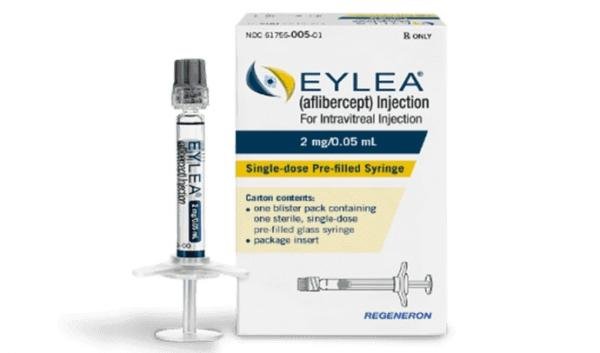
Aflibercept (Monograph)
Brand name: Eylea
Drug class: Vascular Endothelial Growth Factor Antagonists
Chemical name: Vascular endothelial growth factor receptor type VEGFR1 (synthetic human immunoglobulin domain 2 fragment) fusion protein with vascular endothelial growth factor receptor type VEGFR2 (synthetic human immunoglobulin domain 3 fragment) fusion protein with immunoglobulin G1 (synthetic Fc fragment), dimer
Molecular formula: C4318H6788N1164O1304S32
CAS number: 862111-32-8
Introduction
Recombinant humanized fusion protein; a vascular endothelial growth factor A (VEGF-A) and placental growth factor (PlGF) antagonist.
Uses for Aflibercept
Neovascular Age-related Macular Degeneration
Treatment of neovascular (wet) age-related macular degeneration.
Clinically equivalent to ranibizumab. May provide some advantages (e.g., decreased treatment burden) over other agents (e.g., bevacizumab† [off-label], ranibizumab) because of less frequent administration. (See Dosage under Dosage and Administration.)
Macular Edema Following Retinal Vein Occlusion
Treatment of macular edema following retinal vein occlusion.
Diabetic Macular Edema
Treatment of diabetic macular edema.
Diabetic Retinopathy in Patients with Diabetic Macular Edema
Treatment of diabetic retinopathy in patients with diabetic macular edema.
Aflibercept Dosage and Administration
Administration
Ophthalmic
Administer by intravitreal injection only into the affected eye(s); must be administered only by a qualified physician.
Prior to intravitreal administration, withdraw entire contents of aflibercept vial through a sterile 5-µm, 19-gauge filter needle (provided by manufacturer) into a 1-mL syringe (provided by manufacturer) using aseptic technique. Prior to intravitreal injection, replace filter needle with a sterile 30-gauge, ½-inch needle (provided by manufacturer). To obtain appropriate dose (2 mg), expel contents in syringe until plunger tip is aligned with the line that marks 0.05 mL on the syringe.
Inject under controlled aseptic conditions (including surgical hand disinfection and use of sterile gloves, sterile drape, and sterile eyelid speculum [or equivalent]) following adequate anesthesia and administration of a topical broad-spectrum anti-infective agent.
Monitor patients for elevation of IOP immediately following intravitreal injection; monitoring may include evaluation of optic nerve head perfusion or tonometry. A sterile paracentesis needle should be available, if required.
Use each vial only for treatment of a single eye; discard any unused portion. If contralateral eye requires treatment, use a new vial; change sterile field, syringe, gloves, drape, eyelid speculum, and filter and injection needles before administering to the other eye.
Dosage
Adults
Neovascular Age-related Macular Degeneration
Ophthalmic
Intravitreal injection: 2 mg into the affected eye(s) once every 4 weeks for 12 weeks, then 2 mg once every 8 weeks.
Additional efficacy not demonstrated following administration every 4 weeks compared with every 8 weeks.
Macular Edema Following Retinal Vein Occlusion
Ophthalmic
Intravitreal injection: 2 mg into the affected eye(s) once every 4 weeks.
Diabetic Macular Edema
Ophthalmic
Intravitreal injection: 2 mg into the affected eye(s) once every 4 weeks for the first 5 injections, followed by 2 mg once every 8 weeks.
Additional efficacy not demonstrated following administration every 4 weeks compared with every 8 weeks.
Diabetic Retinopathy in Patients with Diabetic Macular Edema
Ophthalmic
Intravitreal injection: 2 mg into the affected eye(s) once every 4 weeks for the first 5 injections, followed by 2 mg once every 8 weeks.
Additional efficacy not demonstrated following administration every 4 weeks compared with every 8 weeks.
Special Populations
Hepatic Impairment
No specific dosage recommendations at this time.
Renal Impairment
No dosage adjustment required.
Geriatric Patients
No dosage adjustment required.
Cautions for Aflibercept
Contraindications
-
Ocular or periocular infections.
-
Active intraocular inflammation.
-
Known hypersensitivity (e.g., severe intraocular inflammation) to aflibercept or any ingredient in the formulation.
Warnings/Precautions
Sensitivity Reactions
Hypersensitivity reactions reported. (See Contraindications under Cautions.)
Endophthalmitis and Retinal Detachment
Intravitreal injections, including with aflibercept, associated with endophthalmitis and retinal detachment. Always use proper aseptic injection technique.
If signs or symptoms of endophthalmitis or retinal detachment (e.g., redness, sensitivity to light, pain, changes in vision [including blurred vision]) occur, manage appropriately.
Increased IOP
Acute increases in IOP observed within 60 minutes of intravitreal injection. Sustained increases in IOP also observed following repeated intravitreal injections of VEGF antagonists. Monitor IOP and perfusion of optic nerve head and manage appropriately.
Thromboembolic Events
Potential risk of arterial thromboembolic events following intravitreal injection of VEGF antagonists, including aflibercept.
Immunogenicity
Incidence of immunoreactivity to aflibercept was similar before and after 24–100 weeks of therapy. No differences in efficacy or safety between patients with or without immunoreactivity.
Specific Populations
Pregnancy
Category C.
No adequate and well-controlled studies in pregnant women. Animal studies suggest a possibility of adverse embryofetal effects.
Use only if potential benefits justify potential risk to fetus. Women of childbearing potential should use effective contraception prior to initiating therapy, during treatment, and for ≥3 months after last intravitreal injection is administered.
Lactation
Not known whether aflibercept is distributed into milk. Use not recommended in nursing women. Discontinue nursing or the drug.
Pediatric Use
Safety and efficacy not established.
Geriatric Use
No substantial differences in safety or efficacy relative to younger adults.
Renal Impairment
No differences in plasma concentrations observed with various degrees of renal impairment. (See Special Populations under Pharmacokinetics.)
Common Adverse Effects
Conjunctival hemorrhage, eye pain, cataract, vitreous detachment, vitreous floaters, increased IOP.
Drug Interactions
No formal drug interaction studies to date.
Aflibercept Pharmacokinetics
Absorption
Bioavailability
Following intravitreal injection, mean peak plasma concentration attained in 1–3 days; peak plasma concentration estimated to be >100-fold lower than concentration required to half-maximally bind systemic VEGF.
Free aflibercept undetectable in plasma 2 weeks after intravitreal injection.
No accumulation observed following repeated intravitreal injections (i.e., once every 4 weeks).
Special Populations
Following intravitreal injection every 4 or 8 weeks, no differences in free plasma aflibercept concentrations observed between patients with mild, moderate, or severe renal impairment.
Distribution
Extent
Not known whether aflibercept is distributed into milk.
Elimination
Metabolism
Expected to undergo elimination through both target-mediated disposition via binding to free endogenous VEGF and via proteolysis.
Half-life
Approximately 5–6 days following IV administration of doses of 2–4 mg/kg.
Stability
Storage
Ophthalmic
2–8°C. Do not freeze; protect from light. Store in original carton until use.
Actions
-
Acts as a soluble decoy receptor that binds to VEGF-A and PlGF and inhibits their biologic activity.
-
VEGF-A induces neovascularization (angiogenesis) and increases vascular permeability, which appear to play a role in the pathogenesis and progression of neovascular (wet) age-related macular degeneration, macular edema following retinal vein occlusion, diabetic macular edema, and diabetic retinopathy.
-
Binding to VEGF-A and PlGF prevents these factors from binding to endogenous VEGF receptors (i.e., VEGFR-1, VEGFR-2), reducing endothelial cell proliferation, angiogenesis, and vascular permeability.
-
Binding affinity of aflibercept for VEGF-A isoforms is higher than that of endogenous receptors; aflibercept blocks VEGF binding and activation of VEGFR-1 and VEGFR-2 even at low concentrations.
Advice to Patients
-
Possible temporary visual disturbances after intravitreal injection and associated eye examinations; importance of avoiding driving a vehicle or operating machinery until visual function has recovered sufficiently.
-
Risk of endophthalmitis or retinal detachment; importance of immediately seeking care from an ophthalmologist if change in vision occurs or if the treated eye becomes red, sensitive to light, or painful.
-
Importance of women informing clinicians if they are or plan to become pregnant or plan to breast-feed.
Importance of informing clinicians of existing or contemplated concomitant therapy, including prescription and OTC drugs, as well as any concomitant illnesses.
-
Importance of informing patients of other important precautionary information. (See Cautions.)
Preparations
Excipients in commercially available drug preparations may have clinically important effects in some individuals; consult specific product labeling for details.
Please refer to the ASHP Drug Shortages Resource Center for information on shortages of one or more of these preparations.
|
Routes |
Dosage Forms |
Strengths |
Brand Names |
Manufacturer |
|---|---|---|---|---|
|
Ophthalmic |
Injection, for intravitreal use only |
40 mg/mL (2 mg/0.05 mL) |
Eylea (available as single-dose vial with syringe, filter needle, and injection needle) |
Regeneron |
AHFS DI Essentials™. © Copyright 2025, Selected Revisions February 1, 2022. American Society of Health-System Pharmacists, Inc., 4500 East-West Highway, Suite 900, Bethesda, Maryland 20814.
† Off-label: Use is not currently included in the labeling approved by the US Food and Drug Administration.
Reload page with references included
Related/similar drugs
Biological Products Related to aflibercept ophthalmic
Find detailed information on biosimilars for this medication.
Frequently asked questions
- What’s the difference between Eylea, Eylea HD, and Avastin?
- What is the difference between Eylea and Eylea HD?
- Does Eylea and Eylea HD raise blood pressure?
- What biosimilars have been approved in the United States?
More about aflibercept ophthalmic
- Check interactions
- Compare alternatives
- Reviews (85)
- Side effects
- Dosage information
- During pregnancy
- Drug class: anti-angiogenic ophthalmic agents
- Breastfeeding
- En español
Patient resources
Professional resources
Other brands
Eylea, Eylea HD, Opuviz, Pavblu