Consumer Information
Print Print   
Carenotes > Ventricular Septal Defect In Children

Ventricular Septal Defect In Children

Advertisement

GENERAL INFORMATION:

What is a ventricular septal defect?

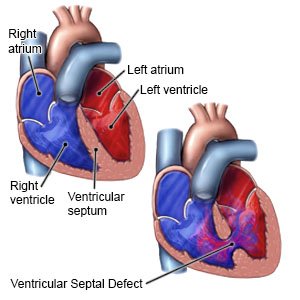
  • Ventricular (ven-TRIK-u-ler) septal defect, also called VSD, is the most common congenital (born with) heart disease. While inside the womb, a wall is formed to separate the four chambers (enclosed spaces) of your baby's heart. The four chambers include two upper chambers, called the atria, and two lower chambers, called the ventricles. Normally, veins bring blood from your child's body to his heart. The blood from the body enters the right atrium first, then is pumped down into the right ventricle. The right ventricle then pumps the blood into the lungs where oxygen is added. The blood goes back to the heart into the left atrium and down into the left ventricle. The left ventricle then pumps the blood out to the body where the oxygen can be used.

  • With VSD, the wall between the ventricles failed to form completely. This results in a hole where blood in the left ventricle flows back to the right ventricle. The hole may be small or very large. Over time, increased backflow of blood may cause the right ventricle to enlarge. This may lead to other problems, such as abnormal heartbeats and increased blood pressure to the lungs. These problems may make it difficult for the heart and lungs to supply oxygen to the body. Treatment is needed so that your child may go on with his usual activities and live a normal life.

What causes a ventricular septal defect? It is not exactly known what causes a VSD. Caregivers think that problems during the development of your child's heart may cause VSD. The following are possible factors or conditions which may increase your child's risk of having a VSD:

  • Certain medicines, illegal drugs, or alcohol used early in your pregnancy.

  • Family history of a VSD or other heart problems.

  • If your child has other congenital conditions, such as Down syndrome.

  • Problems with the information in genes are also thought to cause a VSD. A gene is a little piece of information that tells your body what to do or what to make.

  • Uncontrolled diabetes (high blood sugar) during pregnancy.

What are the signs and symptoms of a ventricular septal defect? A child with a small VSD may not have any signs and symptoms. The most common sign of VSD that may be present is a heart murmur. Heart murmurs are abnormal changes in the heart sounds when caregivers listen to your child's heartbeat. Other signs and symptoms may include any of the following:

  • Cold sweats especially on the forehead.

  • Fainting (passing out).

  • Fast or pounding heartbeat.

  • Lips and fingernails turning blue when crying for a long time.

  • Slow growth or problems putting on weight.

  • Tires easily or feels tired more than the usual.

  • Troubled breathing, such as being short of breath when eating or crying.

How is a ventricular septal defect diagnosed? Your child may need any of the following tests:

  • Cardiac catheterization: A cardiac catheterization is a test to see how well your child's heart is working. It is also used to see how well the blood vessels connected to the heart are doing. A special tube is threaded into your child's heart through a blood vessel in his arm, leg, or neck. Dye may be given so x-ray pictures of your child's blood vessels show up better on a TV-like screen. Your child's caregiver may also measure the pressure inside your child's heart.

  • Chest x-ray: This is a picture of your child's lungs and heart. Caregivers use it to see how your child's lungs and heart are doing. Caregivers may use the x-ray to look for signs of infection (such as pneumonia) or other problems.

  • Doppler test: This test is done to check blood flow in the heart. A small metal disc with gel is placed on your child's chest. Caregivers may hear abnormal sounds when a VSD is present.

  • Echocardiogram: This test is also called an echo. Sound waves are used to show pictures of the size and shape of your child's heart. The echo can also show how well the heart is pumping and how well blood flows through it. Your child will lie down during the test. Caregivers will squirt clear gel onto your child's chest to help the echo probe move easily. The echo pictures are shown on a TV-like screen. The barking or whooshing noise that you may hear is the sound of blood flowing through the heart. Caregivers may ask you to stay in the room with your child during this test.

  • 12 Lead EKG: This test helps caregivers see your child's heart activity. It helps caregivers look for changes or problems in different areas of the heart. Sticky pads are placed on your child's chest, arms, and legs. Each pad has a wire that is hooked to a machine or TV-like screen. This machine shows a tracing of your child's heart beat. This test takes about five to ten minutes. Your child must lie very still during the test.

  • Pulse oximeter: A pulse oximeter is a machine that tells caregivers how much oxygen is in your child's blood. A cord with a clip or sticky strip is placed on your child's foot, toe, hand, finger, or earlobe. The other end of the cord is hooked to a machine. Tell a caregiver if the sticky strip or clip comes off of your child. The machine will alarm if the machine cannot read the oxygen level or if your child needs more oxygen. Tell a caregiver if the machine is alarming. Never turn the pulse oximeter off.

How is a ventricular septal defect treated? Your child may have any of the following:

  • Watchful waiting: Caregivers may want your child to have regular checkups to see if his VSD may close on its own.

  • Medicines:

    • Diuretics: This medicine may be given to help your child's body and lungs get rid of extra fluid. This can help your child breathe easier. Diuretics may make your child urinate more often.

    • Heart medicine: This medicine may be given to make your child's heart beat stronger or more regularly. There are many different kinds of heart medicines. Talk with caregivers to find out what your child's medicine is and why he is taking it.

    • Antibiotics: Ask your child's caregiver if antibiotics can be given when your child is having his teeth cleaned. Caregivers may want to have your child take these to prevent a condition called bacterial endocarditis. Antibiotics may also be given if your child has been exposed to someone with certain infections.

  • Respiratory support:

    • Oxygen: Your child may need oxygen to help him breathe easier. Your child may need a nasal cannula (small tubes placed in the nose) or mask. Many children do not like having these on their face, so caregivers may place the mask next to your child's face. Some children are placed in an oxygen tent or plastic hood. Do not take off your child's oxygen without asking your child's caregiver first.

    • ET tube: Your child may need an endotracheal (ET) tube to help him breathe. An ET tube is put in your child's mouth or nose, and goes into the trachea (windpipe). It may be connected to a breathing machine called a ventilator. The ET tube will be taken out when your child is breathing better.

  • Closure of VSD: Your child may have to undergo certain procedures to close the VSD.

    • Surgery: Surgery may be done by making an incision (cut) through your child's chest to repair the VSD. Your child's caregiver may plug or patch the hole in his heart. Ask your child's caregiver for more information about surgery for VSD.

    • Transcatheter device closure: Your child's caregiver may suggest that your child have a transcatheter device closure. This is a procedure where a device called a septal occluder is used to close the hole in the ventricular wall. Ask your child's caregiver for more information on transcatheter device closure for VSD.

Where can I find support and more information? Accepting that your child has a ventricular septal defect may be hard. You, your child, and those close to you may feel scared, sad, or angry. These are normal feelings. Talk to your child's caregivers, family, or friends about your and your child's feelings. You may also want to join a support group. This is a group of people who also have children with VSD. Contact the following for more information:

  • American Heart Association National Center
    7272 Greenville Avenue
    Dallas, TX 75231-4596
    Phone: 1-800-242-8721
    Web Address: http://www.americanheart.org
  • National Heart, Lung and Blood Institute
    Health Information Center
    P.O. Box 30105
    Bethesda, MD 20824-0105
    Phone: 1-301-592-8573
    Web Address: http://www.nhlbi.nih.gov/health/infoctr/index.htm

CARE AGREEMENT:

You have the right to help plan your child's care. To help with this plan, you must learn about your child's health condition and how it may be treated. You can then discuss treatment options with your child's caregivers. Work with them to decide what care may be used to treat your child.


MedNotes
Advertisement
Save bookmark to...