Vein Stripping
WHAT YOU SHOULD KNOW:
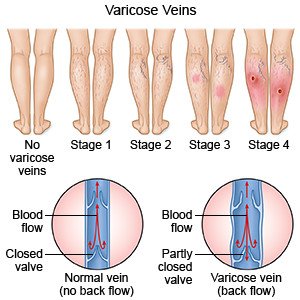
- Vein stripping is surgery done to take out varicose veins. Varicose veins are large and twisted veins that are commonly seen in your legs. They may occur in your calves, thighs, and the back of your knees. Veins are blood vessels that bring blood from your body back to your heart. Varicose veins may look like bluish or purplish, snake-like veins under your skin. Varicose veins may also bulge out under your skin. You may feel that your varicose veins give your legs an unsightly appearance. Varicose veins may cause severe leg pains that make it hard to do your daily activities. Your legs may tire easily and they may feel numb, itchy, or tingly (pins and needles). You may also have leg cramps that occur mostly at night.

- Vein stripping may be done to relieve your symptoms. It may also be done to improve the appearance of your legs. During surgery, your caregiver will strip (pull out) your varicose veins through cuts made in your legs. Other procedures, such as sclerotherapy (using chemicals to make veins smaller), may also be done with vein stripping. Your caregiver may also use cryotherapy (freezing the veins) or electric probes during the surgery. Ask your caregiver for more information about other procedures that may be done for your varicose veins.
CARE AGREEMENT:
You have the right to help plan your care. To help with this plan, you must learn about your health condition and how it may be treated. You can then discuss treatment options with your caregivers. Work with them to decide what care may be used to treat you. You always have the right to refuse treatment.
RISKS:
- With vein stripping, your leg may bruise, swell, or get infected. You may also have scarring where the cuts were made. You may have an allergic response to the anesthesia or bandages that are used for your surgery. During surgery, you may bleed more than expected and need a blood transfusion. Your nerves may be damaged causing pain, numbness, or a burning feeling in your leg. You may also have trouble moving your leg or foot. Blood clots may form and lead to thrombophlebitis (blocked inflamed veins) or deep venous thrombosis (blocked deep veins). Blood clots in your legs may loosen and travel to the blood vessels in your lungs. Blood clots in your lungs may make it hard for you to breathe, and you may die.
- Even if you have the surgery, your symptoms or varicose veins may come back. If you do not have the surgery, abnormal blood flow in your varicose veins may not go away. Your varicose veins may increase in size and number, and your symptoms may worsen. You may also develop phlebitis (swollen veins). Increased pressure inside your veins may lead to skin ulcers (open sores). Varicose veins may also cause bleeding and swelling in your leg. Call your caregiver if you have any questions or concerns about your condition, surgery, or care.
WHILE YOU ARE HERE:
Before your surgery:
- Informed consent: You have the right to understand your health condition in words that you know. You should be told what tests, treatments, or procedures may be done to treat your condition. Your doctor should also tell you about the risks and benefits of each treatment. You may be asked to sign a consent form that gives caregivers permission to do certain tests, treatments, or procedures. If you are unable to give your consent, someone who has permission can sign this form for you. A consent form is a legal piece of paper that tells exactly what will be done to you. Before giving your consent, make sure all your questions have been answered so that you understand what may happen.
- IV: An IV is a tube placed in your vein for giving medicine or liquids. This tube is capped or connected to tubing and liquid.
- Duplex ultrasound: This test may be done to look at the veins in your thighs and legs. It may show the size of your veins, and if your veins have abnormal blood flow or connections. Your caregiver may use this test to mark the areas where cuts will be made during your surgery. You may need to have another duplex ultrasound after your surgery.
- Pre-op care: You may be given medicine to make you feel relaxed and sleepy right before your surgery. You will be taken to the room where your surgery will be done. You may then be given the following medicines:
- Anesthesia: This medicine is given to keep you comfortable during your surgery.
- Local anesthesia: This medicine is given as a shot into your skin. It is used to numb the surgery area and dull your pain.
- Spinal anesthesia: This medicine is put into your back through a shot to numb you below the waist. With spinal anesthesia, the feeling in your legs will return in about two hours.
- General anesthesia: This is medicine that may be given in your IV or as a gas that you breathe. You may wear a face mask or have a tube placed in your mouth and throat. This tube is called an endotracheal tube or ET tube. Usually you are asleep before caregivers put the tube into your throat. The ET tube is usually removed before you wake up. You are completely asleep and free from pain during surgery.
- Local anesthesia: This medicine is given as a shot into your skin. It is used to numb the surgery area and dull your pain.
- Blood thinners: This medicine helps stop clots from forming in your blood. Blood thinners may be given before, during, or after your surgery.
- Blood vessel dilators: This medicine is given to dilate (widen) your blood vessels. It may be mixed with local anesthesia and given as a shot to decrease your pain.
- Anesthesia: This medicine is given to keep you comfortable during your surgery.
During your surgery:
- A tourniquet (tight band) may be wrapped around your thigh or leg to help decrease bleeding. Your caregiver will make a small cut near the top of your thigh over the vein to be removed. Your veins have branches coming off of them that will be tied off. Special tools will be used to take the varicose vein out of your leg. The vein may be pulled out through the cut in your thigh. The vein may also be pulled out through another cut made near your knee or ankle. Your caregiver may strip your entire vein out or only a part of your vein.
- Other cuts may be made in your leg to take out other varicose veins. A drain (thin tube) may be inserted in an area near your groin to remove extra blood and fluid. The cuts will be closed with stitches or special strips, and covered with tight bandages.
After your surgery: You will be taken to a room after your surgery. Your legs may be raised up on pillows. Do not get out of bed until your caregiver says it is OK. When you are fully awake and have feeling in your legs, you may be able to go home. You will be taken back to your room if you are staying in the hospital. A caregiver may remove your bandage after surgery to check your wound.
- Pain medicine: Caregivers may give you medicine to take away or decrease your pain. Medicine may be given regularly, or may only be given if you ask caregivers for it. Tell caregivers if your pain does not decrease enough for you to feel better. Do not wait to ask for your pain medicine until the pain is very bad. The medicine may not work as well at controlling your pain if you wait too long to take it. Ask your caregiver for help getting out of bed if you feel tired or dizzy.
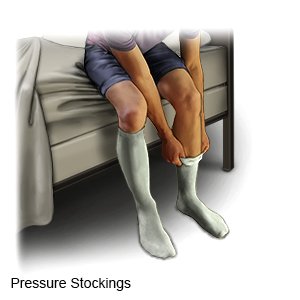
- Pressure stockings: These are also called compression stockings. They are tight elastic stockings that put pressure on your legs. The pressure is highest in your toes and decreases as it goes up toward your thighs. Pressure stockings help push blood back up to your heart. This helps prevent bleeding and swelling in your legs after your surgery. It may also stop clots and bruises from forming in your legs. You may need to wear pressure stockings for a few weeks after your surgery.
Copyright © 2008 Thomson Healthcare Inc. All rights reserved. Information is for End User's use only and may not be sold, redistributed or otherwise used for commercial purposes.
The above information is an educational aid only. It is not intended as medical advice for individual conditions or treatments. Talk to your doctor, nurse or pharmacist before following any medical regimen to see if it is safe and effective for you.
| Link to Page | Print Page | Email Page |