
Tuberculosis
Medically reviewed by Drugs.com. Last updated on Sep 1, 2024.
Tuberculosis (TB) is a severe infection caused by bacteria called Mycobacterium tuberculosis. TB usually starts in the lungs. The bacteria are easily spread from one person to another through the air. They can live in your body a long time without making you sick. This is called latent TB. Latent means you do not have symptoms, but you may develop them later. Latent TB can develop into active TB if it is not treated.
DISCHARGE INSTRUCTIONS:
Call your local emergency number (911 in the US) if:
- You have chest pain or cough up blood.
- You have trouble breathing.
Seek care immediately if:
- You have a fever, headache, and a stiff neck.
- You have a rash or nausea, or you are vomiting.
- The whites of your eyes or your skin look yellow.
- Your urine looks like dark tea or coffee.
Call your doctor if:
- Your symptoms do not go away, or they get worse, even after you take medicine.
- You have a cough that does not go away after 3 or 4 weeks.
- You have questions or concerns about your condition or care.
Medicines:
- Antibiotics help fight the infection. You may need to take 3 to 4 types of antibiotics for up to 8 weeks. Then you may need to take at least 2 types of antibiotics for another 18 to 31 weeks. Latent TB may be treated with 1 antibiotic for 16 weeks. You may instead need to take 2 antibiotics for 12 weeks. You will take these daily or weekly, depending on the antibiotics used.
- Take your medicine as directed. Contact your healthcare provider if you think your medicine is not helping or if you have side effects. Tell your provider if you are allergic to any medicine. Keep a list of the medicines, vitamins, and herbs you take. Include the amounts, and when and why you take them. Bring the list or the pill bottles to follow-up visits. Carry your medicine list with you in case of an emergency.
Remember to take your medicines:
- Take your medicine as directed. If you forget to take your pills one time, skip that dose and take the next scheduled dose. Write down that you missed a dose and tell your healthcare provider at your next visit.
- Get involved in the Directly Observed Therapy (DOT) program. Healthcare providers help make sure you take your medicines correctly.
- Take your medicine at the same time every day. Each night, put out the pills for the next day. Mark a calendar each day you take your pills.
- Create reminders. Ask a family member or friend to remind you to take your pills.
- Keep medicines where you will see them. Keep the pills in a place where you cannot miss them, such as the bathroom or kitchen. Be sure they are out of the reach of children.
Prevent the spread of TB:
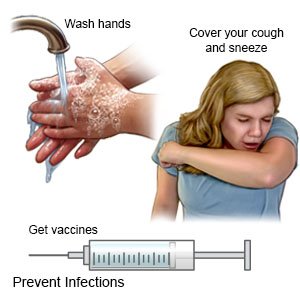 |
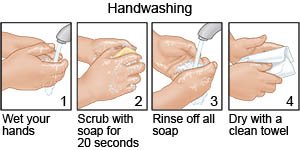
- Wash your hands often. Wash your hands several times each day. Wash after you use the bathroom, change a child's diaper, and before you prepare or eat food. Use soap and water every time. Rub your soapy hands together, lacing your fingers. Wash the front and back of your hands, and in between your fingers. Use the fingers of one hand to scrub under the fingernails of the other hand. Wash for at least 20 seconds. Rinse with warm, running water for several seconds. Then dry your hands with a clean towel or paper towel. Use hand sanitizer that contains alcohol if soap and water are not available. Do not touch your eyes, nose, or mouth without washing your hands first.
- Cover a sneeze or cough. Use a tissue that covers your mouth and nose. Throw the tissue away in a trash can right away. Use the bend of your arm if a tissue is not available. Then wash your hands well with soap and water or use a hand sanitizer. Do not stand close to anyone who is sneezing or coughing.
- Take your medicine as directed. If you forget to take your pills one time, skip that dose and take the next scheduled dose. Write down that you missed a dose and tell your healthcare provider at your next visit.
- Tell family, friends, and coworkers that you have TB. They may have latent TB and need to take medicine to prevent it from becoming active.
Follow up with your doctor as directed:
You may need to return every month for tests to monitor your condition. Write down your questions so you remember to ask them during your visits.
For more information:
- CDC National Prevention Information Network
PO Box 6003
Rockville , MD 20849-6003
Phone: 1- 800 - 4585231
Web Address: http://www.cdcnpin.org
- World Health Organization
Web Address: www.who.int
© Copyright Merative 2024 Information is for End User's use only and may not be sold, redistributed or otherwise used for commercial purposes.
The above information is an educational aid only. It is not intended as medical advice for individual conditions or treatments. Talk to your doctor, nurse or pharmacist before following any medical regimen to see if it is safe and effective for you.
Learn more about Tuberculosis
Treatment options
- Medications for Adrenal Tuberculosis
- Medications for CNS Tuberculosis
- Medications for History, Tuberculosis
- Medications for Ocular Tuberculosis
- Medications for Pulmonary Tuberculosis
- Medications for Tuberculosis
- Medications for Tuberculosis, Active
Care guides
Symptoms and treatments
Further information
Always consult your healthcare provider to ensure the information displayed on this page applies to your personal circumstances.