close :

:

Forgotten your password?
 
Consumer Information
Print Print   
Carenotes > Spinal And Epidural Anesthesia

Spinal And Epidural Anesthesia

GENERAL INFORMATION:

What is Anesthesia? Anesthesia (an-iss-thee-zuh) is medicine to make you comfortable during surgery or a procedure. There are many types of anesthesia. The anesthesia medicine may be given in your IV, through a face mask, or through a tube in your nose or throat. It can also be given as a shot in your back or as a shot in the area where you will have surgery. The type of anesthesia you may have depends on the type of surgery or procedure you are having. You and your caregiver have decided that spinal or epidural anesthesia is best for you.

What is Spinal and Epidural Anesthesia? With spinal and epidural (eh-pih-der-all) anesthesia you are numb from about the nipple line to the waist and down. How high the numbness goes depends on where your surgery will be. Tell your anesthesia caregiver if you or anyone in your family has ever had any problems with anesthesia. Remember to tell your anesthesia caregiver if you have ever had a very high temperature during or after surgery. Spinal and epidural anesthesia can be used for many kinds of surgeries or procedures such as having a hernia fixed. It may also be used when you have your appendix removed, or when you have a baby.

Care: Before the surgery or procedure, you may be given medicine in your IV to make you feel sleepy and more relaxed. Caregivers will help you get comfortable on the operating room bed. Anesthesia caregivers will use machines to see how your body is doing.

  • Pulse oximeter: A pulse oximeter is a machine that tells how much oxygen is in your blood. A cord with a clip or sticky strip is placed on your ear, finger, or toe. The other end of the cord is hooked to a machine. Caregivers use this machine to see if you need more oxygen.

  • Vital signs: This includes taking your temperature, blood pressure, pulse (counting your heartbeat), and respirations (counting your breaths). To take your blood pressure, a cuff is put on your arm and tightened. The cuff is attached to a machine which gives your blood pressure reading. Caregivers may listen to your heart and lungs by using a stethoscope. Your vital signs are taken so caregivers can see how you are doing.

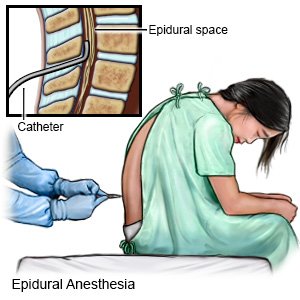
  • Getting the Spinal or Epidural: Caregivers help you lie on your side with your knees and chin bent toward your chest. Caregivers may help you sit up on the operating room bed instead. Your back is cleaned with soap and water. Sheets are put over your back to keep the area clean. You are given a shot of medicine to numb the skin on your back. A needle is put between the bones of your back. Stay as still and quiet as you can. Tell your anesthesia caregiver if you feel a tingling shock or pain in one leg, but try not to move.

    • Spinal Anesthesia: When your caregiver has the needle in the right place, medicine is put through the needle. You are awake during surgery but may be given medicine in your IV so that you are sleepy. Your lower body is numb and you are not be able to move your legs when the medicine starts to work. You can move your legs in 1 to 4 hours when the medicine wears off.

    • Epidural Anesthesia: When your caregiver has the needle in the right place, a catheter (tiny tube) is put through the needle into your back. The needle is then taken out but the catheter is left in place to give more medicine as you need it. Your lower body will be numb and you may be able to move your legs but should not feel pain. Feeling will return to your legs when caregivers stop putting medicine in the catheter and when the medicine wears off.

  • After Getting the Anesthesia: After the anesthesia is in, you are helped to lie down flat. Caregivers will not start surgery until you are numb. After surgery, you are taken to a room where you can rest until the numbness goes away. You may then be allowed to go home. If you are staying in the hospital you may be taken back to your room. When it is time for you to go home, someone should drive you home. Do not drive home alone. An adult should stay with you for at least 24 hours if you had medicine to make you sleepy.

Informed Consent: You have the right to understand your health condition in words that you know. You should be told what tests, treatments, or procedures may be done to treat your condition. Your doctor should also tell you about the risks and benefits of each treatment. You may be asked to sign a consent form that gives caregivers permission to do certain tests, treatments or procedures. If you are unable to give your consent, someone who has permission can sign this form for you. A consent form is a legal piece of paper that tells exactly what will be done to you. This consent also gives permission for anesthesia. Before giving your consent, make sure all your questions have been answered so that you understand what may happen.

Risks: The following are risks that may happen with spinal and epidural anesthesia. Caregivers will watch you closely and treat any problems. Some surgeries cannot be done at all if you choose not to have anesthesia. Call your caregiver if you are worried or have questions about your care.

  • You could have a bad reaction to the medicine.

  • Your blood pressure may drop too low.

  • It may take awhile for the medicine to wear off before you can feel and move normally.

  • The medicine may make you numb above your waist. If this numbness goes too high you could feel nauseated or have trouble breathing on your own. Your anesthesia caregiver may have to put an endotracheal (n-do tray-kee-ull) tube in your throat to breathe for you.

  • You could get a bad headache after surgery that may need special treatment to help it go away.

  • You could have long-lasting numbness, pain or loss of funtion of body parts.

  • Your thinking may be unclear. Do not make important decisions for 24 hours after having spinal or epidural anesthesia.

CARE AGREEMENT:

You have the right to help plan your care. To help with this plan, you must learn about your health condition and how it may be treated. You can then discuss treatment options with your caregivers. Work with them to decide what care may be used to treat you. You always have the right to refuse treatment.


Join Drugs.com
Click here to see what benefits you can get by joining our FREE membership programme.
Drugs.com is the most popular, comprehensive, and up-to-date source of drug information online. Providing advice on more than 24,000 prescription drugs and over-the-counter medicines for consumers and professionals .
Advertisement
In The Pipeline
Save bookmark to...