
Right Heart Catheterization
Medically reviewed by Drugs.com. Last updated on Apr 2, 2024.
What do I need to know about right heart catheterization?
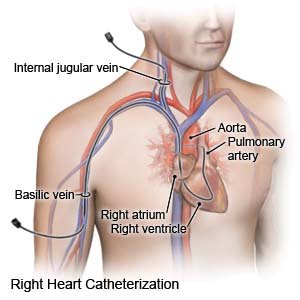
Right heart catheterization is a procedure to check the pressure in your heart and lungs. It is also called a Swan-Ganz or pulmonary artery catheterization. You may need this procedure if you have chest pain, shortness of breath, or a heart condition. You may also need this procedure before heart surgery.
 |
How do I prepare for the procedure?
- Your healthcare provider will tell you how to prepare. You may be told not to eat or drink anything after midnight on the day of the procedure. Arrange to have someone drive you home when you are discharged.
- Tell your provider about all medicines you currently take. Your provider will tell you if you need to stop any medicine for the procedure, and when to stop. Your provider will tell you which medicines to take or not take on the day of the procedure.
- Contrast liquid will be used to show the parts of your heart more clearly in pictures. Tell your provider if you have had an allergic reaction to contrast liquid.
- You may need blood or urine tests before your procedure. Talk to your provider about these or other tests you may need.
What will happen during the procedure?
- You will be given medicine to help you relax. You will receive local anesthesia that will numb the area where the catheter will be placed. You will be awake during the procedure so that your healthcare providers can give you instructions. You will need to let them know if you have any discomfort.
- Your healthcare provider will insert a catheter into a vein in your arm, neck, or leg. Your provider will use an x-ray to guide the catheter to your heart. Contrast liquid will help heart vessels, muscle, or valves be seen more clearly. You may get a warm feeling or slight nausea right after the liquid is injected. This is normal, and will pass quickly. Your provider may remove a small sample of heart tissue and send it to a lab to be tested. Your provider may also open a narrow or blocked heart valve or artery.
- The catheter may be left in place to monitor pressure in your heart. When the catheter is removed, pressure will be applied to the catheter site for at least 30 minutes to help decrease the risk for bleeding. A collagen plug or other closure device may be used to close the site. The site will be covered with a pressure bandage or other pressure device to help stop any bleeding.
What should I expect after the procedure?
You will be taken to a room to rest until you are fully awake. Healthcare providers will monitor you closely for any problems. Do not get out of bed until your healthcare provider says it is okay. When your provider sees that you are okay, you will be taken to your hospital room.
- You may need to lie flat and keep your arm or leg straight for several hours. Arm or leg movement too soon can cause serious bleeding. If you need to cough, support the catheter site with your hand.
- Extra liquids will be given to help flush the contrast liquid out.
What are the risks of right heart catheterization?
During the procedure, the catheter may tear a vein and cause bleeding. An air bubble may enter your lung, or your lung may collapse. You may have a heart attack. After the procedure, you may have bleeding or develop an infection. You may have damage to a heart valve, or a fistula (abnormal opening) may form between an artery and vein. You may have irregular heartbeats that cause dizziness or fainting. You may get a blood clot in your leg or arm. These problems may become life-threatening.
Care Agreement
You have the right to help plan your care. Learn about your health condition and how it may be treated. Discuss treatment options with your healthcare providers to decide what care you want to receive. You always have the right to refuse treatment. The above information is an educational aid only. It is not intended as medical advice for individual conditions or treatments. Talk to your doctor, nurse or pharmacist before following any medical regimen to see if it is safe and effective for you.© Copyright Merative 2024 Information is for End User's use only and may not be sold, redistributed or otherwise used for commercial purposes.
Further information
Always consult your healthcare provider to ensure the information displayed on this page applies to your personal circumstances.
