
Retinopathy of Prematurity
Medically reviewed by Drugs.com. Last updated on Sep 1, 2024.
What is retinopathy of prematurity?
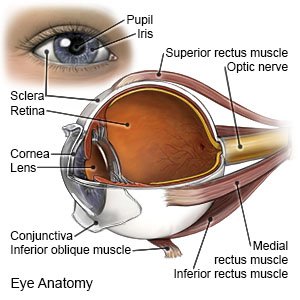
Retinopathy of prematurity (ROP) is a condition that causes problems with how blood vessels in your baby's retinas develop. The retina is the part of the eye that captures light and sends information to the brain. ROP happens in babies born prematurely or with a low birth weight. ROP most often affects both eyes.
 |
What causes ROP?
Your baby's eyes start developing during month 4 of pregnancy. Eye development may stop if your baby is born prematurely. The newborn infant's body reacts by making more blood vessels in the retina. These blood vessels grow larger and spread beyond where they should be in the eye. They are also weak and may leak blood, causing scar tissue to form on the retina. Over time, the scar tissue can make the retina detach (pull away) from its position at the back of the eye.
What increases my baby's risk for ROP?
- A birth weight of less than 3.3 pounds (1,500 grams)
- Being born at 30 weeks gestation or earlier
- Use of a ventilator to help him or her breathe
- A long hospital stay after birth
How is ROP diagnosed?
Infants with a higher risk for ROP are screened for signs of the disease. Your baby's eyes will be numbed to prevent pain. Your baby may be given a pacifier or sweet liquid to soothe him or her. Your baby's healthcare provider will dilate your baby's pupils and look at the back of his or her eyes with an ophthalmoscope. An ophthalmoscope is a magnifying instrument with a light. The provider will look for abnormal blood vessels in your baby's eyes.
How is ROP treated?
Infants with mild ROP may not need treatment. Healthcare providers may ask you to bring your baby to regular eye checkups. This will help healthcare providers monitor your baby's ROP over time. ROP may become severe if the blood vessels grow large and twisted. Severe ROP may lead to blindness. Your baby may need any of the following surgeries to treat severe ROP:
- Anti-VEGF medicine is used to help prevent blood vessels from growing. The medicine will be injected into your baby's eyes.
- Laser therapy is used to remove blood vessels.
- Scleral buckling helps prevent retinal detachment. A band is placed on the eye to help prevent fluid inside the eye from pulling on scar tissue. The band will be removed when your child is older.
- Vitrectomy is used to remove the cloudy or bloody vitreous gel that fills the center of your baby's eye. The gel is replaced by saline (salt water) to maintain normal pressure in the eye.
Treatment options
The following list of medications are related to or used in the treatment of this condition.
What can I do to help my baby?
Keep all follow-up appointments. Your baby's healthcare provider will screen for and monitor your baby's ROP. Your baby may need more tests to find other eye conditions that can happen with ROP. Your baby's healthcare provider will go over any test results with you.
Where can I find support and more information?
- American Academy of Pediatrics
345 Park Boulevard
Itasca , IL 60143
Phone: 1- 800 - 433-9016
Web Address: http://www.aap.org
When should I seek immediate care?
- Your baby is irritable and crying more than usual.
- Your baby has blood spots in his or her eyes.
When should I call my baby's doctor?
- Your baby has a fever.
- Your baby's eye is red, swollen, and draining pus.
- Your baby is not eating or drinking well.
- You have questions or concerns about your baby's condition or care.
Care Agreement
You have the right to help plan your baby's care. Learn about your baby's health condition and how it may be treated. Discuss treatment options with your baby's healthcare providers to decide what care you want for your baby. The above information is an educational aid only. It is not intended as medical advice for individual conditions or treatments. Talk to your doctor, nurse or pharmacist before following any medical regimen to see if it is safe and effective for you.© Copyright Merative 2024 Information is for End User's use only and may not be sold, redistributed or otherwise used for commercial purposes.
Learn more about Retinopathy of Prematurity
Treatment options
Further information
Always consult your healthcare provider to ensure the information displayed on this page applies to your personal circumstances.