
Remote Superficial Femoral Artery Endarterectomy
WHAT YOU SHOULD KNOW:
- Remote superficial femoral artery endarterectomy (RSFAE) is a procedure to remove plaques inside the superficial femoral artery (SFA). The femoral artery is the main blood vessel in your thigh that carries blood and oxygen to the legs. Plaques are fat, cholesterol, or tissues that are clogged in the inner wall of the artery. When plaques build up inside the superficial femoral artery, blood flow to the legs may be decreased. RSFAE may be done to relieve problems caused by a narrowed or blocked artery. Problems that may happen include severe pain in the hip, thigh, calf, or foot, and trouble when walking. Having these problems may decrease a person's ability to do his daily activities and affect his quality of life.
- With RSFAE, the plaque that blocks the artery is removed through a small incision (cut) in the groin. The groin is the area where your abdomen (stomach) meets your upper leg. Caregivers strip, cut, and remove the plaque by using different tools inserted through the SFA. This is done using a special type of x-ray as a guide. RSFAE may be followed by other procedures, such as angioplasty and stenting. Angioplasty opens the artery using a small, high pressure balloon. Stenting uses metal or plastic stents (tubes), in the area where the blockage was removed, to keep the artery open.
CARE AGREEMENT:
You have the right to help plan your care. To help with this plan, you must learn about your health condition and how it may be treated. You can then discuss treatment options with your caregivers. Work with them to decide what care may be used to treat you. You always have the right to refuse treatment.
RISKS:
Without treatment, your symptoms, such as leg pain, trouble walking, and tiring easily, may worsen. If parts of your leg do not get enough blood and oxygen, you may need an amputation (be removed). Your condition may also lead to a heart attack or stroke (brain attack). Problems with a RSFAE may include an infection, having trouble breathing, or getting a blood clot. Even after the procedure, the artery may become narrow again. The blood vessel used for the procedure may tear, causing a large amount of blood loss. Ask your caregiver if you are worried or have questions about your procedure, medicine, or care.
WHILE YOU ARE HERE:
Before your procedure:
- Informed consent: You have the right to understand your health condition in words that you know. You should be told what tests, treatments, or procedures may be done to treat your condition. Your doctor should also tell you about the risks and benefits of each treatment. You may be asked to sign a consent form that gives caregivers permission to do certain tests, treatments, or procedures. If you are unable to give your consent, someone who has permission can sign this form for you. A consent form is a legal piece of paper that tells exactly what will be done to you. Before giving your consent, make sure all your questions have been answered so that you understand what may happen.
- IV: An IV is a tube placed in your vein for giving medicine or liquids. This tube is capped or connected to tubing and liquid.
- Medicines: Your caregiver may give you the following kinds of medicines:
- Blood thinners: This medicine helps stop clots from forming in your blood. Blood thinners may be given before, during, and after a surgery or procedure. Blood thinners make it easier for you to bleed or bruise. If you shave, use an electric shaver. Use a soft toothbrush to help keep your gums from bleeding.
- Clot busters: This medicine helps break apart clots. It is given IV and may be given at the same time as other blood thinners. This medicine could save your life because blood clots in the heart, lungs or brain can kill you. Be careful because you may bleed or bruise easily.
- Blood thinners: This medicine helps stop clots from forming in your blood. Blood thinners may be given before, during, and after a surgery or procedure. Blood thinners make it easier for you to bleed or bruise. If you shave, use an electric shaver. Use a soft toothbrush to help keep your gums from bleeding.
- Pre-op care: You may be given medicine right before your procedure or surgery. This medicine may make you feel relaxed and sleepy. You are taken on a stretcher to the room where your procedure or surgery will be done, and then you are moved to a table or bed.
- Anesthesia: Anesthesia is medicine to make you comfortable during surgery. Caregivers work with you to decide which anesthesia is best and whether you will be awake or completely asleep. Do not make important decisions for 24 hours after having anesthesia. Also, do not drive or use heavy equipment. An adult may need to drive you home and stay with you after you have had anesthesia.
- Monitoring:
- Heart monitor: This is also called an ECG. Sticky pads are placed on different parts of your body. Each pad has a wire that is hooked to a TV-type screen. This shows caregivers a tracing of the electrical activity of your heart.
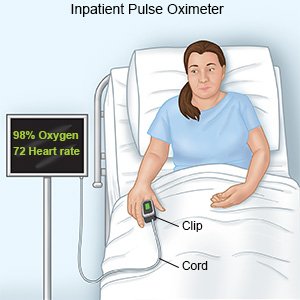
- Pulse oximeter: A pulse oximeter is a machine that tells how much oxygen is in your blood. A cord with a clip or sticky strip is placed on your ear, finger, or toe. The other end of the cord is hooked to a machine. Caregivers use this machine to see if you need more oxygen.
- Vital signs: This includes taking your temperature, blood pressure, pulse (counting your heartbeat), and respirations (counting your breaths). To take your blood pressure, a cuff is put on your arm and tightened. The cuff is attached to a machine which gives your blood pressure reading. Caregivers may listen to your heart and lungs by using a stethoscope. Your vital signs are taken so caregivers can see how you are doing.
- Heart monitor: This is also called an ECG. Sticky pads are placed on different parts of your body. Each pad has a wire that is hooked to a TV-type screen. This shows caregivers a tracing of the electrical activity of your heart.
During your procedure:
- Caregivers clean your abdomen (stomach), groin, and leg with soap and water. This soap may make your skin yellow, but can be cleaned off later. Sheets are put over you to keep the procedure area clean. X-rays with a TV screen are used to guide caregivers during the procedure.
- Caregivers make a small incision in your groin to see the femoral artery. Dye is put in the artery to make the blocked area show up better. A small incision is made in the SFA and plaque is separated from the wall of the blood vessel using special tools. The free plaque is threaded into the loop of a stripper tool and moved down the artery. Once the end of the artery blockage is reached, a cutter is inserted to cut the plaque. The cutter and the plaque are removed out of the artery together.
- After removing the plaque, dye is again put into the artery and pictures are taken. This is to make sure that all the plaque was taken out and blood can flow easily through the artery. A guidewire may be passed through the artery to make sure the inside of the artery is open. Angioplasty may then be done and a stent placed inside the superficial femoral artery to keep it open. The incisions are then closed with sutures (threads) and covered with tight pressure bandages.
After your procedure:
- After surgery: You are taken to a room where you can rest. Caregivers will watch you closely for any problems. Later, you will be taken to your hospital room or you may be able to go home. Do not get out of bed until your caregiver says it is OK. A bandage may cover your stitches or staples. This bandage keeps the area clean and dry to help prevent infection.
- Activity: You will need to lie flat and still in bed for a few hours. Tell your caregiver if you get tired of lying on your back. Keep your leg straight and do not move it until your caregiver tells you it is OK. The pulses of your legs and in your feet will be checked often. This may show caregivers if you have any problems with blood flow after your procedure. You may need to place your fingers over the incision area if you need to cough or sneeze. Your caregiver will tell you when it is okay to get out of bed. Call your caregiver before getting up for the first time. If you feel weak or dizzy after getting up, sit or lie down right away and call your caregiver.
- Medicines: Your caregiver may give you the following kinds of medicines:
- Antibiotics: Antibiotics may be given to help treat or prevent an infection caused by germs called bacteria.
- Antinausea medicine: This medicine may be given to calm your stomach and control vomiting (throwing up). Pain medicine may upset your stomach and make you feel like vomiting. Because of this, pain medicine and anti-nausea medicine are often given at the same time.
- Pain medicine: Caregivers may give you medicine to take away or decrease your pain. Medicine may be given regularly, or may only be given if you ask caregivers for it. Tell caregivers if your pain does not decrease enough for you to feel better. Do not wait to ask for your pain medicine until the pain is very bad. The medicine may not work as well at controlling your pain if you wait too long to take it. Ask your caregiver for help getting out of bed if you feel tired or dizzy.
- Antibiotics: Antibiotics may be given to help treat or prevent an infection caused by germs called bacteria.
- Pneumatic boots: These are plastic boots or leggings put on your feet or legs over pressure stockings or ace wraps. The boots or leggings are connected to an air pump machine. The pump tightens and loosens different parts of the pneumatic boots. This helps push the blood back up to the heart to keep clots from forming.
Copyright © 2008 Thomson Healthcare Inc. All rights reserved. Information is for End User's use only and may not be sold, redistributed or otherwise used for commercial purposes.
The above information is an educational aid only. It is not intended as medical advice for individual conditions or treatments. Talk to your doctor, nurse or pharmacist before following any medical regimen to see if it is safe and effective for you.
| Link to Page | Print Page | Email Page |
