
Pulled Elbow in Children
Medically reviewed by Drugs.com. Last updated on Jun 30, 2025.
A pulled elbow is an injury that occurs when one of the elbow bones slips out of its normal place. It is also called a nursemaid's elbow. The bones of the elbow are held together and supported by ligaments. In children, these ligaments may still be weak. A forceful stretching of the elbow causes the radius to slip out of the ligament that supports it. This causes the ligament to slide over the tip of the bone and get trapped inside the joint. A pulled elbow is the most common injury of the upper limb in children younger than 6 years.
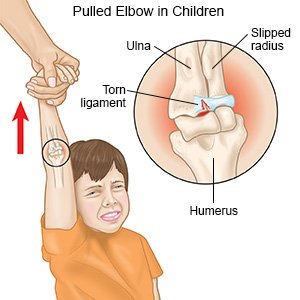 |
DISCHARGE INSTRUCTIONS:
Seek care immediately if:
- Your child has increased pain on the affected elbow.
- Your child gets another pulled elbow.
- Your child's arm or hand feels numb and tingly.
- Your child's skin or fingernails become swollen, cold, or turn white or blue.
Call your child's doctor if:
- Your child refuses to move the arm again.
- Your child's pain does not go away or comes back.
- You have questions or concerns about your child's condition or care.
Medicines:
- Acetaminophen decreases pain and fever. It is available without a doctor's order. Ask how much to give your child and how often to give it. Follow directions. Read the labels of all other medicines your child uses to see if they also contain acetaminophen, or ask your child's doctor or pharmacist. Acetaminophen can cause liver damage if not taken correctly.
- Do not give aspirin to children younger than 18 years. Your child could develop Reye syndrome if he or she has the flu or a fever and takes aspirin. Reye syndrome can cause life-threatening brain and liver damage. Check your child's medicine labels for aspirin or salicylates.
- Give your child's medicine as directed. Contact your child's healthcare provider if you think the medicine is not working as expected. Tell the provider if your child is allergic to any medicine. Keep a current list of the medicines, vitamins, and herbs your child takes. Include the amounts, and when, how, and why they are taken. Bring the list or the medicines in their containers to follow-up visits. Carry your child's medicine list with you in case of an emergency.
Splint or sling:
Healthcare providers may want your child to limit elbow movement for a time. A sling or splint may be used to support the elbow area and help make your child feel more comfortable. Ask your child's healthcare provider for more information on using a splint or sling.
Prevent another pulled elbow:
- Do not swing your child by the hands, wrists, or forearms.
- Do not pull your child by the hand.
- Do not lift your child by the hand, wrist, or forearm. Hold your child under the arms or around his or her body when you lift him or her.
Follow up with your child's doctor as directed:
Write down your questions so you remember to ask them during your visits.
© Copyright Merative 2025 Information is for End User's use only and may not be sold, redistributed or otherwise used for commercial purposes.
The above information is an educational aid only. It is not intended as medical advice for individual conditions or treatments. Talk to your doctor, nurse or pharmacist before following any medical regimen to see if it is safe and effective for you.
Further information
Always consult your healthcare provider to ensure the information displayed on this page applies to your personal circumstances.