Thomson Reuters Micromedex

Nephrolithiasis

WHAT YOU SHOULD KNOW:

Nephrolithiasis (Inpatient Care) Care Guide

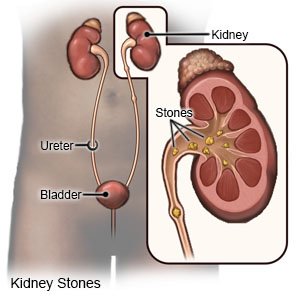
  • Nephrolithiasis (nef-roh-li-THI-ah-sis) is also called renal calculi or "kidney stones". Kidney stones are rock-like pieces that can form in the urinary system, usually in the kidneys. They may be very small, or may grow to the size of a small pebble or larger. You may have one or more kidney stones at one time. Small kidney stones often leave the body without a person even knowing about them. While larger stones may get stuck in one of the two ureters, causing pain and blocking urine flow.

  • You may be sent home to "pass" (urinate) your kidney stones. You may be told to drink at least two to three quarts (eight to twelve cups) of liquid each day. This will help increase the amount of urine you make and may help pass the stone. You may be given medicine to treat your pain while waiting for the stone to pass. A procedure or surgery may be needed to get rid of kidney stones if they cannot be passed.
Picture of the urinary system

CARE AGREEMENT:

You have the right to help plan your care. Learn about your health condition and how it may be treated. Discuss treatment options with your caregivers to decide what care you want to receive. You always have the right to refuse treatment.

RISKS:

Kidney stones can cause infection. They may cause blockage so that urine cannot go out of the kidney or ureters. This can lead to kidney damage, and can cause the kidneys to fail (stop working). Most people's kidneys return to normal after the kidney stone has been passed or removed. However once you have kidney stones, you are at higher risk of getting them again. Call your caregiver if you are worried or have questions about your treatment or care.

WHILE YOU ARE HERE:

Informed consent:

A consent form is a legal document that explains the tests, treatments, or procedures that you may need. Informed consent means you understand what will be done and can make decisions about what you want. You give your permission when you sign the consent form. You can have someone sign this form for you if you are not able to sign it. You have the right to understand your medical care in words you know. Before you sign the consent form, understand the risks and benefits of what will be done. Make sure all your questions are answered.

IV:

An IV (intravenous) is a small tube placed in your vein that is used to give you medicine or liquids.

Medicine:

  • Antibiotics: This medicine is given to help treat or prevent an infection caused by bacteria.

  • Antinausea medicine: This medicine may be given to calm your stomach and prevent vomiting.

  • Pain medicine: Caregivers may give you medicine to take away or decrease your pain.

    • Do not wait until the pain is severe to ask for your medicine. Tell caregivers if your pain does not decrease. The medicine may not work as well at controlling your pain if you wait too long to take it.

    • Pain medicine can make you dizzy or sleepy. Prevent falls by calling a caregiver when you want to get out of bed or if you need help.

Tests:

  • Blood tests: You may need blood taken to give caregivers information about how your body is working. The blood may be taken from your hand, arm, or IV.

  • Cystoscopy: A cystoscopy allows caregivers to look for problems inside your bladder. A cystoscope is put into your bladder through your urethra. The urethra is the tube that urine flows through when you urinate. The cystoscope is a long tube with a lens and a light on the end. The scope may be hooked to a camera or monitor, and pictures may be taken. A tissue sample may also be taken during your cystoscopy. During this test, small tumors may be removed or bleeding may be stopped.

  • IVP: This is also called an intravenous pyelogram. An IVP is an x-ray of the kidneys, bladder, and ureters (tubes that carry urine). Dye is put into your IV, which makes these organs show up better in x-ray pictures. You may need to have more than one x-ray over short periods of time during your IVP. People who are allergic to shellfish (lobster, crab, or shrimp) may be allergic to this dye. Tell your caregiver if you are allergic to shellfish, dyes, or other medicines.

  • KUB x-ray: An x-ray machine takes pictures of your kidneys (K), ureters (U), and bladder (B). The ureters are tiny tubes that carry urine from your kidneys to your bladder. The bladder is where the urine is stored before leaving your body. Caregivers use these pictures to check for problems with your intestines , kidneys, or abdomen.

  • Noncontrast helical CT scan: This test is also called a "CAT" scan. A special x-ray machine uses a computer to take pictures of your kidneys. Your caregivers look at the pictures to see if there are kidney stones or other problems.

  • Abdominal ultrasound: This test is done so caregivers can see the tissues and organs of your abdomen. Gel will be put on your abdomen and a small sensor will be moved across your abdomen. The sensor uses sound waves to send pictures of your abdomen to a TV-like screen.

  • Urine: You will need to save your urine each time you urinate. It will be strained to catch stones that you may pass. Your urine may also be tested for blood.

  • Vital signs: Caregivers will check your blood pressure, heart rate, breathing rate, and temperature. They will also ask about your pain. These vital signs give caregivers information about your current health.

Procedures and surgery:

You may need a procedure or surgery if your kidney stone is too large to pass. The procedure or surgery that you have will depend on the size and type of your kidney stone. It may also depend on where the stone is located in your urinary system. You may need one or more of the following:

  • Lithotripsy: During lithotripsy, shock waves are used to break apart stones in your gallbladder, kidney, or other areas. You may be placed in a water bath or on a water-filled cushion. You may be given medicine to make you drowsy before the procedure. Shock waves are sent through the water and toward the stone or stones. The stones may break apart when the shock waves hit them. Pieces of the stones may then pass out of your body when you use the toilet.

  • Percutaneous nephrolithomy: During this surgery, a tiny incision (cut) is made in your back over the area where the stone is located. A nephroscope is put through the incision into the kidney near the stone. This scope is a long tube with a magnifying glass and a light on the end. The scope and other tools are put into the incisions to gently remove the stone. A special machine may be used to break the stones into smaller pieces.

  • Ureteroscopic kidney stone removal: A ureteroscope is put through your urethra and bladder into your ureter. The ureteroscopy is a long thin tube with a light and magnifying glass on the end. Your doctor put instruments like tiny forceps through the scope to grab small stones. Larger ones are shattered (broken into tiny sand-like pieces) using a special machine. These tiny pieces of stone will be passed in your urine in the next few days.

  • Open nephrolithotomy: During this surgery, an incision (cut) is made in your back or abdomen over the area where the stone is located. The kidney stone is gently removed and sent to the lab for tests. The incision is closed with stitches (thread) or staples.

Copyright © 2012. Thomson Reuters. All rights reserved. Information is for End User's use only and may not be sold, redistributed or otherwise used for commercial purposes.

The above information is an educational aid only. It is not intended as medical advice for individual conditions or treatments. Talk to your doctor, nurse or pharmacist before following any medical regimen to see if it is safe and effective for you.

Learn more about Nephrolithiasis (Inpatient Care)

Advertisement
Close

Recommended

(web4)