close :

:

Forgotten your password?
 
Consumer Information
Print Print   
Carenotes > Laser In Situ Keratomileusis

Laser In Situ Keratomileusis

GENERAL INFORMATION:

What is it? Laser in situ keratomileusis (ker-ah-toh-mi-LOO-sis) or "LASIK" is eye surgery that uses a special kind of laser. Surgery with this laser may help you see better without contact lenses or glasses. LASIK is usually done in an outpatient center or clinic. One or both eyes may be done. You may be able to see with clear, focused vision right after surgery. If this does not happen, you may need to wait for a longer time before your vision is clear and focused. You may have changes in your sight as your eyes heal after the surgery. You should have normal sight without contacts or glasses in about one to three months. If you are over 40 years of age, you may still need to use reading glasses, even after LASIK surgery.

Why do people usually need glasses or contacts? You may need glasses or contacts because you have one or more of the following:

  • Myopia: This is also called "nearsighted". With myopia (meye-OH-pee-ah), you can see near objects clearly, but far objects are blurry (not clear and focused).

  • Hyperopia: This is also called "farsighted". With hyperopia (heye-per-OH-pee-ah), you can see far objects clearly, but near objects are blurry.

  • Astigmatism (ah-STIG-mah-tizm): Objects may appear blurry to you when seeing both near and far.

  • Presbyopia: This is a problem for people as they get older (usually over 40 years old). People with presbyopia (pres-bee-OH-pee-ah) begin to have problems seeing near objects. They may need reading glasses or bifocals (double-lens glasses) to help them read or see near objects clearly. LASIK does not make presbyopia go away.

Can LASIK surgery help my vision? LASIK surgery may not work for everyone. It may help the most if you have medium myopia, mild hyperopia, or astigmatism. Your eye doctor will check your eyes, health history, and may ask you many questions. It is important that you fully understand what LASIK can and cannot do for your sight. Ask questions if you are not sure. Good results from laser surgery vary from person to person. Follow your eye doctor's instructions right after surgery to have the best results.

Who can LASIK help the most? People who usually get the best vision results are called good "candidates". Good candidates for LASIK surgery:

  • Are 18 years of age or older. It is especially helpful for people who have to wear glasses or contact lens all the time. Some eye doctors only do LASIK surgery on patients who are 21 years of age or older.

  • Are in good general health.

  • Have eyesight that has not changed in the past six months.

  • Do not have certain eye problems. These include long-term problems such as cataracts, glaucoma (glaw-KOH-mah), and corneal (KOR-nee-al) scars. These problems include eyes that are often very dry or red with itchy, scaly eyelids. They include pupils that are too large or cornea problems (corneas that are uneven or too thin). They include retina (inside lining of the eye) problems or herpes (virus germ) infections (in-FEK-shuns).

  • Do not have long-term health problems. These include diabetes (deye-ah-BEE-teez), multiple sclerosis, or cancer. These include immune problems (body fights against itself) such as rheumatoid (ROO-ma-toid) arthritis (ahr-THREYE-tis) and lupus.

  • Are not pregnant or breast feeding.

  • Are not taking medicines such as isotretinoin (Accutane®), which is medicine for the skin. Taking steroids (STER-oids) may also be a reason to not have LASIK surgery. Steroids are used to decrease inflammation (in-flah-MAY-shun) which is redness, pain, and swelling, and to treat certain diseases.

  • Do not regularly play sports that cause hits or punches in or near the face. These sports include wrestling, boxing, and martial arts such as karate.

What tests are done to find out if I can be helped by LASIK? Your eye doctor will need to do tests to know if you are a good candidate for LASIK. It is best to stop wearing your contact lenses two to four weeks before this "baseline" (first) exam. Wear your glasses instead. This way, your corneas will be their natural shape (instead of shaped by the contacts) during your exam. After the tests are finished, you and your eye doctor can decide if LASIK is right for you.

  • Complete Eye Exam: Your eye doctor will use special eye drops to dilate (DEYE-layt) your eyes. Dilating your eyes causes the pupils (black dot in the middle of the eye) to become very wide. This helps your eye doctor have the best view of the inside of your eye. Your eye doctor will use computers and a special instrument called an ophthalmoscope (of-THAL-moh-skohp) to look into your eyes. Your eye doctor will do tests to measure your eyes. Some of these tests are as follows:

    • Pachymetry (pak-IH-meh-tree): This test uses a computer to measure the thickness of your cornea.

    • Tonometry (toh-NOM-e-tree): This test measures your eye pressure. Your eye pressure is also called "intraocular (in-truh-OC-u-ler) pressure" or "IOP". While you look ahead, air will be puffed or a special light will shine in your eyes to measure your eye pressure. For other types of tonometry tests, you may need eye drops that will numb your eyes for a short time. An instrument may be put on your eye to measure the eye pressure.

    • Topography (toh-POG-rah-fee): A special camera uses a computer to take pictures of your eyes. This test helps eye doctors measure the size, shape, and health of your cornea. It also helps eye doctors understand other things about your vision.

    • Pupilometer (pu-pi-LOM-e-ter): This is an instrument that measures the size of your pupils. Pupils are the black center of your eye.

What happens during LASIK surgery? You will be given eye drops to numb your eyes so you feel no pain. You may still feel some pressure during the surgery. You may also be given medicine by mouth to feel more relaxed. Before your surgery, a caregiver will wash around your eyes. You are then taken to the surgery room with the laser and computer. Caregivers help you get comfortable on the bed or in a special chair. A special pillow device is used to hold your head still during surgery.

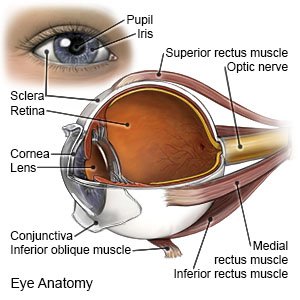
  • A tiny, hinged device called a speculum (SPEK-u-lum) is put in your eye. The speculum will hold your lids apart so you cannot blink during surgery. Then a very small suction ring with a track guide is placed on your cornea (KOR-nee-ah). The cornea is the clear area that covers your iris and pupil. Pressure from the suction ring causes your vision to fade and become black. A special cutting tool called a microkeratome (meye-kroh-KER-ah-tohm) then moves along the track of the suction ring. It cuts a small, hinged cap or flap on your cornea. The track has an automatic stopper that keeps the microkeratome from cutting the flap off.

  • The corneal (KOR-nee-al) flap is folded over. The area under the flap is gently cleaned and examined. The laser is placed over your eye and it reshapes the uncovered layer of the cornea. You may notice an unusual smell while this is being done. The flap is then put back in its normal place. There are no stitches (threads) used. The cornea begins to heal almost as soon as the flap is moved back. The hinged device to keep your eye open is removed. You may be taken to a recovery room. The eye doctor will watch your eyes very closely to make sure the flap does not move or wrinkle.

How can I get more information about LASIK surgery? Contact the following organizations for more information about LASIK:

  • International Society of Refractive Surgery of the American Academy of Ophthalmology
    P.O. Box 7424
    San Franciso, CA 94120
    Phone: 1-415-561-8500
    Web Address: www.isrs.org
  • National Eye Institute
    2020 Vision Pl.
    Bethesda, MD 20892-3655
    Phone: 1-301-496-5248
    Web Address: http://www.nei.nih.gov

CARE AGREEMENT:

You have the right to help plan your care. To help with this plan, you must learn about your health condition and how it may be treated. You can then discuss treatment options with your caregivers. Work with them to decide what care may be used to treat you. You always have the right to refuse treatment.


Join Drugs.com
Click here to see what benefits you can get by joining our FREE membership programme.
Drugs.com is the most popular, comprehensive, and up-to-date source of drug information online. Providing advice on more than 24,000 prescription drugs and over-the-counter medicines for consumers and professionals .
Advertisement
In The Pipeline
Save bookmark to...