
Laparoscopic Herniorrhaphy
Medically reviewed by Drugs.com. Last updated on May 6, 2024.
Laparoscopic herniorrhaphy is surgery to repair a hernia. Laparoscopic surgery is done through small incisions.
WHILE YOU ARE HERE:
Before your surgery:
- Informed consent is a legal document that explains the tests, treatments, or procedures that you may need. Informed consent means you understand what will be done and can make decisions about what you want. You give your permission when you sign the consent form. You can have someone sign this form for you if you are not able to sign it. You have the right to understand your medical care in words you know. Before you sign the consent form, understand the risks and benefits of what will be done. Make sure all your questions are answered.
- An IV is a small tube placed in your vein that is used to give you medicine or liquids.
- Anesthesia is medicine to make you comfortable during the surgery. Healthcare providers will work with you to decide which anesthesia is best for you.
- General anesthesia will keep you asleep and free from pain during surgery. Anesthesia may be given through your IV. You may instead breathe it in through a mask or a tube placed down your throat. The tube may cause you to have a sore throat when you wake up.
- Local anesthesia is a shot of medicine put into the area where you will have the surgery. It is used to numb the area and dull the pain. You may still feel pressure or pushing during surgery.
During your surgery:
- Your surgeon will make 3 to 4 small incisions around your groin area and into your abdomen. Tools will be inserted through the incisions. Carbon dioxide gas may be used to inflate your abdomen. The gas will help your surgeon see the area that needs repair.
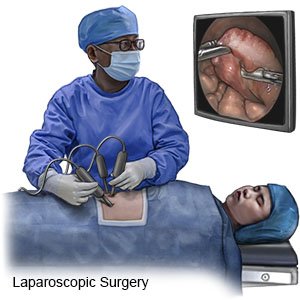
- Your surgeon will examine the weakened muscles in your groin through the scope. He or she will remove your hernia or push it back into its normal space. A mesh patch may be placed over the area of the hernia and stapled or tacked in place. Your peritoneum (inner tissue lining of your abdomen) will then be closed over the mesh with staples or stitches.
- Your incisions will be closed with stitches and covered with a bandage. The bandage will help keep your incisions clean and dry, and help to prevent infection.
After your surgery:
You will be taken to a room to rest until you are fully awake. Healthcare providers will monitor you closely for any problems. Do not get out of bed until your healthcare provider says it is okay. When your healthcare provider sees that you are okay, you will be able to go home or be taken to your hospital room. An ultrasound may be done after your surgery to check the repair.
- You will be helped to walk around after surgery. Movement will help prevent blood clots. You may also be given exercises to do in bed. Do not get out of bed on your own until your healthcare provider says you can. Talk to healthcare providers before you get up the first time. They may need to help you stand up safely. When you are able to get up on your own, sit or lie down right away if you feel weak or dizzy. Then press the call light button to let healthcare providers know you need help.
- Medicine may be given to prevent or relieve pain or nausea.
RISKS:
- You may bleed more than expected during your surgery or develop an infection. Your nerves, blood vessels, or abdominal organs may be injured during surgery. The contents of your bowel may spill into your abdomen and cause a severe infection. Your surgery may need to be changed into an open hernia repair surgery. An open surgery means your surgeon will make larger and deeper incisions, which will take longer to heal.
- You may have shoulder and chest pain from the gas used during your surgery. You may develop bruising, a seroma (collection of fluid), or an infection at your surgery site. You may have trouble emptying your bladder. You may develop a life-threatening blood clot. You may have chronic pain or numbness in your groin area for months or years after your surgery. You may need to have another surgery if your condition returns or occurs in a different area.
CARE AGREEMENT:
You have the right to help plan your care. Learn about your health condition and how it may be treated. Discuss treatment options with your healthcare providers to decide what care you want to receive. You always have the right to refuse treatment.© Copyright Merative 2024 Information is for End User's use only and may not be sold, redistributed or otherwise used for commercial purposes.
The above information is an educational aid only. It is not intended as medical advice for individual conditions or treatments. Talk to your doctor, nurse or pharmacist before following any medical regimen to see if it is safe and effective for you.
Learn more about Laparoscopic Herniorrhaphy
Care guides
Further information
Always consult your healthcare provider to ensure the information displayed on this page applies to your personal circumstances.
