
Consumer Information
Carenotes > Laparoscopic Adrenalectomy (Inpatient Care)

Laparoscopic Adrenalectomy

Advertisement

WHAT YOU SHOULD KNOW:

  • Laparoscopic adrenalectomy is surgery to remove the adrenal gland. It is done when a small tumor is found on the gland. . It may also be done if you are bleeding, , or if you have a chronic (long-term) infection, or other growths in the adrenal gland. Surgery may also be done for an adrenal gland disease, such as Addison disease, that is causing severe (very bad) symptoms. The adrenal gland is a small gland that sits on top of each kidney. The glands produce hormones and chemicals that control how different parts of your body work. An adrenal gland disease may cause the glands to make too much or not enough of these substances. This may lead to high blood pressure, hypoglycemia (low blood sugar), Cushing syndrome, or Addison disease.

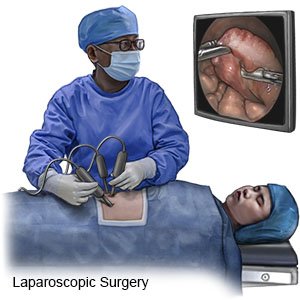
  • During a laparoscopic adrenalectomy, small incisions (cuts) are made in your abdomen (stomach). Caregivers will insert special tools and a laparoscope through these incisions to do the surgery. A laparoscope is a long metal tube with a tiny video camera and a light on the end. This gives caregivers a clear view of the abdominal area by looking at a TV monitor. Your caregiver may remove the whole adrenal gland or just part of it. After this surgery, the symptoms of your adrenal gland condition or disease may go away.
Male Endocrine System
Female Endocrine System

CARE AGREEMENT:

You have the right to help plan your care. To help with this plan, you must learn about your health condition and how it may be treated. You can then discuss treatment options with your caregivers. Work with them to decide what care may be used to treat you. You always have the right to refuse treatment.

RISKS:

  • Problems, such as bleeding that cannot be controlled, may happen during your surgery and may lead to a laparotomy (open surgery). Your stomach, intestines, blood vessels, or kidneys may get injured or burned while having the surgery. You could also have trouble breathing, get an infection, or have too much bleeding after surgery. The gas used to expand your abdomen may cause shoulder or chest pain for 1 to 2 days after your surgery.

  • Without treatment, the symptoms that you have may worsen and cause high blood pressure, or you may have an adrenal crisis. Adrenal crisis is when the symptoms of Addison disease get much worse. These symptoms can put your life in danger. Ask your caregiver if you are worried or have questions about your surgery, medicine, or care.

WHILE YOU ARE HERE:

Before your surgery:

  • Informed consent: You have the right to understand your health condition in words that you know. You should be told what tests, treatments, or procedures may be done to treat your condition. Your doctor should also tell you about the risks and benefits of each treatment. You may be asked to sign a consent form that gives caregivers permission to do certain tests, treatments, or procedures. If you are unable to give your consent, someone who has permission can sign this form for you. A consent form is a legal piece of paper that tells exactly what will be done to you. Before giving your consent, make sure all your questions have been answered so that you understand what may happen.

  • Enema: You may need to have an enema before your surgery. This is when liquid is put into your rectum to help empty your bowel.

  • IV: An IV is a tube placed in your vein for giving medicine or liquids. This tube is capped or connected to tubing and liquid.

  • Pre-op care: You may be given medicine right before your procedure or surgery. This medicine may make you feel relaxed and sleepy. You are taken on a stretcher to the room where your procedure or surgery will be done, and then you are moved to a table or bed.

  • General anesthesia: This is medicine that may be given in your IV or as a gas that you breathe. You may wear a face mask or have a tube placed in your mouth and throat. This tube is called an endotracheal tube or ET tube. Usually you are asleep before caregivers put the tube into your throat. The ET tube is usually removed before you wake up. You are completely asleep and free from pain during surgery.

  • Foley catheter: A Foley catheter is a tube that is put into your bladder to drain your urine into a bag. The bladder is an organ where urine is kept. Keep the bag of urine well below your waist. Lifting the urine bag higher will make the urine flow back into your bladder, which can cause an infection. Avoid pulling on the catheter because this may cause pain and bleeding, and the catheter may come out. Do not allow the catheter tubing to kink because this will block the flow of urine.

  • Nasogastric (NG) tube: A nasogastric tube is put into your nose and down into your stomach. The tube may be attached to suction (vacuum) to keep your stomach empty. You may need a NG tube if your stomach gets too full or if you throw up a lot after surgery. You may also need it if you cannot use your mouth to eat. An NG tube may also be used to help get your bowels working. Food or medicine may be given through your NG tube.

  • Monitoring:

    • Heart monitor: This is also called an ECG. Sticky pads are placed on different parts of your body. Each pad has a wire that is hooked to a TV-type screen. This shows caregivers a tracing of the electrical activity of your heart.

    • Pulse oximeter: A pulse oximeter is a machine that tells how much oxygen is in your blood. A cord with a clip or sticky strip is placed on your ear, finger, or toe. The other end of the cord is hooked to a machine. Caregivers use this machine to see if you need more oxygen.

    • Vital signs: This includes taking your temperature, blood pressure, pulse (counting your heartbeat), and respirations (counting your breaths). To take your blood pressure, a cuff is put on your arm and tightened. The cuff is attached to a machine which gives your blood pressure reading. Caregivers may listen to your heart and lungs by using a stethoscope. Your vital signs are taken so caregivers can see how you are doing.

During your surgery: Your abdomen is cleaned and sheets are put over you. Three or four small incisions cuts are made in your abdomen. Caregivers will insert the laparoscope and other tools into the openings. Your abdomen is filled with carbon dioxide gas to make it swell. This lifts the wall of your abdomen away from the internal organs and gives caregivers more space to work in. Blood vessels of the adrenal gland are tied and cut. The adrenal gland is separated from its attachments and removed. The incisions are closed by sutures (threads) or tape and covered with bandages.
After your surgery: You will be taken to a recovery room until you are fully awake. Caregivers will watch you closely for any problems. When caregivers see that you are OK, you will be taken back to your hospital room. The bandages used to cover your stitches keep the area clean and dry to prevent infection. A caregiver may remove the bandages soon after your surgery to check your incisions.

  • Activity: Caregivers may help you get out of bed to walk on the same day of surgery, or the day after. Ask caregivers if there are exercises that you may do while in bed. Exercise helps blood move through your body and may help prevent blood clots from forming. Your caregiver will tell you when it is OK to get out of bed. Call your caregiver before getting up for the first time. If you feel weak or dizzy while standing up, sit or lie down right away and call your caregiver.

  • Diet: You may be able to eat when bowel sounds are heard. Your caregiver will listen to your stomach for bowel sounds using a stethoscope. You may be given ice chips at first, and then liquids such as water, broth, juice, or soda pop. If you do not have problems after drinking liquids, caregivers may then give you soft foods. Some examples of soft foods are ice cream, applesauce, or custard. Once you can eat soft food easily, you may begin eating your usual diet.

  • Medicines: You may need any of the following:

    • Antibiotics: Antibiotics may be given to help treat or prevent an infection caused by germs called bacteria.

    • Antinausea medicine: This medicine may be given to calm your stomach and control vomiting (throwing up). Pain medicine may upset your stomach and make you feel like vomiting. Because of this, pain medicine and anti-nausea medicine are often given at the same time.

    • Pain medicine: Caregivers may give you medicine to take away or decrease your pain. Medicine may be given regularly, or may only be given if you ask caregivers for it. Tell caregivers if your pain does not decrease enough for you to feel better. Do not wait to ask for your pain medicine until the pain is very bad. The medicine may not work as well at controlling your pain if you wait too long to take it. Ask your caregiver for help getting out of bed if you feel tired or dizzy.

  • Oxygen: You may need extra oxygen to help you breathe easier. It may be given through a plastic mask over your mouth and nose. It may be given through a nasal cannula, or prongs, instead of a mask. A nasal cannula is a pair of short, thin tubes that rest just inside your nose. Tell your caregiver if your nose gets dry or if the mask or prongs bother you. Ask your caregiver before taking off your oxygen. Never smoke or let anyone else smoke in the same room while your oxygen is on. Doing so may cause a fire.

  • Pneumatic boots: These are plastic boots or leggings put on your feet or legs over pressure stockings or ace wraps. The boots or leggings are connected to an air pump machine. The pump tightens and loosens different parts of the pneumatic boots. This helps push the blood back up to the heart to keep clots from forming.

Copyright © 2008 Thomson Healthcare Inc. All rights reserved. Information is for End User's use only and may not be sold, redistributed or otherwise used for commercial purposes.

The above information is an educational aid only. It is not intended as medical advice for individual conditions or treatments. Talk to your doctor, nurse or pharmacist before following any medical regimen to see if it is safe and effective for you.


MedNotes
Advertisement

(web4)