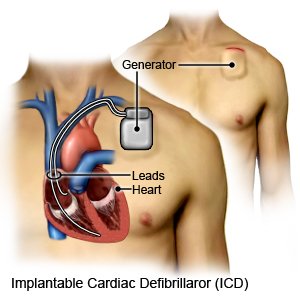
Implantable Cardioverter Defibrillator
WHAT YOU SHOULD KNOW:
- An implantable cardioverter (CAR-d-o-ver-ter) defibrillator (d-FIB-ri-la-ter) is also called an ICD. It is a device that monitors your heart rate and rhythm. The ICD gives your heart a shock if you start having arrhythmias (uh-RITH-me-uhs). Arrhythmias are when your heart does not beat normally. Some arrhythmias can cause the heart to stop beating. The ICD will shock your heart so that it starts beating normally again. An ICD can make your heart beat faster if it is not beating fast enough. It can also slow your heart down if it is beating too fast.
- An ICD is made up of a generator, a programmer, and leads. The generator and the leads will be placed inside you during surgery. The generator has a metal shell with a battery and a small computer inside. The computer monitors your heart rate and rhythm. Leads are wires that have one end that attach to the inside of your heart and the other end is connected to the generator. The generator transmits information about your heart to the programmer. Surgery is needed to get an ICD. The surgery may be done when you are already a patient in the hospital or you may come into the hospital the morning of your surgery. It is possible that you may go home after the surgery.
- The leads are usually placed inside the heart. There are some instances that the leads may be placed on the outside of the heart. The generator is usually placed in a pocket under the skin in the shoulder area. It may also be placed in a pocket under the skin in the abdomen (belly).

CARE AGREEMENT:
You have the right to help plan your care. To help with this plan, you must learn about your health condition and how it may be treated. You can then discuss treatment options with your caregivers. Work with them to decide what care may be used to treat you. You always have the right to refuse treatment.
RISKS:
- There are always risks with surgery. You may bleed more than usual, get blood clots, or an infection. The leads could poke a hole in your heart, lung, or vein. Putting in the leads can cause arrhythmias. Blood may also form in the pocket where the generator is placed. This can cause pain and infection. Sometimes, the leads may disconnect and a second surgery may be needed. The leads may break. A second surgery may be needed to fix them. You could die from this surgery. Your caregivers will closely watch you for any of these problems.
- If you do not get an ICD, your heart problems could get worse and you could die. Ask your caregiver if you have any questions about your care.
WHILE YOU ARE HERE:
Before Your ICD Surgery:
- Informed consent: You have the right to understand your health condition in words that you know. You should be told what tests, treatments, or procedures may be done to treat your condition. Your doctor should also tell you about the risks and benefits of each treatment. You may be asked to sign a consent form that gives caregivers permission to do certain tests, treatments, or procedures. If you are unable to give your consent, someone who has permission can sign this form for you. A consent form is a legal piece of paper that tells exactly what will be done to you. Before giving your consent, make sure all your questions have been answered so that you understand what may happen.
- Blood tests: You may need blood taken for tests. The blood can be taken from a blood vessel in your hand, arm, or the bend in your elbow. It is tested to see how your body is doing. It can give your caregivers more information about your health condition. You may need to have blood drawn more than once.
- Call button: You may use the call button when you need your caregiver. Pain, trouble breathing, or wanting to get out of bed are good reasons to call. The call button should always be close enough for you to reach it.
- Chest x-ray: This is a picture of your lungs and heart. Caregivers use it to see how your lungs and heart are doing. Caregivers may use the x-ray to look for signs of infection like pneumonia, or to look for collapsed lungs. Chest x-rays may show tumors, broken ribs, or fluid around the heart and lungs.
- 12-lead ECG: This test, also called an EKG, helps caregivers look for damage or problems in different areas of the heart. Caregivers may need to prepare your skin by shaving off some hair, or cleaning it with a gritty lotion. Sticky pads are placed on your chest, arms, and legs. Each sticky pad has a wire that is hooked to a machine or TV-type screen. A short period of electrical activity in your heart muscle is recorded. Caregivers will look closely for certain problems or changes in how your heart is working. This test takes about 5 to 10 minutes. It is important that you lie as still as possible during the test. You may need this test more than once.
- IV: An IV is a tube placed in your vein for giving medicine or liquids. This tube is capped or connected to tubing and liquid.
- Oxygen: You may need extra oxygen to help you breathe easier. It may be given through a plastic mask over your mouth and nose. It may be given through a nasal cannula, or prongs, instead of a mask. A nasal cannula is a pair of short, thin tubes that rest just inside your nose. Tell your caregiver if your nose gets dry or if the mask or prongs bother you. Ask your caregiver before taking off your oxygen. Never smoke or let anyone else smoke in the same room while your oxygen is on. Doing so may cause a fire.
- Pulse oximeter: A pulse oximeter is a machine that tells how much oxygen is in your blood. A cord with a clip or sticky strip is placed on your ear, finger, or toe. The other end of the cord is hooked to a machine. Caregivers use this machine to see if you need more oxygen.
- Vital signs: This includes taking your temperature, blood pressure, pulse (counting your heartbeat), and respirations (counting your breaths). To take your blood pressure, a cuff is put on your arm and tightened. The cuff is attached to a machine which gives your blood pressure reading. Caregivers may listen to your heart and lungs by using a stethoscope. Your vital signs are taken so caregivers can see how you are doing.
- Heart monitor: This is also called an ECG. Sticky pads are placed on different parts of your body. Each pad has a wire that is hooked to a TV-type screen. This shows caregivers a tracing of the electrical activity of your heart.
- Bathroom: Go to the bathroom before your ICD surgery. Otherwise, you may have to wait until after surgery.
- Transport: You will be taken on a stretcher (cart) to the operating room. A caregiver will help you onto the operating room table and will help make you comfortable. A belt will be put over your legs for safety. Your arms will be tucked at your sides. The room will be very bright and noisy, and there will be lots of people walking around.
- Anesthesia: Anesthesia is medicine to make you comfortable during surgery. Caregivers work with you to decide which anesthesia is best and whether you will be awake or completely asleep. Do not make important decisions for 24 hours after having anesthesia. Also, do not drive or use heavy equipment. An adult may need to drive you home and stay with you after you have had anesthesia.
- Local or monitored anesthesia: This is a shot of numbing medicine put into the skin where you will have surgery. You may still feel pressure or pushing during surgery but you should not have pain. With local anesthesia, you will be fully awake during the procedure. With monitored anesthesia care, you will also be given medicine through an IV. This medicine keeps you comfortable, relaxed, and drowsy during the procedure.
During Your ICD Surgery:
- Your caregiver will clean your neck and chest with a special soap. This soap may make your skin yellow, but it will be cleaned off later. Sheets will be put over you to keep the surgery area clean.
- A lead is put into a vein near your collarbone or neck. With the help of a special x-ray machine, the lead is then placed or guided into your heart. The leads will be sewn to the inside of your heart, but may be sewn to the outside of your heart instead. The other end of the lead is connected to the generator. The generator is then placed in a pocket under your skin. This pocket is usually in the shoulder area, but may also be in the abdominal (belly) area. The ICD is set so that it will monitor your heart all the time. The incision is then closed with stitches or staples.
- The surgery may last two to three hours.
After Your ICD Surgery: You will be taken to a recovery room where you will wake up. There will be lots of noise and activity. This is normal. Caregivers will be checking on you often. You will have a bandage covering your stitches or staples. If you are spending the night in the hospital, you will be taken to your room when you are awake and your pain is controlled. If you are going home, you will be allowed to leave as soon as you are awake and your pain is controlled.
What Medicines Will I Take After My ICD Surgery?
- Antinausea medicine: This medicine may be given to calm your stomach and control vomiting (throwing up). Pain medicine may upset your stomach and make you feel like vomiting. Because of this, pain medicine and anti-nausea medicine are often given at the same time.
- Heart medicine: This medicine may be given to make your heart beat stronger or more regularly. There are many different kinds of heart medicines. Talk with your caregiver to find out what your medicine is and why you are taking it.
- Pain medicine: Caregivers may give you medicine to take away or decrease your pain. Medicine may be given regularly, or may only be given if you ask caregivers for it. Tell caregivers if your pain does not decrease enough for you to feel better. Do not wait to ask for your pain medicine until the pain is very bad. The medicine may not work as well at controlling your pain if you wait too long to take it. Ask your caregiver for help getting out of bed if you feel tired or dizzy.
- Antibiotics: Antibiotics may be given to help treat or prevent an infection caused by germs called bacteria.
Copyright © 2008 Thomson Healthcare Inc. All rights reserved. Information is for End User's use only and may not be sold, redistributed or otherwise used for commercial purposes.
The above information is an educational aid only. It is not intended as medical advice for individual conditions or treatments. Talk to your doctor, nurse or pharmacist before following any medical regimen to see if it is safe and effective for you.
| Link to Page | Print Page | Email Page |