Ileostomy Care

What is an ileostomy?

  • An ileostomy is an opening that is made in the ileum (the lowest part of the small intestine) with surgery. After the opening is made, the end of the ileum is brought to the surface of the abdomen. The stool drains from the ileum to the outside of the body through an opening in the abdomen called a stoma. The stoma is usually located on the lower right side of the abdomen. The stool has a liquid to soft consistency and drains into a flat, changeable, watertight bag or pouch. The pouch is attached to the skin with an adhesive (substance that seals the pouch to the skin).
    Ileostomy


  • An ileostomy is sometimes needed for Crohn's disease, ulcerative colitis, cancer, trauma or other diseases. With an ileostomy, the colon and rectum are usually removed and cannot be used again. However, temporary ileostomies are sometimes done to allow the colon to rest and heal for a period of time.

Where is the small intestine located?

The small intestine is part of the digestive system. The digestive system consists of the parts of the body that are involved in the digestion (breakdown) of food. Food moves from your stomach to the small intestine where food is digested and nutrients are absorbed. The food then goes to the colon (part of the large intestine). The colon absorbs water from digested food and turns the digested food into stool.

Anatomy of Small Intestine

What types of products are used for ileostomies?

  • Pouch: Pouches are used to collect stool that drains from the stoma. Ileostomy pouches have a spout at the bottom that is used to drain the stool from the pouch. There are a variety of sizes and styles of ileostomy pouches. Most pouches are lightweight and odor-proof. Some pouches also have filters which release gas slowly and help to decrease gas odor. Your ostomy nurse or caregiver can help you decide which type of pouch is best for you. The following is general information about types of ileostomy pouches.

    • One-piece: A one-piece pouch contains the pouch and adhesive skin barrier together as one unit. The adhesive skin barrier is the part of the pouch system that is placed around the stoma and attached to the skin. When the pouch is removed and replaced with a new one, the new pouch must be reattached to the skin.

    • Two-piece: The two-piece pouch has two parts: an adhesive flange and pouch. The adhesive flange stays in place while the pouch is removed and a new pouch is attached to the flange. The pouch does not need to be reattached to the skin each time. The two-piece system can be helpful for patients with sensitive skin.

    • Reusable or disposable: A reusable pouch has a barrier (or faceplate) that is attached to the skin with cement or adhesive. The reusable pouch can be washed and reused. Disposable pouches have a skin barrier surface that is already prepared for being applied to the skin. The disposable pouch is thrown away after being used.

    • Pre-cut or cut-to-fit pouches: Some pouches have pre-cut openings that match the size of your stoma. Other pouches can be cut to fit the size and shape of your stoma. Cut-to-fit pouches are especially useful right after your surgery because your stoma decreases in size for about eight weeks.

  • Skin protection:

    • Film: A film can be placed on the skin to protect against damage from the adhesive material. Films are helpful for people with sensitive, dry, or oily skin.

    • Pectin-based paste or paste strips/rings: These products are helpful for protecting skin against the digestive enzymes found in the stool (proteins that break down foods). The digestive enzymes that are in the stool that drains from an ileostomy can irritate or damage the skin. Pastes are also used to create a flat pouch surface by filling in small skin creases.

How do I change my pouch?

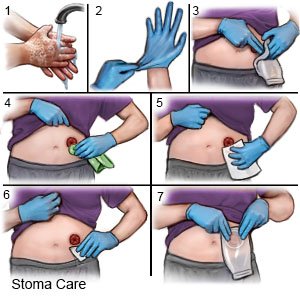
The amount of time that your pouch stays tightly on your abdomen depends on many things. These include the size and shape of your stoma, the shape of your abdomen, and the type of pouch you use. Your caregiver will tell you how often to change your ileostomy pouch. However, if you think your pouch may be leaking, change it right away. Your caregiver will give you specific instructions on how to change your ileostomy pouch. The following is general information about how to change your pouch:

  • Empty the contents of the pouch into the toilet. Gently remove the pouch by pushing the skin down and away from the adhesive skin barrier with one hand. With the other hand, pull the pouch up and away from the stoma.

  • Clean the skin around the stoma with warm water. You may also use soap but do not use soaps that have oil or perfumes. Pat your skin dry.

  • Use a pouch that has an opening that is one-eighth of an inch larger than the stoma on each side.

  • Use skin protection products if you have irritated skin around the stoma. The skin can be treated with these products to protect your skin and create a dry surface.

  • Center the pouch over the stoma and press it firmly into place on clean, dry skin. It may be helpful to hold your hand over the newly applied pouch for 30 seconds. The warmth of your hand can help to mold the adhesive skin barrier into place.

  • Place the old pouch in another plastic bag to be thrown away if the pouch is disposable. If you use a reusable pouch, talk to your caregiver about how to clean the reusable pouch.

How do I empty my pouch?

  • You will have to empty your pouch about every four to six hours. Empty the pouch when it is one-third full. Do not wait until the pouch is completely full because this could put pressure on the seal and cause a leak. The pouch may also detach, causing all of the pouch contents to spill.

  • Place toilet paper into the toilet to reduce splash back and noise.

  • Take the end of the pouch and hold it up. Remove the clamp.

  • Make a cuff at the end of the pouch to keep it from getting soiled.

  • Drain the pouch by squeezing the pouch contents into the toilet.

  • Clean the cuffed end of the pouch with toilet paper or a moist paper towel. Make sure and keep the end of the pouch clean.

  • Undo the cuff at the end of the pouch. Replace the clamp or close the end of the pouch according to your caregiver's instructions.
    Picture of emptying, cleaning and rinsing an ostomy bag

What are some problems that may happen with an ileostomy stoma?

  • Skin problems: Your skin may become irritated if you do not have a tight seal around your stoma and your stool touches your skin. Your skin may become very red, sore and weeping (always wet). Keep a watertight seal around your stoma to prevent skin problems. Keeping the skin around your stoma clean and dry will also help prevent skin problems.

  • Food blockage: Sometimes food blocks the stoma. These blockages are often caused by certain foods such as corn, nuts, seeds, and fruit and vegetable peelings. Food blockages may be complete or partial. A complete blockage is one in which there is no output for more than six hours. A partial blockage is one in which some liquids pass through the stoma. Symptoms of a food blockage include cramping pain, bloating, nausea, and vomiting.

  • Dehydration: You may become dehydrated (lose too much water from your body) during certain times because you lose extra liquids through your stoma. The risk of dehydration is highest during periods when the output of your stool is high such as with diarrhea or vomiting. You may also become dehydrated when you do not drink enough liquids during the day. Some signs of dehydration are dry mouth, low urine output than normal, dizziness, and increased thirst. You will need to drink extra liquids if you have dehydration. Ask your caregiver about liquids that contain electrolytes (sodium and potassium).

  • Diarrhea: Persons with ileostomies may get diarrhea that is caused by the flu, certain medicines or a partial food blockage. The symptoms of diarrhea usually include a large amount of watery stool with cramps. When you have diarrhea, your intestines may not absorb enough fluids and electrolytes. You will need to drink extra liquids during periods of diarrhea. Ask your caregiver about liquids that contain electrolytes.

  • Stoma retraction: Retraction happens when the height of the stoma goes down to the skin level or below the skin level. Retraction may happen soon after surgery because the small bowel does not become active soon enough. Retraction may also happen because of weight gain. The pouching system must be changed to match the change in stoma shape.

  • Peristomal hernia: Peristomal hernias occur when part of the bowel (colon) bulges into the area around the stoma. Hernias are most obvious during times when there is pressure on the abdomen. For example, the hernia may be more obvious when sitting, coughing, or straining. Hernias may make it difficult to create a proper pouch seal or to irrigate. The hernia may be managed with a hernia belt. Changes may also need to be made to the pouching system to create a proper seal. Surgery may also be done in some people.

  • Prolapse: A prolapse means the bowel becomes longer and protrudes out of the stoma and above the abdomen surface. The stomal prolapse may be caused by increased abdominal pressure. Surgery may be done to fix the prolapse in some people.

  • Stenosis: A stenosis is a narrowing or tightening of the stoma at or below the skin level. The stenosis may be mild or severe. A mild stenosis can cause noise as stool and gas is passed. Severe stenosis can cause obstruction (blockage) of stool. If the stoma is mild, a caregiver may enlarge it by stretching it with his finger. If the stenosis is severe, surgery is usually needed.

What types of foods can I eat after an ileostomy?

  • You will have to avoid foods that are hard to digest during the first six to eight weeks after your surgery. These foods include tough meats, nuts, seeds, and raw fruits and vegetables. After the first six to eight weeks, you can start eating a regular diet. However, you may still have to limit some foods that are hard to digest such as corn, nuts, seeds, and celery.

  • There may be some foods that you cannot tolerate very well after surgery. If a food gives you cramps or diarrhea, do not include that food in your diet. Try the food again in a few weeks. Eat small portions first and then gradually increase your portion sizes.

  • You may also want to avoid foods that cause gas and odor. Some foods that may cause gas and odor are vegetables such as broccoli, cabbage, and cauliflower. Other foods include beans, eggs, and fish. You can also reduce gas by eating slowly and not using straws to drink liquids. Foods that may help to control odor and gas in some people are fresh parsley, yogurt and buttermilk.

  • Drink at least 8 to 10 (eight ounce) cups of water each day. Healthy liquids for most people to drink are water, juices, and milk. Limit the amount of caffeine you drink, such as coffee, tea, and soda.

How can an ileostomy fit into my lifestyle?

  • Work: You can go back to work when your caregiver says it is OK. You may need special support to prevent a hernia if you work is heavy labor, such as lifting or digging. You may need an ostomy belt over the pouch to keep it in place if you move a lot at your job.

  • Exercise: Exercise is very important. Talk to your caregiver about an exercise program once you feel stronger. Together you can plan a program that works for you. It is best to start slowly and do more as you get stronger. Exercising makes the heart stronger, lowers blood pressure, and helps keep you healthy. Your body and mind should feel better after exercising. Walking, jogging, bicycling, and swimming are good exercises. Talk with your caregiver before playing contact sports. You may need to wear special protection for your stoma. Empty your pouch before playing sports.

  • Swimming: For swimming, you should always wear your pouch. Empty your pouch before getting into the water if you swim. You may want to put waterproof tape strips over the edges of your skin barrier.

  • Relationships:

    • You may feel anxious, nervous, or scared when you first start to care for your ileostomy. You may not like the way your body looks. You may feel like you are no longer in control of your body. These are normal feelings. Talk to someone close to you or to your caregiver about these feelings.

    • Learning to live with an ileostomy may be difficult for both you and your spouse. Together you can find ways to live with this change in your life. It will take time for you to feel better after surgery. If you had an active sex life before ileostomy surgery, it can be the same after surgery. You cannot hurt your stoma by having close body contact. Be sure to empty the pouch before having sex.

  • Traveling: Always carry extra ileostomy supplies and pouches with you when traveling. Take enough supplies for your trip. You may not be able to find what you need while traveling. Contact your local ostomy group or ostomy nurse for help. They may be able to give you a list of ostomy caregivers in the area you are visiting.

    • If you fly, pack your supplies in your carry-on luggage not your checked suitcase because luggage is sometimes lost or delayed.

    • If you drive, do not put your supplies in the trunk or glove compartment. This can cause your supplies to get hot, melt and not stick well. Keep your ostomy supplies in the coolest place in the car.

Where can I find support?

You may feel embarrassed, anxious, or worried because you have an ileostomy. These feelings are common. It will take time for you to get used to your new body image and body function. Talk about your feelings with your caregiver or with someone close to you. Ask your caregiver about support groups for people with an ileostomy or to arrange for an ostomy visitor. Such a group or person can give you support and information. Contact the following for more information and support.

  • United Ostomy Associations of America, Inc.
    P.O. Box 512
    Northfield , MN 55057-0512
    Phone: 1- 800 - 826-0826
    Web Address: http://www.ostomy.org
  • Wound Ostomy and Continence Nurses Society
    15000 Commerce Parkway
    Mount Laurel , NJ 08054
    Web Address: www.wocn.org

Care Agreement

You have the right to help plan your care. Learn about your health condition and how it may be treated. Discuss treatment options with your caregivers to decide what care you want to receive. You always have the right to refuse treatment.

© 2013 Truven Health Analytics Inc. Information is for End User's use only and may not be sold, redistributed or otherwise used for commercial purposes. All illustrations and images included in CareNotes® are the copyrighted property of the Blausen Databases or Truven Health Analytics.

The above information is an educational aid only. It is not intended as medical advice for individual conditions or treatments. Talk to your doctor, nurse or pharmacist before following any medical regimen to see if it is safe and effective for you.

Advertisement
Close

Recommended

(web5)