Home CareNotes How To Use A Metered-dose Inhaler
Thomson Reuters Micromedex

How To Use A Metered-dose Inhaler

What is it?

How To Use A Metered-dose Inhaler Care Guide

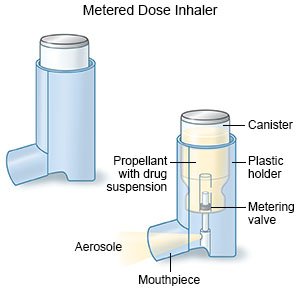
A metered-dose inhaler is also called an MDI. An MDI is a hand-held container of medicine that sprays a mist of medicine into your throat and lungs. The medicine may help you breathe more easily. An MDI gives one dose of medicine with each puff. You must use your inhaler correctly so the medicine will go into your throat and lungs to do the most good. If you use it wrong, the medicine will end up on your tongue or in the back of your mouth. Follow your caregiver's advice about how often to use your MDI. An MDI is often used to help treat bronchitis, asthma, and other breathing problems.

What are three ways to use an MDI?

Following are three methods (ways) to use an MDI. Ask your caregiver which method is best for you. Methods 1 and 2 can be used for all inhaler medicines. Method 3 should not be used for inhaled steroid medicine but can be used for other types of asthma medicine.

Pictures of using an MDI inhaler 3 methods
  • Method 1: Hold the inhaler one to two inches in front of your mouth (about two to three finger widths).

  • Method 2: You may be given a spacer to use with your inhaler. This is a piece of plastic-like tubing that is put on the mouthpiece of the inhaler. The medicine goes into the spacer first. It slows the mist going into your mouth and throat and may make it easier to inhale your dose. Close your lips around the spacer mouthpiece. Do not block the opening with your teeth or tongue. Spacers come in different shapes. Some spacers have different-sized masks for children. If your child uses a spacer, make sure you have one at home and one at school or daycare.

  • Method 3: You may be told to put the mouthpiece of the inhaler in your mouth on top of your tongue. Do not block the opening of the mouthpiece with your teeth or tongue.

Checklist for using an MDI:

There are many different types of MDIs. Always follow your MDI or caregiver's instructions when using the MDI. When using your MDI, do the following:

  • __ 1. Hold the MDI upright with the mouthpiece at the bottom.

  • __ 2. Shake the inhaler very well to mix the medicine

  • __ 3. Remove the cap from the mouthpiece. Make sure the mouthpiece is clean and not clogged. If you use a spacer, attach it (put it on) to the MDI mouthpiece.

  • __ 4. Exhale (breathe out) slowly all the way.

  • __ 5. Firmly press down on the inhaler and start to breathe in slowly (three to five seconds). This gives you one dose of medicine. Press your inhaler only one time while you are breathing in. If you use a spacer or holding chamber, first press down on the inhaler. Within five seconds, begin to breathe in slowly.

  • __ 6. Take the mouthpiece away from your mouth. Hold your breath for 10 seconds or more. This helps the medicine soak into your airways and reach deep into your lungs.

  • __ 7. Breathe out slowly. Then begin to breathe normally.

  • __ 8. Follow your caregiver's advice for the number of doses to take. If you need to take two doses, wait one minute before the next dose. Do not forget to shake the container again.

How is a breath-activated MDI different than other MDIs?

"Breath-activated" means you do not need to press down (spray) the MDI to get your medicine. Instead, you simply put your mouth on the mouthpiece and slowly breathe in (inhale). When you breathe in from the mouthpiece, medicine is released from (comes out of) the MDI. Ask your caregiver if you have a regular MDI or a breath-activated MDI.

Checklist for using a breath-activated MDI:

Follow your MDI or caregiver's instructions when using a breath-activated MDI. When using a breath-activated MDI, do the following:

  • __ 1. Remove the cap from the mouthpiece. Check to make sure the mouthpiece is clean and not clogged.

  • __ 2. Hold the MDI upright with the mouthpiece at the bottom. Shake the MDI gently to mix the medicine inside.

  • __ 3. Exhale slowly all the way.

  • __ 4. Put your mouth on the mouthpiece. Close your lips firmly around the MDI so that no air or medicine can come out the sides.

  • __ 5. Using your mouth, breathe in slow and steady (evenly). As you breathe in, you should hear a clicking sound. After the click, you will feel a mist of medicine come out of the MDI. Continue to breathe in, even after you hear the click and feel the medicine. Inhale until your lungs feel completely full of air.

  • __ 6. Take your mouth off the MDI and hold your breath for 10 seconds.

  • __ 7. Breathe out slowly. Then begin breathing as you normally do.

  • __ 8. Follow your caregiver's advice for the number of doses (puffs) to take. Wait one minute between each dose.

Should I clean my mouth after using my MDI?

Yes. Rinse your mouth and gargle with water. Do not swallow the water. Rinsing your mouth helps decrease the amount of medicine left in your mouth and throat. Gargling decreases the burning you may feel in your throat and decreases the need to cough. Rinsing and gargling may also keep you from getting a mouth infection (in-FEK-shun).

How do I clean my MDI?

Look at the hole where the medicine comes out from your inhaler. Clean the inhaler if you see medicine in or around the hole. Remove the metal canister from the plastic mouthpiece. Rinse only the mouthpiece and cap in warm water. Dry them overnight at room temperature. Put the mouthpiece back on the canister in the morning. Place the cap onto the mouthpiece.

How do I know when my inhaler is empty?

Inhaler canisters have the number of puffs listed on the canister. Following is an example of how you can know when your inhaler may be empty. If your canister has 200 puffs and you are told to take eight puffs every day, divide 8 into 200. The answer is 25 (days). If you began using the inhaler May 1, replace it on or before May 25. Write the date that you started using the MDI on the canister. If possible, always have a new MDI canister ready seven to ten days before you need it. Do not put your canister in water to see if it is empty. This does not work.

Care Agreement

You have the right to help plan your care. To help with this plan, you must learn about your breathing problems and using an MDI. You can then discuss treatment options with your caregivers. Work with them to decide what care will be used to treat you. You always have the right to refuse treatment.

Copyright © 2011. Thomson Reuters. All rights reserved. Information is for End User's use only and may not be sold, redistributed or otherwise used for commercial purposes.

The above information is an educational aid only. It is not intended as medical advice for individual conditions or treatments. Talk to your doctor, nurse or pharmacist before following any medical regimen to see if it is safe and effective for you.

Learn more about How To Use A Metered-dose Inhaler

(web6)