Consumer Information
Carenotes > How To Increase Your Milk Supply (Discharge Care)

How To Increase Your Milk Supply

Advertisement

WHAT YOU SHOULD KNOW:

  • Breastfeeding offers many good effects for both you and your baby. It helps strengthen the bond between you and your baby. Breastfeeding helps stop bleeding from your uterus (womb) right after giving birth. Breastfeeding also helps you lose the extra weight and fat you put on during pregnancy. Breastfeeding without giving any formula to your baby can delay the return of your menstrual cycles. It can help control or decrease the amount of sugar in your blood and reduce your risk for diabetes (too high blood sugar). It helps protect you against breast, ovarian and uterine cancers. Breastfeeding can also make your bones stronger and help prevent osteoporosis later in life.

  • Breast milk requires no preparation and is always clean, fresh, and at the right temperature. Human breast milk has the best combination of nutrients for your baby. Nutrients include all the protein, fat, sugar, vitamins, and minerals that your baby's body and brain need to grow. Breastfeeding helps protect your baby from infections. It may also decrease your baby's risk of getting allergies and certain diseases. These diseases include sudden infant death syndrome (SIDS), asthma, diabetes (high blood sugar), lymphoma (lymph node cancer), and leukemia (blood cancer). Signs that your baby is getting enough breast milk include changes in your breasts before and after feeding. There are also signs your baby makes that you can look for to make sure he is getting enough breast milk.

AFTER YOU LEAVE:

Checking if your baby is getting enough breast milk:

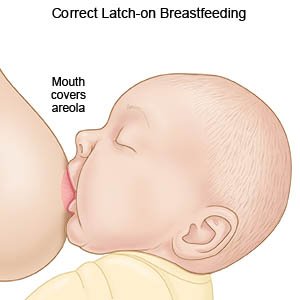
  • Breastfeeding is not painful for you: When your baby is well latched-on during breastfeeding, you should have little or no discomfort in your nipple or breast. Nipple soreness can happen if your baby does not take your nipple far enough into his mouth. This is a sign that your baby has not latched-on well during feeding. To latch-on means that your baby has taken all of your nipple and part of your areola (dark circle around your nipple) far into his mouth. If you have sore nipples, ask your caregiver for more information about breastfeeding and nipple soreness.

    • Your baby latches-on well during feeding: Latch-on is important for your baby to get enough breast milk. How you position your baby and breast for feeding can affect how well he is able to latch-on. Ask your caregiver for more information about how to hold and breastfeed your baby.
      Correct Infant Latch-on Position


  • You hear your baby suck and swallow: Your baby should be able to suckle milk right away after he latches-on. Suckling should change from quick short sucks to slow deep sucks. You should be able to hear him swallowing and see his jaw move downward with each suck. He should look relaxed until he finishes.

  • Your breasts feel different before and after breastfeeding: Your breasts should feel full before breastfeeding your baby and softer after. You may feel mild nipple pain that lasts for about a week. Two weeks after giving birth, you should start feeling the let-down reflex. The let-down reflex starts milk flowing through your milk ducts. You may have tingling or a "pins and needles" feeling in your breasts when this happens. Milk may also drip or spray from your other breast while breastfeeding. If your milk has recently come in, your breasts may be engorged (too full with milk). Ask your caregiver for more information about breast fullness versus breast engorgement.

Signs your baby shows that he is getting enough breast milk:

  • Your baby breastfeeds often and is drinking enough milk at each feeding: Breastfed babies usually want to feed every 2 to 4 hours. Your baby will usually breastfeed between 8 and 12 times each day. He should act content after every feeding.

    • Your jaundiced baby: Your baby may get newborn jaundice or breast milk jaundice. Newborn jaundice usually starts when he is 3 or 4 days old. Breast milk jaundice usually starts at around seven days of age. Jaundice is a condition where his skin becomes yellow or yellow-orange in color. If your baby has jaundice, getting enough milk is very important. Being well fed will help him get rid of the jaundice. He should be breastfeeding 11 or more times in a day. Getting rid of jaundice can make your baby's stools a greenish color instead of yellow. Ask your caregiver for more information about jaundice in newborns.


  • Your baby urinates and has stools often: Your baby's urine should look clear. His stools should be yellow and yogurt-like with seedy curds. His pattern of passing urine and stool will change over time:

    • First two days of age: Your baby may urinate only two times a day.

    • From 3 to 5 days old: Your baby should be passing stools 3 to 4 stools a day. He should also urinate 3 to 5 times a day.

    • From 5 to 7 days old: Your baby should have 3 to 6 stools a day. He should urinate 4 to 6 times a day.

    • One month: Your baby may have fewer stools each day. Babies that only drink breast milk may go several days without having a bowel movement.

  • Your baby's weight increases as he grows older: Your baby's caregiver will check his weight at each visit to see if he is gaining weight as he should. If he has concerns about your baby's weight, he may arrange for your baby to be weighed at home. It is normal for breastfed babies to be leaner (look thinner) and have less fat on their bodies compared to formula-fed babies. Breastfed babies generally follow this pattern of weight gain:

    • The first few days of your baby's life: Your baby may lose up to 10 percent of his birth weight. This is normal and happens to all babies after being born. This means that if your baby weighed seven pounds at birth, he may lose up to 11 ounces to then weigh six pounds and five ounces.

      • Your milk comes in 2 to 4 days after delivery: Your milk will come in during the first several of days after your baby is born. This means that your body is changing from making colostrum (KO-lah-strum) to making regular milk to feed your baby. Colostrum is the yellow, creamy fluid your breasts make before they start making milk. When your milk comes in, your baby should start to gain weight.


    • From 10 to 14 days old: Your baby should weigh more than what he weighed when he was born.

    • Two months old: Your baby should gain about one ounce each day.

    • From 4 to 6 months old: Your baby's weight should be two times as much as he weighed when he was born. For example, if he weighed seven pounds at birth, he should now weigh 14 pounds.

    • One year old: Your baby's weight should be three times as much as he weighed when he was born. For example, if he weighed seven pounds at birth, he should now weight 21 pounds.

Increasing your milk supply: The basis for increasing your breast milk supply is working with your body's "supply and demand" system. This means that when more milk is removed from your breasts, your breasts will respond by making more milk. Milk can be removed by breastfeeding your baby. You can also hand express (getting milk from your breast using your hands) or pump out your milk. The following will help increase your supply of breast milk:

  • Breastfeed your baby whenever he shows signs that he wants to be fed. Signs include looking more awake, being more active, mouthing, or rooting. Mouthing is when your baby puts his hands in his mouth or acts like he is sucking. Rooting is when your baby opens his mouth and turns his head to where his cheek is touched. Fussing and crying are later signs of hunger.

  • Breastfeed your baby frequently and regularly, even at night. Breastfeed your baby 8 to 12 times a day, or every 2 to 3 hours. You may have a longer gap of 4 to 5 hours when breastfeeding at night. This long gap should not happen more than once each night. It may take your baby 10 to 15 minutes to finish breastfeeding on each breast. Over time, your baby will learn how to breastfeed faster.

  • Completely empty both breasts at each feeding. Offer your baby your other breast after he finishes the milk in one breast. Your baby may stop feeding and act like he has had enough milk after feeding from only one breast. When this happens, burp your baby or change his diaper to keep him awake and active. You may also hand express or pump to completely empty your breasts after feeding your baby. If your baby was premature (born too early), you will need to do this until he can breastfeed well.

  • If separated from your baby, express or pump on a regular schedule. When you are away from your baby you will need to hand express or pump your breast milk. Doing this will help you keep your milk supply from going down. You should express or pump milk from your breasts about every four hours to maintain your supply. Regular expressing or pumping can also help increase your breast milk supply. You may need to express or pump more often than every four hours when trying to increase your supply. Ask your caregiver for more information about expression, collection and storage of breast milk.

  • Get enough rest and sleep when you are breastfeeding. Rest and sleep will help your body produce more breast milk. You need to get 8 to 10 hours of restful sleep, even if it has breaks in between during the day and night. Try to sleep or rest when your baby is sleeping. Being tired or feeling stressed will decrease the amount of breast milk you make.

  • Record feeding and pumping information. Your baby's caregiver may ask you to write down information about when your baby breastfeeds. You may be asked to write down are how long your baby suckled on each breast. You may also be asked to write down when and how much if you hand express or pump. You may want to do this even without being asked to do it. This will help you see how often and how well your baby is breastfeeding. It will also let you see how much milk you are getting with hand expressing or pumping.

Factors that can decrease breast milk supply:

  • Decreased breast emptying times. This means shorter breastfeeding or expression sessions, or longer periods between breastfeeding or expression sessions. It can be caused by breastfeeding or expressing hurriedly, or returning to work soon after giving birth.

  • Getting pregnant soon after having a baby. Breastfeeding is not completely effective as a means of preventing pregnancy. You will need to use other methods of birth control, such as condoms. Ask your caregiver for more information on ways to avoid becoming pregnant again just after having a baby.

  • Not being able to put your baby to breast. You may get less milk from your breasts when you express it. You will have to work to learn how to get the most milk out when doing hand expression or pumping. If your baby is premature (born too soon) or ill, you may not be able to breastfeed him directly at first. You will have to pump your breasts on a regular schedule to keep up your milk supply. Ask your caregiver for more information about expression, collection and storage of breast milk.

  • Pressure on your breasts. Sleeping in a face down position may squeeze your breasts and block milk ducts. Wearing bra that is too tight or a sling that press on your breasts can decrease milk supply.

  • Stress and fatigue. This includes physical, mental, and emotional stress. Stress and fatigue can decrease your milk let-down and the amount of milk you make. Decreased milk let-down for a long period can stop your breasts from making milk.

  • Use of certain substances and chemicals. Ask your caregiver for more information about effects of smoking, alcohol, and medicines on breastfeeding.

    • Drinking too much alcohol. Alcohol is found in beer, wine, liquor, such as vodka and whiskey, and other adult drinks. Drinking alcohol can reduce let-down and decrease the amount of breast milk you make.

    • Smoking. Nicotine from cigarette smoking can decrease the hormones that help your breasts make milk. It can also decrease or slow down milk flow from your breasts.

    • Taking certain medicines. These include oral contraceptive pills that contain estrogen and over-the-counter (OTC) medicines, such as antihistamines. Antihistamines are medicines used for allergies. Ask your caregiver for information on other medicines which can decrease your milk supply.

Expressing, collecting, and storing breast milk:

  • Expression: Expression of breast milk is getting milk from your breast without your baby suckling on it. Your breast milk can be expressed using your hands. This is called "hand expression" or "manual expression." You can also use a breast pump to express milk from your breasts. You may need to express your breast milk if you will be away from your baby for periods of time. This may also be done to treat engorged (too full) breasts or plugged milk ducts. Expression may be needed if you will be taking medicines that pass through breast milk that may be harmful to your baby. Expressing will help your body continue to make milk until it is safe to breastfeed your baby again.
    Picture of how to express breast milk


  • Collection: You can use plastic or glass bottles for collection and storage of your breast milk. Wash reusable milk containers in the dishwasher, or with warm, soapy water, rinsing them with hot water. You may want to use screw-top glass or plastic bottles that can be attached to a store-bought nipple. Disposable plastic bags made for storing breast milk can also be used. Babies less than six months old often drink between 3 and 5 ounces at a feeding. You may want to pump and store small amounts of milk, such as four ounces, in one container. If you do this, you can thaw or prepare the right amount for your baby to drink at a feeding.

  • Storage: After collecting milk, remove the container and cover it. It is important to label the container with the date and time the milk was expressed. If your baby is in the hospital or daycare, also write your baby's name on the label. Do not add fresh milk to breast milk that is already in the refrigerator or freezer. Throw away breast milk that is past the time limits of safety. Use the oldest stored milk first. Read the labels carefully. The sooner stored breast milk is used, the less chance of it having germs. The expressed milk may be safely stored in the following ways:

    • Room temperature: For 4 to 8 hours. Cover the container and keep it as cool as possible.

    • Insulated cooler with ice packs: For up to 24 hours. Try not to open the cooler except to take out or add more milk. Keep the milk next to the ice packs.

    • Refrigerator: For up to 8 days. Store the milk in the back or body of the refrigerator where the temperature is coldest. Do not place the milk in the door of the refrigerator.

    • Freezer:

      • Refrigerator freezer compartment: For up to 6 months if the freezer section has its own outer door. For up to 2 weeks if freezer door is inside of the refrigerator.

      • Deep freezer: For up to 12 months.

Making sure your milk is healthy for your baby: Keeping your breast milk safe means that you need to decrease or avoid being exposed to certain substances and chemicals:

  • Alcohol: Alcohol that you drink close to a feeding can be passed on to your baby. You should not drink alcohol two hours or less before you breastfeed.

  • Harmful chemicals: Avoid being exposed to gardening and farming chemicals. These include pesticides used to kill insects and herbicides used to kill weeds.

  • Harmful medicines: Most medicine passes through breast milk. Very few kinds of medicines cannot be taken during breastfeeding. Make sure your caregiver knows about every medicine that you take, including over-the-counter (OTC) and herbal medicines.

  • Heavy metals: Decrease your exposure to heavy metal chemicals, such as mercury and lead. Mercury is found in large bottom-dwelling fish. Lead may be present in old house paint and in paint on items made in Asian countries. Contact your local health department for more information about lead and these items.

  • Infectious diseases: Tell your caregiver if you are HIV positive or have a disease that can be passed to others such as AIDS. You may need to stop breastfeeding.

  • Nicotine: Nicotine from cigarettes and other tobacco products passes into breast milk. It is best not to smoke at all if you are going to breastfeed your baby. If you are going to smoke cigarettes, breastfeed your baby first before smoking. Do not smoke another cigarette until after the next feeding. Never smoke near your baby. Talk to your baby's caregiver about the safety of using nicotine gum or patches while breastfeeding.

  • Street drugs: Do not use illegal or street drugs, such as marijuana or cocaine, if you are breastfeeding.

Diet:

  • Avoid eating foods that have caused allergies in other family members. These foods may include peanuts, eggs, fish, and wheat. Ask your baby's caregiver for more information about food allergy.

  • Drink enough liquids. Drink 1.8 Liters of liquid each day (close to 8 eight-ounce cups). Good liquids to drink are milk, water, and juices.

  • Decrease the amount of caffeine you drink. Caffeine is found in drinks such as coffee, tea, and soda.

  • Decrease the amount of alcohol you drink. Do not drink more than one glass of wine, or 2 bottles or cans of beer in a day. Drinking alcohol close to a feed can change the taste of milk and be passed on to your baby. Ask your caregiver for more information about alcohol use while you are breastfeeding.

  • Eat a variety of healthy foods from all the food groups every day. Choose foods that will give your body the extra nutrition it needs as you breastfeed. Dairy products, such as milk, yogurt, and cheese, and brown and white bread, provide calcium. Red meat and fortified breakfast cereals provide iron. Eat a variety of fruits and vegetables, including dark green and orange vegetables, and legumes (dry beans). Eat the right amount of calories as advised by your caregiver. Ask your caregiver for information about breastfeeding and your diet. Ask your caregiver if you need to take vitamins, minerals, or other food supplements. Ask him also if you need to be on a special diet.

  • Limit the amount of fish you eat to limit mercury in your diet. Mercury is found in large bottom-dwelling fish, such as shark, swordfish, mackerel, and tilefish. You can eat up to 12 oz of other kinds of fish every week. That includes a maximum of 6 oz of albacore (white) tuna per week. Always check for advisories about eating locally-caught fish.

For support and more information: Ask for information about breastfeeding and make sure caregivers know that breastfeeding is important to you. Join a breastfeeding support group. Ask your caregiver for the name of a Lactation Consultant. This person is specially trained to help women breastfeed their babies. Contact the following for more information:

  • La Leche League International
    1400 N. Meacham Rd
    Schaumburg, IL 60173-4808
    Phone: 1-847-519-7730
    Web Address: http://www.lalecheleague.org
  • The National Women's Health Information Center
    Phone: 1-800-994-9662
    Web Address: http://www.4woman.gov
  • Women, Infants and Children Program
    Food and Nutrition Services
    WIC Program
    Supplemental Food Programs Division
    Alexandria, VA 22302
    Phone: 1-703-305-2196
    Web Address: http://www.fns.usda.gov/wic

CONTACT A CAREGIVER IF:

  • You or your baby has a fever.

  • Your baby is very sleepy or very irritable, or acts hungry after most feedings.

  • Your baby refuses to breastfeed for more than 8 hours.

  • You feel you are not making enough breast milk for your baby.

  • You have nipple pain that becomes worse after breastfeeding, or feel a lump or a hard area in your breast.

  • Your breasts become hard, painful, or swollen, or you cannot get your milk to flow.

  • Your breasts do not feel full before feedings and softer after breastfeeding.

SEEK CARE IMMEDIATELY IF:

  • Your baby will not breastfeed or feeds poorly, and he acts sleepy and has floppy muscle tone.

  • Your baby has not had a wet diaper in the past 6 to 8 hours.

  • Your baby's hands and feet are cold to the touch, he is breathing fast, and does not interact with you.

  • Your baby's soft spot on the top of his head is sunken in or his eyes appear sunken.

  • Your baby cries but has no tears, is irritable, and has a dry mouth and lips.

Copyright © 2008 Thomson Healthcare Inc. All rights reserved. Information is for End User's use only and may not be sold, redistributed or otherwise used for commercial purposes.

The above information is an educational aid only. It is not intended as medical advice for individual conditions or treatments. Talk to your doctor, nurse or pharmacist before following any medical regimen to see if it is safe and effective for you.


MedNotes
Advertisement

(web1)