Thomson Reuters Micromedex

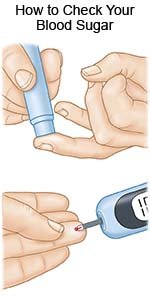
How To Check Your Blood Sugar

WHAT YOU SHOULD KNOW:

How To Check Your Blood Sugar (Aftercare Instructions) Care Guide

You may need to check the amount of sugar (glucose) in your blood if you have diabetes mellitus. Diabetes mellitus is a disease that affects the way your body makes insulin and how it uses sugar. Insulin is a hormone that helps the body use sugar by allowing the sugar to enter body cells. Sugar must enter body cells to give your body the energy it needs. With diabetes mellitus, your body does not make enough insulin, or your body does not use insulin the way it should. When insulin does not work the way it should, sugar builds up in your blood. High blood sugar levels increase your chances of having a heart attack, stroke, eye problems, and kidney problems. You can decrease your risk of having these health problems by controlling your blood sugar levels. Low blood sugar levels can also lead to serious health problems and must be treated right away. The only way to know your blood sugar level is to test it.

INSTRUCTIONS:

Take your medicine as directed:

Call your primary healthcare provider if you think your medicine is not helping or if you have side effects. Tell him if you are allergic to any medicine. Keep a list of the medicines, vitamins, and herbs you take. Include the amounts, and when and why you take them. Bring the list or the pill bottles to follow-up visits.

Follow up with your primary healthcare provider as directed:

Keep all appointments. Write down questions you have about your diabetes and how it is treated. This way you will remember to ask them during your next visit. Bring the record of your blood sugar levels with you every time you see your primary healthcare provider.

Steps for checking your blood sugar level:

There many different types of meters and test strips. Read the instructions that came with your meter so that you understand how to use it. The following are general steps for testing your blood sugar:

  • Wash your hands with soap and water.

  • Put a new lancet in the lancet device.

  • Turn the glucose meter on and make sure the code on the test strips container matches the one displayed on the meter.
    Blood Glucose Meter and Test Strips


  • Place a test strip into the blood glucose monitor.

  • If you are taking blood from your finger, choose a spot on the side of your fingertip to poke.  Poke the side of your finger with the lancet device. This is usually done by pressing a button on the lancet device. Wait for a drop of blood to form. If a drop does not form, you can gently squeeze your finger until a drop forms.

  • Place the drop of blood on the test area of the test strip. If your strip draws in your blood, place the drop of blood against the side of the test area. Wait until the right amount of blood has been drawn into the test strip.

  • Wait for the blood glucose monitor to show your results. The amount of time it takes to get a result depends on the type of meter you have. It usually takes between 5 and 50 seconds to get a result.

  • Use gauze or a tissue to wipe your fingertip clean. Hold it on the area until the bleeding has stopped.

  • Throw away the lancet in a hard container with a lid. Keep the container out of the reach of children and pets.

When and how often to check your blood sugar level:

Ask your primary healthcare provider when and how often you should check your blood sugar levels. You may need to check your blood sugar levels before meals, after meals, or at bedtime. Check your blood sugar at least 3 times each day if you use an insulin pump or need several injections of insulin each day. Blood sugar levels need to be checked more often when you are sick, or if you change your daily routine. Test your blood sugar level if you feel like your blood sugar may be too high (hyperglycemia) or too low (hypoglycemia).

Signs and symptoms of hyperglycemia:

Check your blood sugar if you have any of the following signs and symptoms:

  • More thirst than usual

  • More urine than usual

  • More hunger than usual

  • Blurred vision

Signs and symptoms of hypoglycemia:

If your blood glucose level is low, you need to eat some sugar right away. Ask your primary healthcare provider for more information about how to treat hypoglycemia. Check your blood sugar if you have any of the following signs and symptoms:

  • Fast heartbeat

  • Feeling dizzy, faint (lightheaded), shaky or confused

  • Headache

  • Seizures

  • Sweating

Keep a record of your blood sugar levels:

Write down your blood sugar level each time you test it. Write down the date, the (time) of the test (including if it was before or after a meal), and the result. Write down the time you took your insulin or diabetes pills. Record the kind and amount of insulin you used, or the kind of insulin pill, and how many you took. Write comments about anything that may have made your blood sugar level go up or down. Blood sugar can be affected by exercise, eating more or less than usual, or stress. Bring this record with you every time you see your primary healthcare provider. These records will help you and your primary healthcare provider find out how well your diabetes plan is working.

Take care of your glucose meter and test strips:

  • Storage: Keep the test strips away from heat, cold, or moisture (water). Do not take a test strip out of the container until you are ready to use it. Put the lid tightly on the container afterwards. Do not use test strips that are damaged, wet, or bent.

  • Expiration date: Check the date on the test strip container to be sure the test strips have not expired. Your blood sugar level readings may be wrong if you use expired test strips. Use the type of glucose test strips that work with your glucose meter.

  • Coding your meter: Your meter may need a special code that matches each new bottle of test strips you use. If your meter is not coded correctly, your blood sugar readings may be wrong. The way the code should be entered depends on the meter you have. You may need to enter the code yourself. Some meters have a code test strip or chip that needs to be inserted into the meter. When the code test strip or chip is put in, the code is entered. Follow the instructions for entering the code that came with your meter or strips.

  • Accuracy: Your meter may not work right if it is left in the heat, cold, or if it gets wet. Your blood sugar readings may be wrong if you use an old meter or drop it. If any of these things happen, check the accuracy of the meter. You can check the accuracy of your meter by testing a drop of control solution. Control solution often comes with a meter or can be bought at a drug or medical supply stores. The blood sugar reading of the control solution should match the one that is listed on the bottle. Ask your primary healthcare provider for more information about control solutions.

Risks:

You and your primary healthcare provider will not know if your blood sugar levels are under control if you do not check them regularly. You may have hypoglycemia or hyperglycemia and not have any symptoms. Regularly checking your blood sugar levels helps you watch for and prevent hypoglycemia and hyperglycemia. Over time, hyperglycemia can hurt your heart, kidneys, eyes, blood vessels, and nerves. Hypoglycemia can also lead to serious health problems and must be treated right away. Ask your primary healthcare provider for more information about hypoglycemia and how to treat it.

Medical alert bracelet or necklace:

Make sure you wear medical alert jewelry or carry a card that says you have diabetes.

Contact your primary healthcare provider if:

  • Your blood sugar level is higher or lower then what your primary healthcare provider says it should be.

  • You have a fever.

  • You are vomiting.

  • You have any questions about your diabetes, medicine, exercise, or diet.

  • You often have high blood sugar levels or low blood sugar levels.

Return to the emergency department if:

  • You cannot think clearly, are very weak, sweating, or pale.

  • You have a seizure.

  • You cannot be awakened.

  • You are breathing faster or slower than normal, are very sleepy, or your breath smells fruity.

  • You have chest pain.

  • You do not feel well, even when following your diabetes plan.

Copyright © 2012. Thomson Reuters. All rights reserved. Information is for End User's use only and may not be sold, redistributed or otherwise used for commercial purposes.

The above information is an educational aid only. It is not intended as medical advice for individual conditions or treatments. Talk to your doctor, nurse or pharmacist before following any medical regimen to see if it is safe and effective for you.

Advertisement
Close

Recommended

(web6)