
Healthy Living for Children
Medically reviewed by Drugs.com. Last updated on Aug 4, 2025.
What are some guidelines for helping my child make healthy food choices?
- Offer your child regular meals and snacks and let him or her decide how much to eat. Most children know how much food their body needs at one time. Give your child small portions and then let him or her have another serving if he or she asks for one. Your child will be very hungry on some days and want to eat more. For example, he or she may want to eat more on days when he or she is more active. Your child may also eat more if he or she is going through a growth spurt. There may be days when he or she eats less than usual.
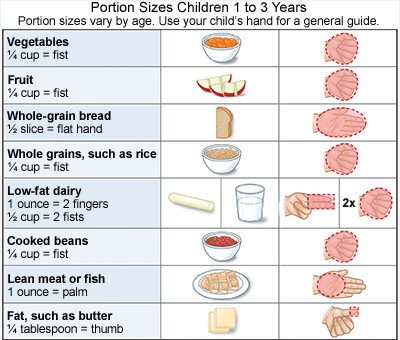
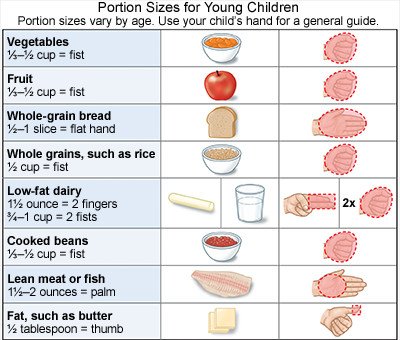
- Make meal and snack times calm and fun for your child. Turn the television off and have your child sit at the table to eat. It is a good idea to eat meals and snacks with your child. Children like to eat the same kind of food they see their parents eating. If your child sees you eat healthy food, he or she will learn to like healthy food too.

- Do not offer food as a reward. This teaches your child to eat for reasons other than being hungry. Offer other rewards, such as stickers, a special toy, or a special activity.
- Limit foods high in fat and sugar. These foods do not have the nutrients your child needs to be healthy. Food high in fat and sugar include snack foods (potato chips, candy, and other sweets), juice, fruit drinks, and soda. If your child eats these foods often, he or she may eat fewer healthy foods during meals. Your child may gain too much weight. Your child may not get enough iron and develop anemia (low levels of iron in his blood). Anemia can affect your child's growth and ability to learn. Iron is found in red meat, egg yolks, and fortified cereals and breads.
What are guidelines for feeding my child who is 1 to 6 years old?
- Give your child whole milk until he or she is 2 years old. Your child's body needs the extra fat in whole milk to help him grow. After he or she turns 2, your child can drink skim or low-fat milk (such as 1 or 2% milk).
- Do not give your child foods that can cause choking. These foods include hot dogs, raw vegetables, hard candy, and nuts. Young children who do not have all their teeth cannot chew and swallow these foods easily. These foods may cause children under 4 years old to choke.
- Be patient and let your child learn how to feed himself or herself. Children between 1 and 2 years are still developing eating skills. Food may end up on the floor or on your child instead of in his or her mouth. It will take time for your child to learn how to use a spoon. Avoid giving your child a fork until he or she is able to use it without hurting himself or herself.
- Do not force your child to eat new foods if he or she does not want to. Offer the food again after a few days, and let your child decide if he or she wants to eat it. Children need to see a new food as many as 8 or 10 times before they are willing to eat it.
- Know that picky eating is a normal behavior in children under 4 years of age. Your child may like a certain food on one day and then decide he or she does not like it the next day. Your child may eat only 1 or 2 foods for a whole week or longer. Your child may not like mixed foods, or your child may not want different foods on the plate to touch. These eating habits are all normal. Continue to offer 2 or 3 different foods at each meal, even if your child is going through this phase.
- Offer 100% fruit juice to your child beginning at 1 year old. Have your child drink fruit juice from a cup. Do not give fruit juice before bedtime. The sugar from fruit juice that stays on your child's teeth over night can cause cavities. Limit fruit juice to 4 ounces a day for toddlers 1 to 3 years of age. For children 4 to 6 years of age, limit fruit juice to 6 ounces a day.
What are guidelines for feeding my child who is 6 to 11 years old?
- Teach your child how to make healthy food choices at school. A healthy lunch may include a sandwich with lean meat, cheese, or peanut butter. It could also include a fruit, vegetable, and milk. Pack healthy foods if your child takes his own lunch. Pack baby carrots or pretzels instead of potato chips in your child's lunch box. You can also add fruit or low-fat yogurt instead of cookies. Keep his lunch cold with an ice pack so that it does not spoil.
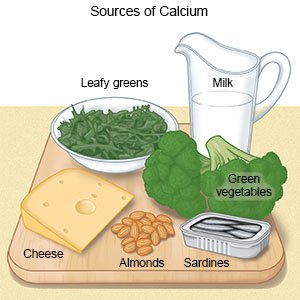
- Make sure your child gets enough calcium. Calcium is needed to build strong bones. Children who are 6 to 8 years old need 800 milligrams (mg) of calcium each day. Children who are 9 to 11 years old need 1300 mg each day. To get enough calcium, your child should eat foods high in calcium. Good sources of calcium are low-fat dairy foods (milk, cheese, and yogurt). Other foods that contain calcium include tofu, kale, spinach, broccoli, almonds, and calcium-fortified orange juice.
What are some healthy foods that I can give to my child?
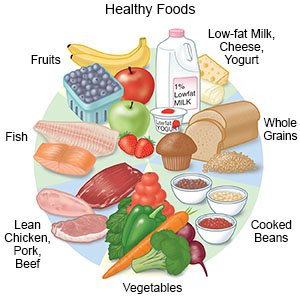
Offer your child a variety of foods from all the food groups. The number and size of servings that your child needs from each food group depends on his or her age and activity level. Ask your dietitian how much your child should eat from each food group.
- Half of your child's plate should contain fruits and vegetables. Offer more dark green, red, and orange vegetables. Dark green vegetables include broccoli, spinach, romaine lettuce, and collard greens. Examples of orange and red vegetables are carrots, sweet potatoes, winter squash, and red peppers.
- Limit fruit juice to 8 ounces a day. Offer fresh, canned, or dried fruit instead of fruit juice as often as possible. Fruit juice can replace 1 serving of fruits a day. Increased amounts of fruit juice can cause weight gain and cavities.
- Offer whole grains to your child each day. Half of the grains your child eats each day should be whole grains. Whole grains include brown rice, whole wheat pasta, and whole-grain cereals and breads.
- Offer dairy foods each day. Dairy foods are a good source of calcium. Dairy foods include milk, cheese, cottage cheese, and yogurt.
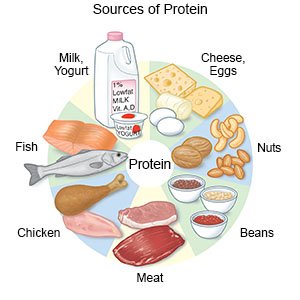
- Offer lean meats, poultry, fish, and other protein foods. Other sources of protein include legumes (such as beans), soy foods (such as tofu), and peanut butter (for children over 5). Bake, broil, and grill meat instead of frying it to reduce the amount of fat.
- Offer healthy fats in place of unhealthy fats. A healthy fat is unsaturated fat. It is found in foods such as soybean, canola, olive, and sunflower oils. It is also found in soft tub margarine that is made with liquid vegetable oil. Limit unhealthy fats such as saturated fat, trans fat, and cholesterol. These are found in shortening, butter, stick margarine, and animal fat.
 |
How much physical activity does my child need?
- Children 2 to 5 years old should get physical activity through play several times each day. Give your child opportunities to run, climb, and jump. There is no set recommendation for the amount of physical activity children under 5 years old should get each day.
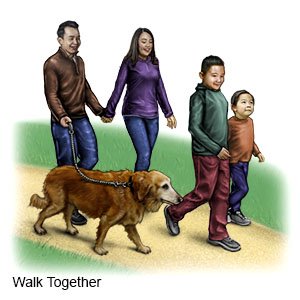
- Children 5 to 11 years old should get 1 hour or more of physical activity each day. Examples of physical activities include playing sports, running, walking, playing at the playground, jumping rope, and riding bikes. The hour of physical activity does not need to be done all at once. It can be done in shorter blocks of time.
- Limit your child's screen time. Screen time is the amount of television, computer, smart phone, and video game time your child has each day. It is important to limit screen time. This helps your child get enough sleep, physical activity, and social interaction each day. Your child's pediatrician can help you create a screen time plan. The daily limit is usually 1 hour for children 2 to 5 years. The daily limit is usually 2 hours for children 6 years or older. You can also set limits on the kinds of devices your child can use, and where he or she can use them. Keep the plan where your child and anyone who takes care of him or her can see it. Create a plan for each child in your family. You can also go to https://www.healthychildren.org/English/media/Pages/default.aspx#planview for more help creating a plan.
Care Agreement
You have the right to help plan your child's care. Discuss treatment options with your child's healthcare provider to decide what care you want for your child. The above information is an educational aid only. It is not intended as medical advice for individual conditions or treatments. Talk to your doctor, nurse or pharmacist before following any medical regimen to see if it is safe and effective for you.© Copyright Merative 2025 Information is for End User's use only and may not be sold, redistributed or otherwise used for commercial purposes.
Further information
Always consult your healthcare provider to ensure the information displayed on this page applies to your personal circumstances.