Home CareNotes Ganglion Cysts
Thomson Reuters Micromedex

Ganglion Cysts

WHAT YOU SHOULD KNOW:

Ganglion Cysts (Discharge Care) Care Guide

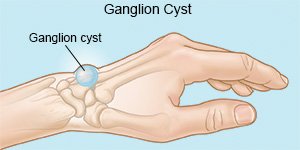
  • A ganglion (GANG-glee-on) cyst is a lump under the skin that is filled with thick, jelly-like fluid. It may grow on the thin outer covering of a tendon. A tendon is a tissue that connects muscle to bone. It may also grow on a joint capsule. A joint capsule is an area where two bones join together, such as the wrist or fingers. Ganglion cysts may also grow on the back of the knee, the foot, the ankle, or the finger. Ganglion cysts are most common in women between the ages of 20 and 50.

  • Ganglion cysts may cause a dull ache or tenderness in the area of the cyst. You may see a firm, fluid-filled lump under the skin. You may have numbness, muscle weakness, or swelling around the ganglion cyst. You may have pain that is made worse by use or movement of the joint with the cyst. Your caregiver may tell you that no treatment is needed because ganglion cysts often go away in time. Even with treatment, your ganglion may go away and then grow back later. Surgery may be done if your ganglion cyst is causing pain or is limiting your joint movement. It may be done if other forms of treatment have not caused your ganglion cyst to go away.

AFTER YOU LEAVE:

Medicines:

  • Keep a current list of your medicines: Include the amounts, and when, how, and why you take them. Take the list or the pill bottles to follow-up visits. Carry your medicine list with you in case of an emergency. Throw away old medicine lists. Use vitamins, herbs, or food supplements only as directed.

  • Take your medicine as directed: Call your primary healthcare provider if you think your medicine is not working as expected. Tell him about any medicine allergies, and if you want to quit taking or change your medicine.

  • NSAIDs: Nonsteroidal anti-inflammatory (NSAID) medicine may decrease swelling and pain or fever. This medicine can be bought with or without a doctor's order. This medicine can cause stomach bleeding or kidney problems in certain people. Always read the medicine label and follow the directions on it before using this medicine.

Ask for information about where and when to go for follow-up visits:

For continuing care, treatments, or home services, ask for more information.

How can I take care of myself at home?

  • Watch and wait: Your caregiver may tell you to wait for the ganglion cyst to go away on its own. Do not try to break the cyst yourself. Pressing, poking, or slamming hard objects on it can hurt you, and usually will not make the ganglion go away.

  • Wear a splint: Your caregiver may tell you to put a splint on the joint with the ganglion cyst. You may wear a splint to rest your joint and limit movement. This may help your ganglion cyst to decrease in size. You may be given a splint to wear after your ganglion has been drained or removed by surgery.

  • Care after a needle aspiration:

    • Caregivers may use a needle to drain the fluid out of the ganglion cyst. You may then be given shots of medicine called steroids into the cyst to decrease inflammation (redness and swelling). Caregivers may add local anesthesia to the steroids to help decrease pain. You may go home with a tight dressing over the cyst. Follow caregiver's instructions for how to care for the cyst area.

    • Rest your joint for 48 hours. Avoid doing activities that would cause you to use it a lot. Avoid activities that may cause the joint with the ganglion cyst to be bumped or knocked.

    • Caregivers may tell you to use ice to help decrease inflammation (swelling, pain, and redness). Put crushed ice in a plastic bag or use a bag of frozen peas or corn. Cover it with a towel. Place this over the ganglion cyst for 15 to 20 minutes every hour as long as you need it. Do not sleep on the ice pack because you can get frostbite.

CONTACT A CAREGIVER IF:

  • The ganglion becomes larger or more painful.

  • You hand or wrist gets weak or numb.

  • Your hand or wrist suddenly swells up, or you develp a fever.

  • You find a lump or swelling near any of your joints.

Copyright © 2011. Thomson Reuters. All rights reserved. Information is for End User's use only and may not be sold, redistributed or otherwise used for commercial purposes.

The above information is an educational aid only. It is not intended as medical advice for individual conditions or treatments. Talk to your doctor, nurse or pharmacist before following any medical regimen to see if it is safe and effective for you.

Learn more about Ganglion Cysts (Discharge Care)

(web6)